 This year saw a unique collaboration for me, with St Paul’s Opera Company, on their production of Donizetti’s L’Elisir d’Amore (The Elixir of Love). The Director, Eloise Lally, wanted to set her version of the opera in a hospital immediately post-World War two and Patricia Ninian, SPO founder and Director had read my books The Midnight Man and A Death in the Afternoon, which are set in the South London Hospital for Women and Children. So Tricia approached me to see if using that setting might work. I was sure it would.
Thus I found myself working with Eloise and Ted Blackburn the producer/designer on the concept and the design. I had gathered a huge amount of material – photographs, documents, news clippings – when doing my research into the Hospital, which I was happy to share to inform Ted’s design for costumes and the staging. I also spoke, at length, with Eloise about the period and the South London. 1948 was a point in time when men were returning home from the war to take up the jobs and roles they had left behind, which had, in their absence, been done by women. Not all the women, especially the younger ones, wanted to return to a purely domestic sphere, but they had little choice. At the South London, however, the opposite was happening. Male medics and staff were leaving, to be replaced by women and male patients were also being excluded. This unique point of tension informed my books and would inform the opera.
Adina, the heroine, was to be the Matron (sung by Fiona Hymns, soprano, above in rehearsal with Martins Smaukstelis, tenor, as the hero Nemorino) and Nemorino would be a lowly hospital staff member. Dr  Dulcamara, the quack doctor who regularly sells his ‘elixir’ for a one-time-only, knock-down price, has also returned from the war, hoping to wheedle his way in to the SLH, but Adina sends him on his way. Belcore, the Sergeant, (sung by Ted Day, see left, in rehearsal) is a long term patient, who believes the war is ongoing and marshalls his ‘troops’ of other patients, many of them wounded servicemen.
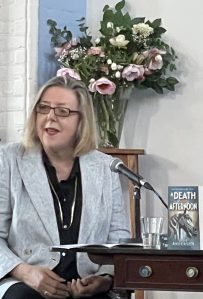
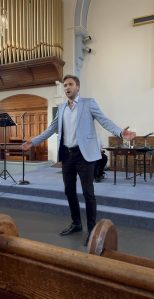
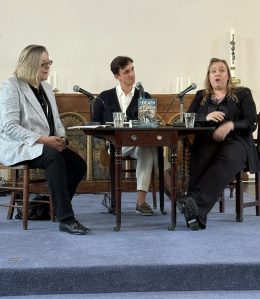
We also collaborated on an event at the end of May which would be both book launch for A Death in the Afternoon and an Insight event to attract more people to the opera. This proved an enormous success, with an audience of over one hundred people, you can see photographs below and there’s a link to a video on X here https://x.com/stpaulsopera/status/1929521928898801784. We also mounted a small exhibition about the South London, using documents and memorabilia lent to us by Dr Juliet Boyd, former anaesthetist at the hospital and its unofficial archivist. This included everything from an annual report from 1917, showing the medical officers in post (all female – the only male name is that of a chaplain) to protest badges against the closure of the hospital almost seventy years later. The banners (right, with SPO Director, Patricia Ninian) produced by the opera company would be used as information at each of the performances.
In addition, I was to attend rehearsals. So I began a Rehearsal Diary, which would eventually find its way, in shortened form, into the opera Programme and on to the SPO website. I will be posting from that Diary here, later.

 Julie Anderson