Given the recent 80th anniversary of VE Day, I have chosen three books with a World War Two setting. They are all standalone mysteries but are also part of a series. Settle into an armchair and immerse yourselves in a world made dangerous by bombs and Nazis, as well as criminals.
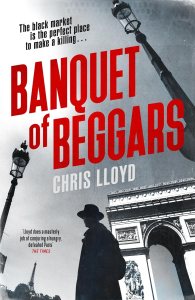 My first book is Banquet of Beggars by Chris Lloyd (Orion, £9.99). This is the third in his Occupation series, the first of which, The Unwanted Dead, won the Historical Writers Association Gold Crown Award for the best historical fiction in 2021. The next two books are just as good. Lloyd’s hero is Inspector Eddie Giral, Parisian cop. Once a First World War veteran and family man, once a nightclub bouncer and cokehead, now a laconic and cynical flic who is dangerously close to self-destruction. In 1940, Eddie, all of Paris, is under the rule of the occupying German forces.
Lloyd conjures a bitterly cold and hungry city, where the streets are empty of all but bicycles and German transport. Parisians grow truculent and rebellious as their overlords begin to show the iron fist. While Paris starves, the Germans, and some French, enjoy the very best that the city can offer. The general population resorts to the thriving black market and it is that black market which Eddie investigates after a murder, determined to find a measure of justice, despite the criminal complicity of the occupiers – a complex and dangerous mission. The Parisian underworld is evocatively drawn, as are the minor transgressions forced upon ordinary citizens so as to survive. This is a city where there are few moral certainties.
Eddie is a multi-layered protagonist, trying to do the right thing in impossible circumstances. He is despised by both the Germans and the Parisians, who see him as a coward and collaborator. His sparring with the German who is the liaison officer with the French police, the urbane and menacing Major Hochstetter, is one of the most intriguing relationships in the book. Lloyd entangles the reader in the politics of the occupiers, their ambitions, loyalties and internecine quarrels, as the Gestapo and SS attempt to take over command of the city, but it is Eddie, imperfect but humane, who captures the reader.
My next two recommendations have British settings.
Death of an Officer by Mark Ellis (Headline, £10.99) is set in post-Blitz London in Spring 1943. His protagonist is Detective Chief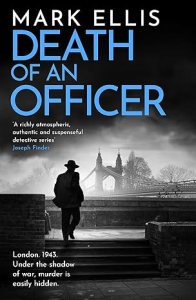 Inspector Frank Merlin, incorruptible Scotland Yard policeman. Merlin doesn’t quite fit with the establishment, he’s the half Spanish son of an East End chandler and his cockney wife, yet he commands respect amongst the gangland underworld and his fellow coppers (many of whom are corrupt). There are two murders for him and his small team, depleted because of wartime conscription, to solve. First, that of a respected consultant surgeon of Indian extraction, killed in his Kensington flat and, later, the discovery of an unidentified corpse on a bombsite in Limehouse, an apparently well-to-do, young man dressed for a night out ‘up West’.
The investigations take in the high and the low, London clubland and London gangland. The latter is in the person of Jakey Solomon, a fictional rendering of the real-life gangster Jack Cohen (who also appears, incidentally, as Zack Caplan, in my own A Death in the Afternoon). The cases touch upon the intricacies of war-time relations with the Americans and MI5, especially when an international aspect is discovered. Soon, however, Merlin is inexorably led towards the upper echelons of British society, the Army and the Navy. Ellis is very strong on the British class system, its internal gradations and marital arrangements and how these dovetail with the services during wartime.
Very evocative of the times, Death is above all an intricate whodunnit, the plot strands weave though and around each other, drawing in a colourful, well-drawn cast of characters. Never short of revelations, the pacing is, nonetheless, gradual, as both investigations progress and become intertwined. The final resolution is very satisfying. A postscript reveals how justice is eventually served, sometimes in court, sometimes by the only way out.
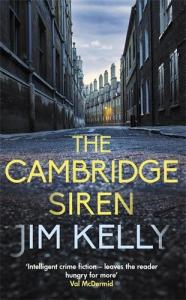 Finally, The Cambridge Siren by Jim Kelly (Allison & Busby, £9.99). As the title suggests this is set in war-time Cambridge, a strange city when denuded of its student population, its colleges standing empty or used for war-time research. Kelly, like Lloyd with Paris, or Ellis with London, clearly knows this cityscape like the back of his hand. His ’tec is Detective Inspector Eden Brooke, as with Eddie Giral, a survivor of World War One, albeit with permanently damaged eyesight. So, he must wear heavily tinted spectacles and prefers the hours of darkness. This different way of seeing is a metaphor for Brooke’s investigative thinking as well as requiring him to be a ‘nighthawk’ and the series is called the Nighthawk series.
Brooke is a family man and it is his son-in-law, a serving submariner, who first identifies a crime, when he’s asked to fix an apparently faulty periscope. It has been deliberately sabotaged and the factory it was made in is in Cambridge. There is also a mysterious death to deal with, the apparent suicide of a man found in an air-raid shelter. A man with a tropical suntan and Brooke’s telephone number written upon his hand.
The crimes in Siren are distinctly war-time crimes, when greedy, venal and ambitious people seek to exploit the wartime situation to their advantage. It features a ‘funk hole’, where those who are not fighting retire to the countryside and avoid the war in relative luxury, various war-time scams and some deadly crimes, including a, real, Cambridge science project. Brooke and his trusty, if depleted band of coppers at the Borough handle them all and this gives the book a much more ‘small town’, feel when compared to my other two, capital city based, recommendations.
Three wartime books set in three, very different, locations: all gripping and immersive. Put your feet up in front of the fire while the rain pours down and enjoy.
This review first appeared in Time and Leisure Magazine. Since it was written Death of an Officer by Mark Ellis has won the inaugural Cob and Pen Award at Bloody Barnes Book Festival.
 Julie Anderson