 Only three weeks to go before my next book is published (by Hobeck Books) and I’ve received some very complimentary comments from fellow authors who have read proofs, like Vaseem Khan (award-winning author of the Malabar House series, set in 1950s India), Victoria Dowd (award-winning author of the Smart Woman series) and Elizabeth Buchan (multi-award winner and fellow south Londoner ). This is the enjoyable time, the pleasant anticipation, the dream of a best-seller, unsullied by one star reviews or poor sales numbers.
I’m busy making last minute promotional arrangements. Many are local, the book is set in Clapham so I’ll be speaking at the Clapham Society and local libraries and book clubs. Some are London wide – the London Transport Museum is carrying the book in its shop and I’ll be working with them to be part of their events calendar. Some are national – so I’ll be part of the Royal College of Nursing’s Summer exhibition and events programme, which is taking place across the country. I’m looking forward to attending its launch on 10th May (see above).
And thereby hangs a tale. I was contacted by a representative of the RCN Museum and Library, having emailed the College to tell them about the book, largely because of its setting – the South London Hospital for Women and Children. This lady was enthusiastic about my taking part in their programme and we arranged a time to discuss that, but she also mentioned, as an aside, that she was related, by adoption, to one of the original founders of the South London Hospital, Maud Chadburn. Her father is the son of one of the children adopted by Maud and her partner in work and life, Eleanor Davies-Colley (the first woman admitted to the Royal College of Surgeons).
This was, as you can imagine, rather a surprise. Professions run in families, but Antonia was  not a medic, though she worked for the RCN; a third generation involvement with nursing and medicine, albeit in a different capacity to her surgeon great grandmother. She told me lots of stories about Maud, known by the family as ‘Aunt Mary’ and sent me a photograph of her portrait, which currently hangs in Antonia’s mother’s house in London.
The portrait is believed to be by Henry Lamb, one of the Camden Town School of artists. According to the family story, it was offered to the Royal College of Surgeons, but they declined it, Maud never having been a member. There was, Antonia said, much speculation within the family about why Maud didn’t join. Eleanor certainly did and blazed a trail for others. Towards the end of Maud’s life ( she died in 1957 ) there must have been several women members and Maud could have joined too. So why didn’t she?
 I don’t know the answer to that and neither did Antonia. I hope to be able to speak with her father, who has a fund of stories about ‘Aunt Mary’ which might be enlightening. Nonetheless, I like to think that Maud, who had probably developed something of a thick skin by this time – she was denounced from the pulpit by her minister father (he said he would rather she died than became a doctor) when she was younger and had to blaze trails in other ways, decided, rather like Groucho Marx, not to join any club which would have her as a member, especially one which, in years previously, would not admit her.
 This is not the only remarkable coincidence attaching to this book. Early in the writing process, at first draft stage, I received an unanticipated invitation to a birthday celebration for a friend and couldn’t (for reasons too tedious to go into here) buy a birthday gift in time. So my gift was to name a character after my friend in the new book. I duly did so and, just prior to final editing, I sent her a copy of the manuscript. If she hadn’t liked ‘her’ character, or had had second thoughts about my using her name, she could withdraw and I would change the name. She and her partner, who also had a named character, were very happy, though she responded by sending me a copy of the birth certificate of her first born son. He was born at the South London Hospital in the 1970s! She had never mentioned where he was born (he now lives in Canada) so I had no idea. Thus, I found, my friend was a real patient at the real hospital as well as being a ‘character’ in the fictional version. What are the chances of that?
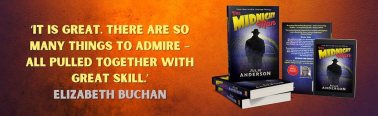 Two happy accidents; I hope they bode well for the book. ‘The Midnight Man’ is published by Hobeck Books on 30th April. I will be posting further pieces about it as the date approaches. Available for pre-order from Mr Besos’ emporium, Waterstones and Hobeck direct. Paperback at £10.99 and ebook £3.99.
N.B. Both Antonia and my old friend, Lesley, have given permission to be included and named in this blog post.
 good location for my book, enabling me to show changes taking place. Then I found out about the South London Hospital for Women & Children. Clapham has been my home for over thirty years and I used to walk past the empty hospital buildings on my way to and from the tube every day, but I knew little about it. When I began researching, I discovered that it was the largest woman-only hospital in the UK, run exclusively by and for women. This made it both unusual and very apposite for my book.
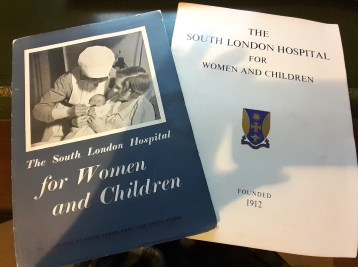 the early hospital. I also spoke with a former midwife and former nurses, all of whom fondly remembered the hospital. There is a Facebook group, to which I now belong, called South London Women’s Hospital occupation 1984─85 where those who protested at the hospital’s closure, many of them staff and patients, reminisce and organize the occasional get together.
 architect’s plans. I also read minutes of meetings of the South London’s management board and similar minutes belonging to other hospitals of the time and this helped to give me an understanding of the context. It is instructive that, despite there being an acute shortage of nurses after the war, the SLH never had a problem attracting nurses; it was a place where women wanted to work.
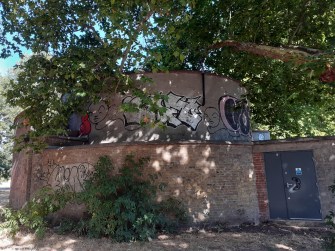 Clapham South underground station onto Clapham Common Southside, about a hundred yards away you’ll see a concrete pillbox of a building, on the common very close to the busy road. Currently graffiti covered, this unlovely and unloved building is the entrance to a fascinating world beneath the ground.
 rockets bombarded London. South Londoners descended, nightly, in the lifts, to their bunk space in the shelter, which held canteens, lavatories, washrooms and a medical centre. Apparently, it was quite sociable, people played music, sang songs and played cards and other games as the rockets fell overhead. All this while the underground trains rumbled above them, the shelters being deeper even than the underground lines.
 my characters go to watch the latest films, exist but have been repurposed. The cinema is now a wine warehouse. The hospital buildings are a supermarket and apartments. The common is, of course, still there as is Sugden Road, where one of my main characters lives in a rented Victorian terraced house. Her working-class family wouldn’t be able to afford that now.
 Julie Anderson