‘The Midnight Man’ is published and out in the wild. I’ve had an amazing week following its publication, with some tremendous reviews. My interview with Crime Time presenter Paul Burke was great fun, although recorded earlier (you can listen to it on the link below) and I’m doing more, with UK Crime Book Club on the 17th and Riverside Radio Arts on 24th May. In between there are book 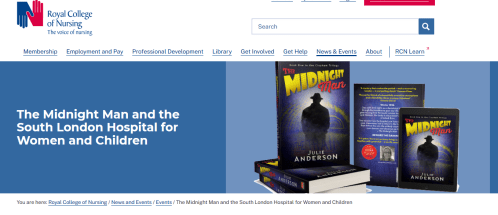 clubs and libraries to visit where I’ll be talking about ‘The Midnight Man’ and the South London Hospital for Women and Children. Tomorrow I’m off to the Royal College of Nursing for the launch of their Summer exhibition and programme of events ‘Shining a Light’.
The RCN isn’t the only medical institution to be interested, the UK Association for the History of Nursing has asked for a copy and ‘The Midnight Man’ will feature in their journal and possibly on their website. The Fawcett Society has shown an interest and the Historic Novel Society is carrying a review. So lots of interest.
In the meanwhile I’ve been to see ‘Nye’ the new play by Tim Price, based on the life of Aneurin Bevan, ‘founder’ of the National Health Service. Bevan, played by Michael Sheen, was Minister for Health in the Attlee government and the driving force behind the creation of the NHS, although he had to make compromises to force it through. I was pleased to see that the play represented the opposition of the some of the medical unions, something which is also referred to in ‘The Midnight Man’. We treasure the NHS now ( or should do, though I appreciate that many years of underfunding and ‘reorganisations’ has meant long delays and some deficiencies ) but, at the time it wasn’t a foregone conclusion that it would be set up, let alone survive. Yet, as the post curtain call stats shone on to the back of the stage show, it has saved many lives and alleviated much suffering, which
  would not have been the case had it not existed.
The play also seeks to show the pain, anguish and anger caused when medicine is not available, because of the inability to pay for care, something I tried to do in ‘Midnight Man’ through the character of Phoebe. Tuberculosis was a killer disease, for which there was no cure, and which reached pandemic proportions at different times in its history. It was also highly contagious and sufferers were isolated, with their loved ones made to keep a distance from them (not unlike COVID).
I can certainly recommend the play and it is a remarkable performance by Sheen, with Sharon Small as Jennie Lee. It’s not the only recent West End play which features the period immediately post-war. Lucy Kirkwood’s ‘The Human Body’ starring Keeley Hawes and Jack Whitehall was at the Donmar until the end of last month, about post-war female emancipation and the NHS. Must be something in the zeitgeist.
I speak about some of this in the interview with Paul. If you’re interested you can hear that here.
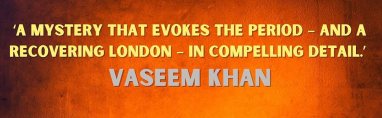
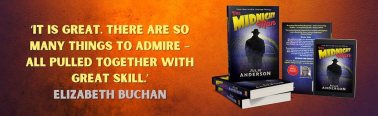
 Only three weeks to go before my next book is published (by Hobeck Books) and I’ve received some very complimentary comments from fellow authors who have read proofs, like Vaseem Khan (award-winning author of the Malabar House series, set in 1950s India), Victoria Dowd (award-winning author of the Smart Woman series) and Elizabeth Buchan (multi-award winner and fellow south Londoner ). This is the enjoyable time, the pleasant anticipation, the dream of a best-seller, unsullied by one star reviews or poor sales numbers.
 so I’ll be speaking at the Clapham Society and local libraries and book clubs. Some are London wide – the London Transport Museum is carrying the book in its shop and I’ll be working with them to be part of their events calendar. Some are national – so I’ll be part of the Royal College of Nursing’s Summer exhibition and events programme, which is taking place across the country. I’m looking forward to attending its launch on 10th May (see above).
 not a medic, though she worked for the RCN; a third generation involvement with nursing and medicine, albeit in a different capacity to her surgeon great grandmother. She told me lots of stories about Maud, known by the family as ‘Aunt Mary’ and sent me a photograph of her portrait, which currently hangs in Antonia’s mother’s house in London.
 I don’t know the answer to that and neither did Antonia. I hope to be able to speak with her father, who has a fund of stories about ‘Aunt Mary’ which might be enlightening. Nonetheless, I like to think that Maud, who had probably developed something of a thick skin by this time – she was denounced from the pulpit by her minister father (he said he would rather she died than became a doctor) when she was younger and had to blaze trails in other ways, decided, rather like Groucho Marx, not to join any club which would have her as a member, especially one which, in years previously, would not admit her.
 This is not the only remarkable coincidence attaching to this book. Early in the writing process, at first draft stage, I received an unanticipated invitation to a birthday celebration for a friend and couldn’t (for reasons too tedious to go into here) buy a birthday gift in time. So my gift was to name a character after my friend in the new book. I duly did so and, just prior to final editing, I sent her a copy of the manuscript. If she hadn’t liked ‘her’ character, or had had second thoughts about my using her name, she could withdraw and I would change the name. She and her partner, who also had a named character, were very happy, though she responded by sending me a copy of the birth certificate of her first born son. He was born at the South London Hospital in the 1970s! She had never mentioned where he was born (he now lives in Canada) so I had no idea. Thus, I found, my friend was a real patient at the real hospital as well as being a ‘character’ in the fictional version. What are the chances of that?
 Two happy accidents; I hope they bode well for the book. ‘The Midnight Man’ is published by Hobeck Books on 30th April. I will be posting further pieces about it as the date approaches. Available for pre-order from Mr Besos’
 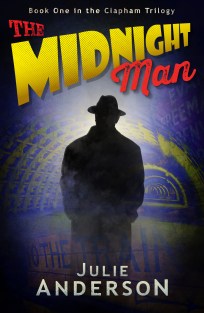 I am very pleased with the cover of my next novel, The Midnight Man. Created by graphic designer,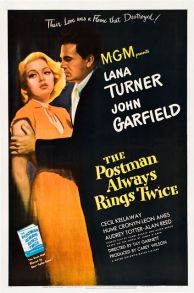


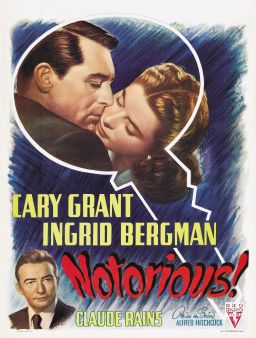
 hereby hangs another tale, which I will doubtless return to.
 Julie Anderson