 I have just returned to a cold and sleety Clapham after the sunnier skies of southern Spain, where the scent of orange blossom was already in the air and the 27th edition of the Festival de Jerez filled the town with music.
My body still feels the compras, the rhythm, while my head is full of the sound of the guitar and, when I close my eyes, I see exquisite and dramatic stage pictures. Sara Calero dancing, joyously and spikily, to a jaunty Day of the Dead number, while Gema Caballero’s smoky voice sang words which prompted smiles in the audience. Flamenco with humour and wit. The intensity and athleticism of Eduardo Guerrero, in a pose beneath the spotlights with was both Christ-like and evocative of Japan. Maria Jose Franco amid a swirl of motion and fringed silk, a more traditional show, but marked out by the stunning skill of the dancer. Then, the final night, fabulous guitarist Manuel Valencia with long time collaborator, singer David Carpio, two of our favourites so obviously having as wonderful a time on stage as we were in the audience.
Sitting in Plateros we described what we had seen to friends who didn’t go to flamenco. It wasn’t ladies in polka dot dresses with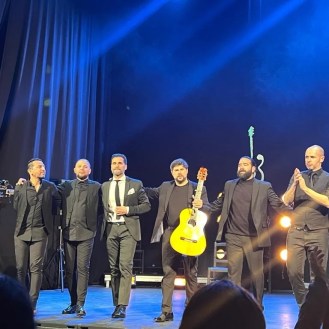 castanets dancing to black clad male guitarists, although you could see that if that was what you wanted. No, something fascinating has been happening for a number of years at this festival and this edition was no exception. Younger practitioners are examining the boundaries of what flamenco means, exploring and expanding their art.
Some of our other favourites weren’t there this year, or our timing meant that we missed them. There was no Manuel Lignan, the man who often dances in a dress and explores gender roles, nor was there Santiago Lara, the Jerezano flamenco guitarist who plays jazz a la Pat Methany and is currently writing a concerto for guitar and orchestra. We missed Rafaella Carrasco and Antonio Rey because of dates, but would have loved to have seen them.
 We did see an amazing reflection on life and death in Finitud, the aforementioned Calero Caballero collaboration. We saw the pair ten years ago when their skill and artistry was expressed beautifully through the traditional forms and we’ve looked out for them ever since. Boy, have they developed. The show included an electric base guitar as well as flamenco guitar and, astonishingly, Mozart’s Requiem. A singer, a dancer and two musicians conjured up the vibrancy of the south American Day of the Dead, the solitude of graveyard contemplation and a lot in between. We had a fun 1930s cartoon of skeletons dancing to make us laugh and ended with an auto de fe. Stunning! This show was hugely emotionally engaging and created some stupendous images which will fill my mind for quite some time. It encapsulates what a new generation of flamenco artists are doing, developing themselves and their art.
Valencia and Carpio were less unusual in their set, although I recall a tremendous concert some years ago in which Carpio and the dancer, Lignan, performed a duet, the one singing, a cappella, the other responding in dance and with rhythm (Valencia was the guitarist that day too). But their set lastr3orillas (The Three Shores) on Tuesday was wonderful and the thirteenth century church rang to the sound of shouts and applause. We’ll be back to listen to them again.
All this gave me lots of food for thought. How do artists use the creativity of other artists in developing their own work? In music, in art or, as a writer, on the page? What is creativity? I, for one, will be reflecting on this, with friend and fellow writer, Sunday Times best-selling novelist, Elizabeth Buchan in a talk for The Clapham Society at Omnibus Theatre on 20th March at 8 pm. Come and join us if you’re free.
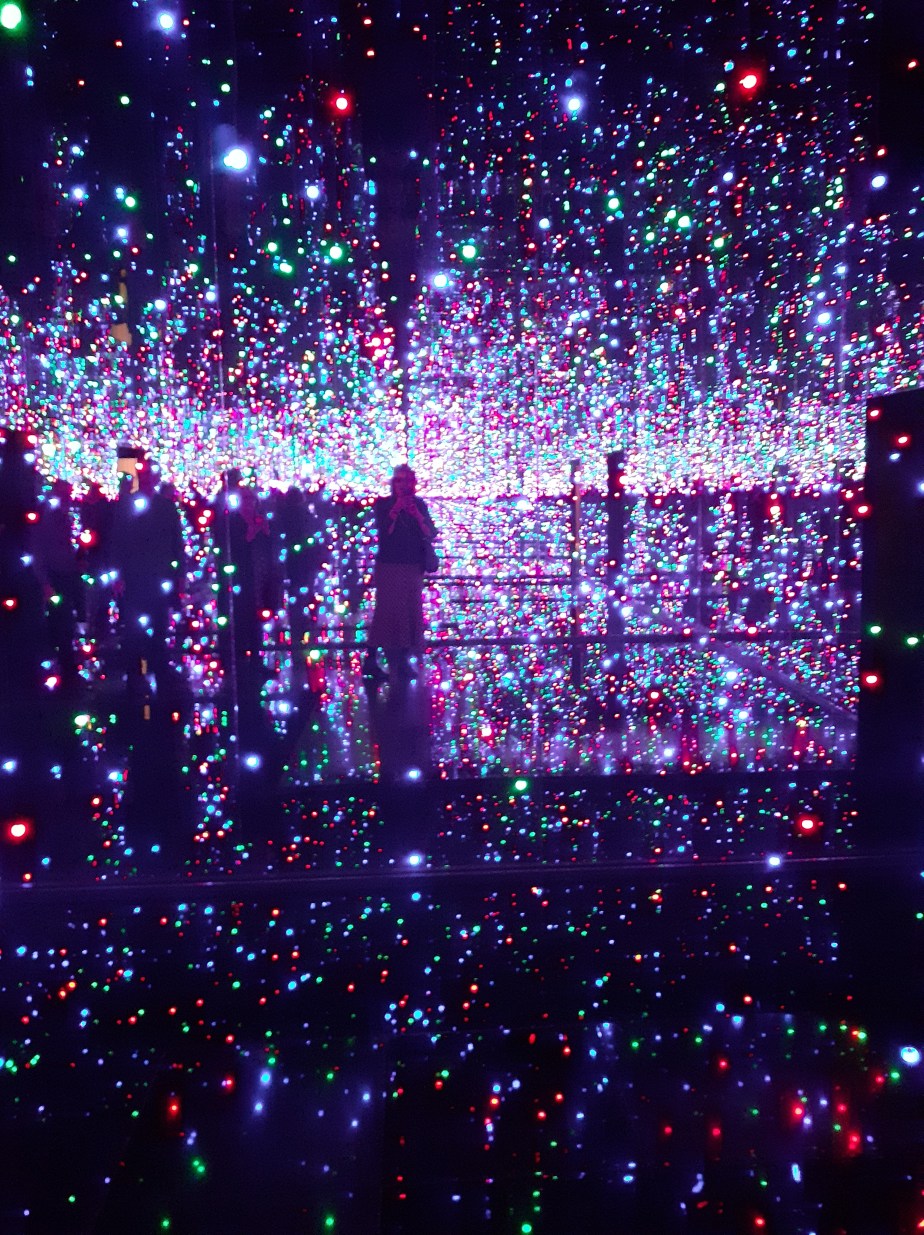
 Deep inside the Blavatnik Building, itself recently the subject of a Supreme Court ruling, sit two small ‘rooms’ white painted ‘blocks’ from outside, but full of light, water and reflection within. These are Yayoi’s Kusama’s Infinity Mirror Rooms, global phenomena. Tickets are limited and even when you have them you will queue to enter each room. At four fifteen on a Friday those queues were each about ten minutes in length, but getting longer as time went on. When you get to the doors you are allowed inside in groups of six people only and, when you’re inside, it’s easy to see why numbers are restricted.
 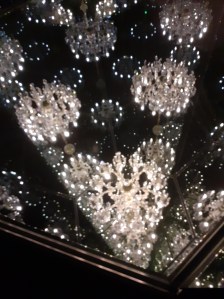 ). It is disorientating; difficult to tell who is real and who is reflection – and it wasn’t any easier looking at the photos afterwards. The chandelier repeats into an apparently vast chasm in the floor as well as along corridors into space. There are reflections of reflections, not all in the manner you imagine either, but when, say, a pair of bodyless photographing hands gets caught in the regressions.
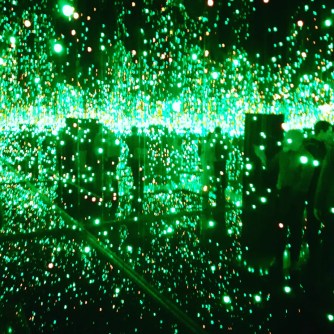 A myriad of lights are hung from the ceiling ( at least that’s how I reasoned it must work, I don’t actually know if that’s correct ) reflecting in multiple mirrors again, but also in the water on the floor. The visitor walks along a three foot wide pathway between the lights from one side of the ‘room’ to the other, something which takes but two or three minutes, if one was walking at normal pace. In fact one walks then stands, marvelling at the reflections and the lights, before starting out again. What the photographs in this piece don’t show is the variation in the colours of these lights as they slowly change from colour scheme to colour scheme. That is best shown when you look into the water (see below for a slightly better representation).
 biographical details which place the rooms into context of Yayoi Kushama’s life and work, plus the wonderful mirror box which in featured in an earlier piece I wrote when the Tate extension first opened. That too is worth seeing and playing with. Booking is currently until April though the exhibition is closed for maintenance in March. At a tenner it’s worth visiting (and you can catch the wonderful standing collection and some superb, free exhibitions, like A Year in Art; Australia 1992, which I’ve also written about elsewhere ). Highly recommended.
 The 2022 Clapham Book Festival is all but over. It began on a gloriously sunny autumn day on 9th October, walking around the Common on the Literary Trail, something which was repeated this Saturday last. It was a lovely day again, but, as the walk neared its end, the sky grew black. People dispersed and I headed for home to change for my afternoon session when the heavens opened. I got soaked through.
 tremendous, a joy to interview, in that he has a huge fund of anecdotes and amusing tales which makes life very easy for the interviewer. He grew up in Hamilton, just outside Glasgow to Bengali parents and talked about schooldays tribalism – ‘Are you a Catholic or a Protestant?’ ‘I’m a Hindu.’ Silence, followed by, ‘Yes, but are you a Catholic Hindu or a Protestant Hindu?’. The hour flew by and there was little time for questions, but everyone was entertained and impressed. The books practically flew off the counter, all signed by Abir.
 The cafe/bar at Omnibus had been packed all afternoon, not just with Festival goers, but also a ‘New Mums n’ Dads’ club meeting, but this ended by about five thirty, which was a relief, as we knew we had a completely full house that evening for Sir Antony Beevor and Dr Piers Brendon. The Cafe/bar is a super space, but it would be creaking at the seams with eighty Festival folk, let alone the new parents. We need not have worried. Although crowded, this leant the whole evening an excited buzz.
 win the Russian Civil War? What did he think would happen in Ukraine? Why was the Russian Civil War so full of atrocities and were we seeing a repetition in Ukraine? The hour, as with Abir Mukherjee, flew past, though for different reasons, this was intellectual engagement of a high order. Afterwards the queue for both presenters was long, with people anxious to get their books signed before the evening closed.
 Hosted by Lucy Kane from media partners
  The first event of 2022’s Clapham Book Festival took place yesterday on a gloriously sunny, autumn day on Clapham Common. Starting at Omnibus Theatre on the Northside a small but determined group of walkers spent two hours discovering and discussing Clapham’s literary connections, past and present. From Roger L’Estrange, the ‘Bloodhound of the Press’ to Malorie Blackman, Children’s Laureate, via novelists, biographers, historians, poets and Nobel prize-winners we had fun seeing where they lived and worked in Clapham.
 Wyndham and Bannerjee series of murder mysteries set in 1920s Calcutta, which begins with ‘A Rising Man‘ and runs to the most recent, ‘The Shadows of Men‘. Our intrepid heroes navigate the slums of ‘Black Town’, the genteel villas of Alipor, Chinese opium dens, the high politics of the Lieutenant Governor’s mansion and the low machinations of the secret service. Pre-independence India’s politics, religious and secular, feature in all the books which adds to their fascination.
 In the evening we have a real treat for history lovers and all those interested in today’s Russia and how it got to where it is now. The eminent and much garlanded Sir Antony Beevor discusses his latest book on Russia – ‘Russia: Revolution and Civil War 1917 – 1921′ – with Cambridge historian Dr Piers Brendon. Tickets for this are selling quickly, so I anticipate a full theatre and I’m not surprised, Sir Antony is always knowledgeable and insightful and Piers Brendon is the perfect person to draw out the historical parallels. Expect a treat.
 November another online event, discussing ‘Crossed Off the Map: Travels in Bolivia’ with prize-winning travel writer Shafik Meghji. I know very little about Bolivia, so this will be new and interesting for me. Both the zoom events cost only £5.
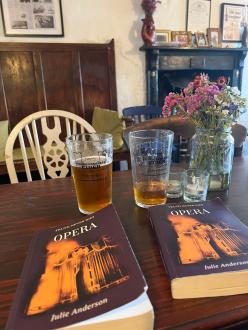 Now ‘Opera’, having been well and truly launched, seems to be off on tour. In part with me, visiting real and virtual locations to promote it, but also with new owners to all parts of the globe.
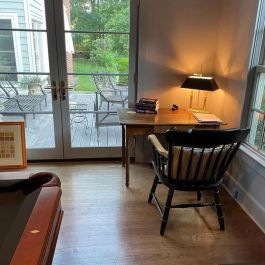 the pile of books on the lamplit table. I confess, I did not see it and (forgive me, Steve) I tuned out when the entries began discussing Robertson Screws. (No, me neither.) Then he confessed and I saw it. So did all the people who had tried to guess. But this was not the furthest flown ‘Oracle’. That must, at time of writing, be the copy in California, pictured by another friend, as it perched, with its siblings, on a rock above the blue sea of the bay. Not so autumnal there, as yet.
 I am promised pictures from Mexico and Australia, when their owners get there and I will certainly be posting some pics of ‘Opera’ in Spain. In the UK I have taken it, virtually, to Exeter (my talk for Devon Libraries) and Tamworth (Tamworth Book Club) and it will be going, live, to various parts of south London in the near future and, it is planned, eventually to Newcastle too. It has already been pictured on an LNER express, hurtling through the countryside.
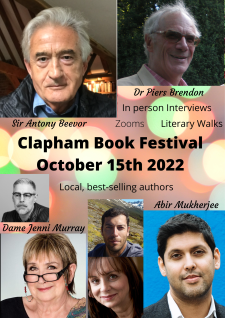
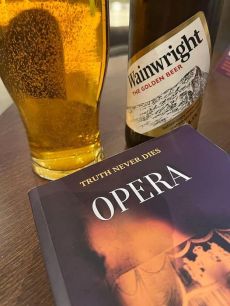 be appearing. I can’t, in all conscience, mention it on the Literary Walks I’ll be leading, alongside luminaries like Graham Greene, Angela Carter and Kazuo Ishiguro, but it may get a mention during my interview with Abir Mukherjee, award-winning author of the Wyndham and Bannerjee crime fiction series, set in 1920s India. The walks take place on the afternoon of 9th October and morning of 15th. Abir is the first interviewee in an afternoon and evening of live author events. There are still tickets available for all three and much else besides, including Dame Jenni Murray talking with Elizabeth Buchan and Sir Anthony Beevor speaking about Russia with Dr Piers Brendon. So maybe I, and ‘Opera’ will see you there.
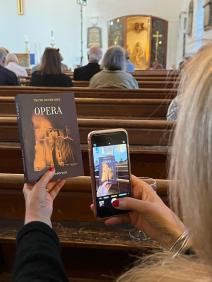 The low, autumnal sunlight slanted across the churchyard of St Paul’s Church in Clapham on a beautiful September evening one week ago. Cars drew up to the church’s railings, people walked down the winding path to the heavy church doors and inside there was a buzz of anticipation of good entertainment to come. They were there to celebrate the launch of ‘Opera‘ the third in the Cassandra Fortune series of murder mysteries, together with the music of Puccini and Tosca in particular (the opera in ‘Opera‘). I was at the door to greet them.
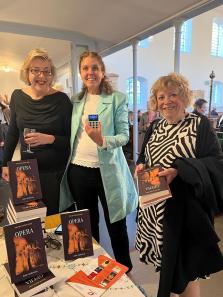 evening’s entertainment), the sound system was set up, the bar was stocked, staffed and ready to dispense and the Claret Press table was ready with signed books for sale. Programmes were handed out at the door. The church filled, gradually, with local friends, of the author or of the opera company, and with those from farther afield who had come to help celebrate. About a third of the crowd were probably also writers, many of them writers of crime fiction (see Anne Coates, author of the Hannah Weybridge mysteries, with Katie Isbester of Claret Press and myself, right). Other Claret authors, Steve Sheppard and Sylvia Vetta were there as well as reknown Clapham authors like Elizabeth Buchan. Clapham Book Festival friends were out in force, as were the members of the Clapham Writers Circle. In total there were between seventy and eight people in the beautiful church.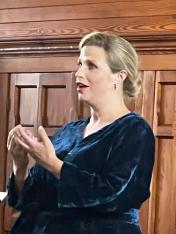

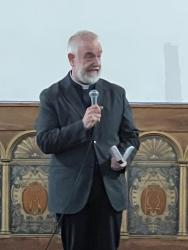
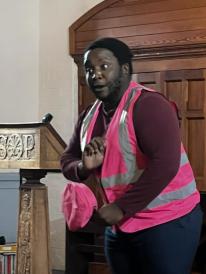 Grand opera is always intense and these two arias especially so, so a lightening of the mood was required before the interval. This was provided by an ‘interruption’ by a police constable, PC Willis, who had just arrived from the Houses of Parliament (although dressed in pink). Bass baritone Masimba Ushe delivered the sentry’s song from Gilbert & Sullivan’s Iolanthe ‘When all night long, a chap remains…’ in sonorous and amusing fashion. Laughter heralded the interval, when everyone headed to the bar (where the barkeepers were kept very busy).
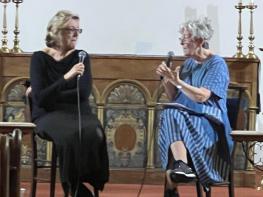 beforehand and I kept my answers short (as she had told me to, I tend to ramble). People seemed to enjoy it and, after questions from the floor, we ended to loud applause.
 bunting made of the posters and other images of Tosca which I had been collecting for months before the book was published.
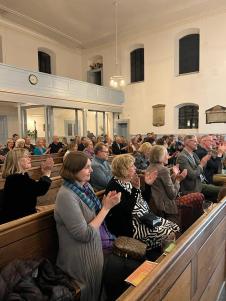 Ninian and the singers of St Paul’s Opera, which made it unique. Many of those who attended spoke or wrote to me, telling me how much they enjoyed it. Plus, my publisher sold lots of my books. It was a spectacular way to launch a title and a very special occasion.
 Today’s the day and ‘Opera’ is let loose upon the world. There are, already, plenty of posts on social media – Twitter mainly, but Insta and old favourite, Facebook, too – I haven’t ventured into the unknown territory of Book-Tok or the dragon-lands of Twitch and Discord ( no, me neither ). Kelly Lacey at
  Clapham Society Newsletter (circulation about 1,400) though I know there are a number of print critics who will be reviewing the book. These are in the regional press, or in literary publications, no national dailies ( without a prize listing or a shed load of publisher’s support, i.e. money, that is unlikely ). There are regional and local broadcast interviews lined up too, starting with Radio Tamworth ( Tamworth Books ) on Wednesday and following up with local radio here in south London.
 There are plenty of online events arranged and ‘Opera’ and I should be reaching audiences from Devon to the north of England, through regional library networks, like Devon or Staffordshire Libraries. I’ll also be doing some Festivals, live as well as virtual, not just the Clapham Book Fest, which takes place in October, but also Newcastle Noir ( 9th – 11th December ) as well, as, potentially, a number next year. Indeed my diary for 2023 is already being filled with online talks and discussions and live events, some of them for societies and clubs which I have visited before with ‘Plague’ or ‘Oracle’. I never imagined I would be doing quite so much.
 Helen and Sue ( they know who they are ). Also to my fellow authors who have been kind enough to wish me well on this Publication Day and to the bloggers and supporters, who, unpaid, contribute so much to the life of books. Finally thank you to my longsuffering husband, who cooks the meals and makes the tea while I am away in my head concocting yet another mystery.
 In April of this year I posted a piece about images of Tosca ( see ‘
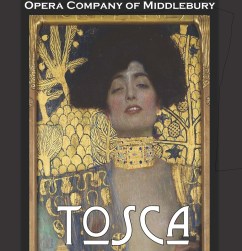 The artist most associated with Tosca, partly because he designed many posters for the Comedie Francais, where Bernhardt performed, and partly because his style is such a good example of Art Nouveau is probably Alphonse Mucha. Even the Hohenstein poster for the opera’s premiere in Rome in 1900 owed much to Mucha’s style. But his is not the only style which was copied and often other artist’s works were rifled for use on the posters. See the use of the Gustav Klimt’s ‘Judith’ in the poster for Middlebury Opera’s production (right) .
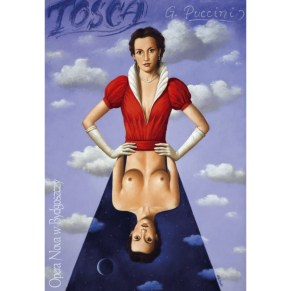 I found a very striking poster from Poland, probably for a production by the opera company of the city of Bydgoszcz which was very reminiscent of the style of Frieda Kahlo (see left). It drew many comments on social media and divided people, they either loved or hated it.
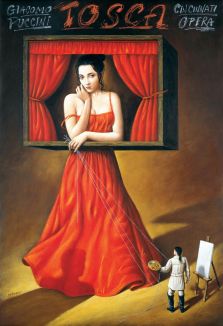 colour in the poster. I’m not sure if this was a sneaky subliminal message, but it is certainly surreal and I do not pretend to understand it, though it seems to be trying for an analysis of the opera at a subconscious level – Tosca pulling Cavaradossi’s strings.
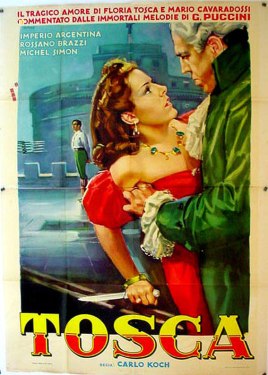 life, so there are plenty of leering Scarpias and retreating, suffering Toscas, though often clutching a dagger. The Italian ones are even more lurid than the Hollywood ones ( I suspect because Hollywood treated it as ‘high art’ ), but here is a more restrained offering – ‘The tragic love of Floria Tosca and Mario Cavaradossi commemorated in the immortal melodies of G. Puccini’. The director, ‘Carlo Koch’ is actually the noted German art historian and film director, Karl Koch, who undertook the film in 1939, jointly with Jean Renoir, at Mussolini’s invitation. Koch was Renoir’s assistant on Le Regle de Jeu
 and Renoir was instrumental in getting Koch out of Germany in 1936. Renoir eventually withdrew from the film, but Koch completed it, together with his assistant, one Luchino Visconti. Incidentally Koch and his wife settled in Barnet, north London once the war ended.
 preparation I’ve been collecting and sharing images relating to Tosca for some months and I plan to use them at the launch event. These range from copies of the original posters for the premieres of both the play by Victorien Sardou, in Paris in 1887 and Puccini’s opera in Rome in 1900, through to film posters of the 1970s and modern posters for productions of the opera. In the course of searching for these images, however, I have discovered that ‘Tosca’ is also the name given, presumably in honour of the diva and Puccini, to a number of other items, including several types of perfume, at least two cars and a cocktail.
 The Tosca Eau de Parfum can still be bought today for £16.74 and accompanied by shower gel, deodorant and moisturiser in the same fragrance. There is also an extremely expensive version by Xerjoff Casamorati, available from Harrods – a snip at £81.95 for 30ml (see above). It seems that the original perfume was created by Farina 4711 and vintage bottles are now traded on ebay and etsy (see left). The very expensive, bright pink/purple bottle of the Xerjoff is much less attractive, to my eye, but it is certainly distinctive. I have yet to discover why it was designed as it was.
 fast ( and, in most of the images I could find, red, which continues a colour theme found in the Tosca opera posters. More of a surprise is that it is a hybrid with a traditional V10 engine, as well as electric batteries. Even Italian super cars are going green these days. Just as surprising is the La Tosca, a 1955 concept car from Ford. It was designed to be remote controlled, so is driverless and in that is very modern, but it has the sort of design which owes much to aircraft and was thought to
  be ‘space age’ at the time. The pictures of it that I have seen show a car which seems to float above the ground with huge wing fins, a plexi-glass bubble over the passenger compartment and an exhaust which looks like a jet engine. The car is often a bubblegum pink, which makes me think of a sort of very sporty version of Lady Penelope’s Rolls Royce from Thunderbirds. This was the Ford La Tosca, an actual car, though it was never put into production.
 2019 production of Tosca at La Scala, Milan and was served in Il Foyer bar there. It is made with the south American spirit, Mezcal, two types of Martini (we are in Italy after all) elderflower foam and, to dress, tomato powder and chilli pepper. If it appeals you can find the recipe
  women through the ages. I went along yesterday and found it informative and interesting. It’s a small exhibition which considers an enduring subject, the presentation of a female likeness looking out of a window, sometimes directly at the viewer, sometimes not. Women have often been represented like this, usually by men, for various purposes, the sacred, the profane, the decorative or the titillating. I was hard pressed to think of more than one or two examples where men were represented in this way.
 man climbing a ladder to present apples to a woman in a window, probably a hetaira or courtesan. The fun times in the ancient world give way during the medieval period to the discouraging of looking at women, in the window or elsewhere, for fear of arousal and sin. In this period the ‘woman’ is the Madonna (see by Dirk Bouts left) in her role as the ‘window to heaven’, a symbolic window at her back. Or the saint suffering for her faith (a striking and slightly unsettling stone bas relief/sculpture of an incarcerated woman pressing her face against the bars of her cell). Moving on to the Renaissance and non-divine women are the subjects again – I was particularly struck by the Botticelli (his ‘line’ is always mesmerising). Through the Dutch interiors, showing women if not through windows then beside them, playing instruments, reading letters; then to the wonderful Rembrandt of an un-named young woman who leans out of the canvas in all her human glory (see above right).
 Degas and a Sickert, but the exhibition didn’t follow a linear timeline, interspersing modern works with the old. Some of these were more successful than others. Some were interesting – the ‘swap’ of poses and locations, between a female photographer and a female prostitute (I cannot remember the name of the photographer, which is annoying). Both women looked very much at home in their new personas.
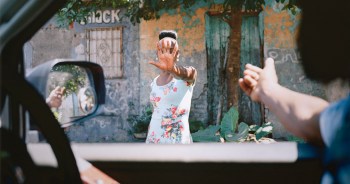 being beckoned forward by a faceless man in a car and rejecting his summons by holding up her palm. This, like the Codrington, with its dead hen and half drunk bottle of what looks like vodka, was a story in a picture, or many possible stories. There were some beautifully staged photographs, the woman reading a letter (an eviction notice, it is mounted in a frame next to the photograph) which echoed those Dutch interiors and a super Australian piece ‘The Apartment’ showing two women in a domestic scene overlooking an industrial harbour – its perspective was remarkable.
 Julie Anderson