What follows was first published in 2016. I reprise it here specifically for those who enjoyed the reading, for UK Crime Book Club, of some chapters of Reconquista, in their series of lockdown books for younger readers, and for anyone else who may enjoy reading about the inception of that book.
Once upon a time there was a boy. His name was Luke and he was twelve years old. Luke had fair hair and grey eyes and he was slim and clever. He was very good at maths.
So good at maths that he used to go to Cambridge University at weekends where  he would speak the language of numbers with a young professor. At home he would write long and complicated formulae and equations, with lots of numbers and squiggles which his family didn’t understand.
One Spring Luke and his family were to go on a journey to visit his god-mother, who lived in a far-away place where the sun was hot and shone for most of the year round. Her home was just outside an ancient town, which had walls with battlements and towers and a castle in one corner, on the highest point.
Luke’s god-mother puzzled over how to organise things so that Luke would enjoy his visit. She could speak different languages, but she wasn’t fluent in number. But what she could do was create worlds. She was a writer and she wrote books and stories. So she went out into the town, to particular places which she loved, so as to seek inspiration to write a story for Luke.
The town was old and beautiful, with narrow cobbled streets and ornate balconies  at the windows of the houses. It had fountains and perfumed jacaranda trees in tranquil, shady squares and the wider roads were lined with orange trees.
First the god-mother went to Plateros, a square in the old town, which was once part of the Jewish quarter, where all the silversmiths lived. There she saw the Church of San Dionysio, the patron saint of the town, which, before it was a church, had been a mosque. From the square she looked down to the cathedral, which had a separate tall bell tower, standing all on its own, which looked suspiciously like a minaret. And she understood that her story had to include all these different cultures and religions, the Christian, like the church, the Jewish, like the square and the Muslim, like the mosque and minaret. She would give voices to people from all three.
Then she went to the Alcazar, the castle or citadel, with battlements and towers over a thousand years old and she climbed the tallest tower. The wind blew on her face and it smelled of the sea, for the sea, though she couldn’t see it, was close by, just beyond a range of hills. And she realised that the sea would play a big part in her story.
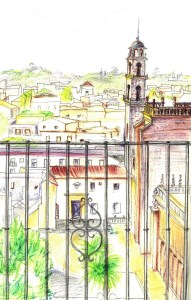 As she stood on the tower she looked down at the surrounding countryside below she remembered the history of the town and she imagined…..
The town is under attack. Outside the walls an army tries to force its way in. Men with long pikes, wearing metal helms and leather breast plates mass at the foot of scaling ladders. Knights on horseback ride back and forth, encouraging their men. And in the wind the flags and banners blow, the rearing claret lion of Leon and the golden castle towers of Castile.
Inside the defenders hurl rocks down on to the way attackers, pushing the scaling ladders away from the walls. But it’s no good, because the besieging army is too strong and has too many weapons, giant mangonels and trebuchets which throw huge rocks into the town and burning smoke bombs filled with oil.
The townspeople are desperate. What can they do? The ruling council can’t decide. Should they surrender? What will happen to them and their town if they do? The army outside is a Christian army from the north, led by King Alfonso. But the people in the town are a mixture, some Christian, some Jewish and some Moors, people who originally came from North Africa, before they crossed the narrow sea to Al Andalus.
But in reality the townsfolk have no choice. They must surrender to the King.
So King Alfonso and his knights and soldiers come into the town. He and his courtiers and knights stay in the Alcazar or castle, but ordinary soldiers are billeted on the townspeople, who are forced to take them into their homes and feed and look after them. In a house in Plateros Square three pike-men are foisted on a Jewish family. Simon, the silversmith, has no choice but to take them in. His son, Nathan, finds them interesting.
Now, a word about Nathan. He is one of the heroes of the god-mother’s story. He is  fourteen years old, with fair hair and grey eyes, small for his age, but quick and clever. He is always bickering with his older cousin Rebecca, who lives with Nathan and his father. She is fifteen and is another of the heroes of the story, and, really, she and Nathan love each other like brothers and sisters do, but that didn’t stop them fighting.
Often the peacemaker was their friend Atta, a Muslim. He and his father move in with the family when their own house is destroyed during the long siege. Atta is the same age as Nathan, but he is tall and skinny whereas Nathan is slight and not so tall. Atta has floppy black hair and dark eyes and he wants to become a doctor like his father.
One addition to the household in Plateros is more welcome than the soldiers. This is Thomas, a kind young English doctor, at the court of the King. He brings food for the family, from the King’s stores. And they need the food, because there isn’t much left in the city after the siege. Everyone is hungry.
But life isn’t safe in the ancient town. There is a curfew, no one is allowed on the streets after sundown or they are taken to the dungeons of the castle. There are riots in the marketplace and brutal crack-downs.
So many townsfolk decide to leave, to quit their homes and, carrying what belongings they can, travel in search of a safer, better life. Many of those who leave are Moors or Muslims and many Jewish people too, because they fear that they will not be liked by the Christians. So long columns of people, heavily laden wagons and donkeys stretch along the roads leading out of the city.
Atta and his father decide to join them, to become refugees. They’re afraid because Atta’s uncle is a powerful man at the court of the Emir of Granada, an enemy of King Alfonso, so they fear they will be treated as traitors, even though they’ve done nothing wrong.
 So Atta and his father abandon their home and all their things, taking only what they can carry. Nathan is very sad to see his friend leaving and is unhappy to be left behind. Yet at least he is with his family. But only two days later things get even worse for Nathan and his father, because one of the family had a secret plan.
So, the god-mother’s heroes are scattered far and wide. How could she bring them all back together and end the story? She didn’t know. And Luke was arriving in three weeks time. She had to find the end of the story before then.
She went out again into the town to look for inspiration. She visited Plateros, but couldn’t find an answer. She went to the castle, but couldn’t find an answer there either. Then she went up into the tower and looked again at the countryside. Nothing, no inspiration.
Then she saw the sunlight glinting on something far off. The god-mother screwed up her eyes to see. It was something reflecting in a town on a hill-top many kilometres away southward, a window or a mirror maybe. She’d been to that town recently and had stood on a high tower in its castle, just like the one she was standing on now. And she had seen the ocean and the coastline, the Bay of Cadiz, the beach stretching away southwards, down to a large cape which pushed out into the Atlantic.
This was Cape Trafalgar, where there had been a famous navy battle and Admiral Lord Nelson had defeated the Napoleonic fleet. Cape Trafalgar, Tarif al Ghar as it used to be, the Cape of Caves.
That was it, the god-mother realised. There would be a climactic battle between the Armada of the King and the pirate ships belonging to the evil warlord Don Raul. Rebecca, Nathan, Atta and other characters would take part.
The god-mother went home to finish her tale and send it to Luke. He liked his story and when, many years later, his story became a book, he remembered the heroes and their adventures, even though he was fully grown. The book is ‘Reconquista’ and it was long listed for the Children’s Novel Award 2016.
Thank you for visiting the land of Al Andalus with me. This is a true story, some of which actually happened.
 All three, as far as I’m concerned. It depends, of course, on how you define politics and the political. The dictionary definition is ‘the art or science of government or governing, especially the governing of a political entity, such as a nation; and the administration and control of its internal and external affairs. ‘
 the public that seems more apposite. Plague‘s successor, Oracle, is much more of a ‘classic murder mystery’, though I hope it has the same page-turning quality. Yet it too has the political at its heart and, already, some of its themes are hitting the real-life headlines, like questions about the politicisation of the police, something which surfaced again after the assault on the U.S. Capitol. I suspect that this issue is something crime writers will be incorporating in their stories for the next few years.
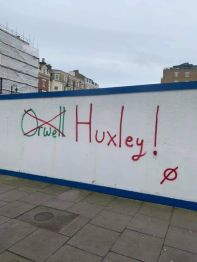 arguably no longer the dominant force in story telling and when social media allows us all to be citizen journalists and political commentators, what place does political fiction have? An important and relevant one, in my view. And I’m not alone – see this piece of graffiti, found in London, NW7 earlier this week ( thank you John Johnston for the photo ). Is the political image of our age the age of the boot on the face, or the pill and the palliative? Orwell or Huxley?
 On Wednesday the world watched as an enraged mob, whipped into action by their leaders, including the outgoing President of the United States, stormed the U.S. Capitol in order to derail the process of endorsing the recent and overwhelming Presidential election results. As the attempted overthrow of legitimate government took place, elected representatives were removed to or found places of safety and thugs ransacked offices, stole Capitol ‘souvenirs’ and took selfies. Pipe bombs, molotov cocktails and guns were found and a policeman, a female insurrectionist and three others died.
 preparedness among those whose job was to protect the Capitol ( the Capitol Serjeant at Arms has already resigned and the Chief of Capitol Police is going ). Many of the questions relate to events which lead up to the insurrection, which didn’t occur spontaneously ( a quick look at QAnon substantiates that ) and the attitudes and beliefs of the people involved. Mistaken and sometimes reprehensible beliefs which have been encouraged by lies in social and mainstream media and by Republicans. There were plenty of Damascene conversions and, as someone on Twitter pointed out, a ‘traffic jam on the Damascus road’ in both Houses, so keen were Republicans to condemn what happened.
 tyranny. This is basic level Civics, but something which seems to need restating. These are also ideas which I explore in Oracle.
 It is estimated that audiobook sales have more than doubled in the last six years, with a significant rise during the pandemic. There has been double digit sales growth in the English speaking markets for the last three years ( the US is by far the biggest market for audio books, but the UK and Australasian markets are growing rapidly ) and more audiobooks are being produced than ever before. UK book sales are still overwhelmingly (80%) of printed books, but the digital market has grown at the expense of print during the pandemic, possibly after the Treasury reduced VAT on digital books to zero, in line with printed books, in May 2020. Digital fiction sales is the fastest growing element of this market.*
 particular, this is tapping into a new market, good news for the book industry.
 Los Angelina, Elizabeth now lives in North Carolina, so we had been corresponding during the recent US elections. Originally from south London, she was over to visit her sister for Christmas. She gave me lots of tips about online speaking, having listened to my recent talk for the Royal Borough of Kensington & Chelsea and Westminster Libraries ( she thought my delivery poor ). I learned a lot, for example about
  The good news is that Essential Audiobooks provide a ‘taster’ for promotional purposes, so I’ll make that available here as soon as I have it. I don’t know if the upsurge in audio will continue into this new lockdown period, when only essential workers will be commuting, but there will be plenty of joggers, like me and plenty of walkers and gardeners too, who will be outdoors at the first sign of spring.
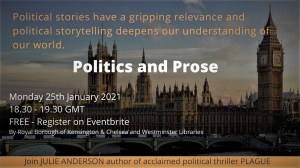 Maybe it’s because I’m preparing a talk on Politics and Prose for the Royal Borough of Kensington & Chelsea and Westminster Libraries ( it’s free and happening on 25th January if anyone is interested, see Eventbrite
  others. The crude and barbaric terror of the Stalinist period is shown, full throttle, where the answer to any problem was murder and truth was what the most powerful said it was. It’s a mesmerising and very funny film, in an absurdist way, but it’s also not comfortable watching. If you haven’t seen it, I can definitely recommend it.
 the tight-knit nature of U.S. politics – the intern is the daughter of the Committee member, the rival campaign managers are well-known to each other (each trying to exploit the other’s known foibles ). It’s a quieter film which depicts an inhuman and corrupt world – hardly news – but does so through the prism of one man’s ambition and where it leads. Again, recommended.
 Anyone who remembers the wit of The West Wing won’t be surprised by that on show here, it made this viewer laugh out loud a few times, though with a bitter twist. This truly was a ‘political trial’. It’s also a clever depiction of a moment in time rather in the way that the TV series Mrs America captured the spirit of the 1970s political backlash to the 60s. I strongly recommend you watch this film.
 I’ll be exploring how politics is depicted in stories, as well as discussing what a ‘political novel’ is in my talk on 25th January.
 seeks to generate real world action in pursuit of justice.
 events like Grenfell become referred to as a ‘tragedy’ or a ‘tragic accident’, yet they were foreseeable and avoidable and these events and others like them will continue to occur until the law adapts to make punishment of those who enable such events both possible and direct. Zemiology presupposes that isn’t likely to happen, as the powerful have co-opted the law and the legal system to protect their power and interests. An idea not unfamiliar to readers of Plague.
 Christmas period.
 For now, may I wish everyone reading this a happy and peaceful Christmastide, where ever and with whomever, you are managing to keep it. Here’s hoping for a much better 2021.
 Phew! I finally get to look forward to Christmas after the whirlwind of activity – talks, discussions, events, giveaways – which has accompanied the publication of my first crime thriller back in September. All something of an eye-opener to this writer, whose adventure books set in 13th century Spain never generated this much activity and interest. Even in a world reduced by COVID I’ve been very, very busy, almost always online. It’s been tremendous fun, by and large, and I’ve worked with and met some great people, online, on social media and, not least, the readers of my book.
 from a U3A crime fiction reading book group who have chosen Plague as their book for March and want me to do a talk for them, which I’m happy to do. The Royal Borough of Kensington and Chelsea and Westminster people also seemed pleased, they have asked me to do another talk in January, this time about ‘Politics and Prose’ – political fiction in a time of increasing citizen journalism and social media commentary. That’s something I’ve blogged about in the past ( see
  genuine enthusiasm shine through. I’m definitely more comfortable when interacting, either with other speakers or with questioners. That is, in part, why the Secrets of Subterranean London discussion worked so well. If you haven’t watched it, you can find a link
  Fortunately, it worked out well.
 Like any place inhabited by humans for centuries, London is a multi-layered city, its history piled up beneath the feet of the people who walk its streets. This was the subject of last night’s tremendous discussion with Dr Tom Ardill of the Museum of London and award-winning Blue Badge Guide Fiona Lukas.
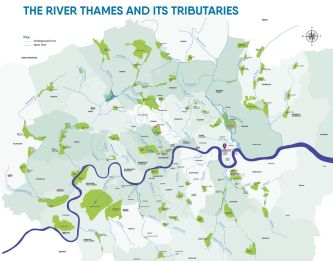 that, by the thirteenth century Londoners of the City were seeking for a fresh water supply further afield and they lighted upon the Tyburn. In order to bring its waters to the City they constructed the Great Conduit which ran south then east across London.
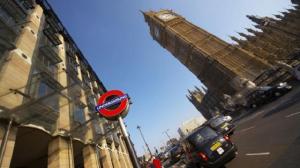 Fiona’s description of the modern travails of London Transport with new London Underground stations was very interesting, especially the example of the new, very deep and very modern, Westminster station . I never knew that the two District line tube tunnels were on top of one another not along side, but, when I thought about it, this made sense of the way the inside of the station was designed. I certainly wasn’t aware of the difficulties encountered because of the proximity of the station to the Houses of Parliament, not least the secrecy about why designs for the new station were repeatedly vetoed.
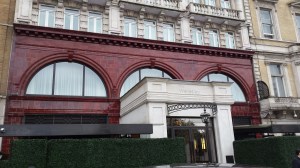 where Churchill’s wartime cabinet used to meet when the Cabinet Office War Rooms were unavailable, or Brompton Road. There is also Aldwych, formerly Strand, a station I used to walk past every day on my way to work in Bush House, close to, yes, a bona fide Roman Baths.
 Actually, there were twelve of them, all members of the UK Crime Book Club, from Perth to Hampshire, Denbighshire to London and many points in between. Twelve signed copies of Plague have been parcelled up and despatched.
 Craven, former CWA Dagger winner, who is currently sitting atop the Best Seller lists with his latest crime thriller ‘The Curator’. A darling of the UK Crime Book Club, ‘The Curator’ has just been voted the Club’s Book of 2020. Good fortune again that it was an easy question for me to answer ( so not about writing best sellers then ) and something of an honour for this crime writing debutante. The whole hour whizzed by, with people sending in questions via Facebook – and telling me that they’d bought the book, which was very good news.
 There was one small problem, one individual, a gentleman from Wales, didn’t respond to my messages of congratulation, indeed, didn’t respond at all. I left it a couple of days and then contacted the Facebook site administrator and said that I would try once more but might need their help. Fortunately, my message yielded a result, though not the expected one. A few minutes after I put up my plea I received a reply from a woman – ‘Dad! You won!’.
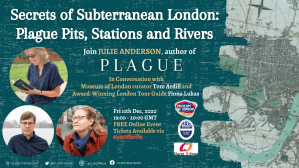 Claret Press is organising an online event which may be of interest to readers of this website. On 11th December, from 7 – 8 in the evening, I will be speaking with Tom Ardill, Curator at the Museum of London and Fiona Lukas, award-winning Blue Badge guide and expert on the London Underground.
 the time. Did you know, for example, that there is a Tyburn Angling Society, set up to try and ‘restore’ the river so as to fish in it ( an almost impossible task since it has been subsumed into Bazalgette’s wonderful London sewer system, but a charming, if quixotic, idea )? He is also a fellow river traveller, having followed the course of the Tyburn, as I did, but taking the southernmost arm, down to Pimlico and he ran it, rather than walked. You can read about his run
 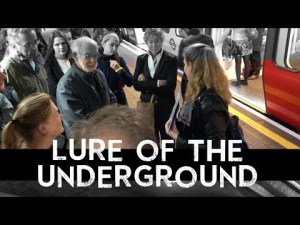 The other contributor is Fiona Lukas, an award-winning Blue Badge Guide, ( she was Guide of the Year for the City of Westminster and City of London ) whose speciality is London Underground. She regularly hosts the popular tour The Lure of the Underground ( listen to her podcast about it
  the novel, although I expect Tom to have far more knowledge than I about the Tyburn itself. I’ll be touching on Plague Pits, Roman Remains – like the baths at North Audley Street, completely unmarked on the surface, the Great Conduit which runs along Oxford Street and, of course, the Palace of Westminster, with all its idiosyncrasies.
 Julie Anderson