From Brixton to Pimlico, I’ve been having some unusual writerly fun out and about recently.
 First at the famed Brixton Book Jam held at the Hootananny, Brixton. I’d never been to the Book Jam and was surprised when a friend and fellow writer remarked on how scary it was. The Hootananny is, I discovered, a live music venue, a big room with a full height stage, sound system and spotlights. Suddenly I understood what she meant. On a freezing Monday night in March it seemed very daunting. There was a mixed line-up of writers. I got there early and sat chatting to one of the most experienced performers, Paul Eccentric and his wife Donna Ray. They were live Festival veterans (seven Glastonburys) on the poetry circuit, Paul being half of the Antipoet. The other half, a bassist, came along to watch.
The really enjoyable part of appearing was the chatting with the other writers in the Green Room off to the right of the stage, a  fabulous side room wall-papered with posters of previous performers. It’s terrifically nostalgic and much time was spent spotting bands we recognised or knew from more youthful days. Zelda Rhiando, herself a published writer and the organiser of the Jam, was there to calm our nerves and point out the beers in the little fridge and the bottles of wine. I swore not to touch a drop before I went on.
I was not, I discovered, the only one with nerves, yet all of us were used to discussing books, our own and others’ in public. It was that high stage, the single mic and the coloured spotlights (which ran the whole spectrum) which looked so terrifying. The hall was filling up and Zelda said we were off. The first writer’s hands were shaking as he waited at the foot of the stairs to the stage. I was on fourth, to end the first set before the interval and I managed. I even got a laugh at my wry comment at the beginning about my cardigan. Phew, it was over. A big glass of wine later I was back in the Green Room to support the others. Ashley, West and Zelda were all tremendous.
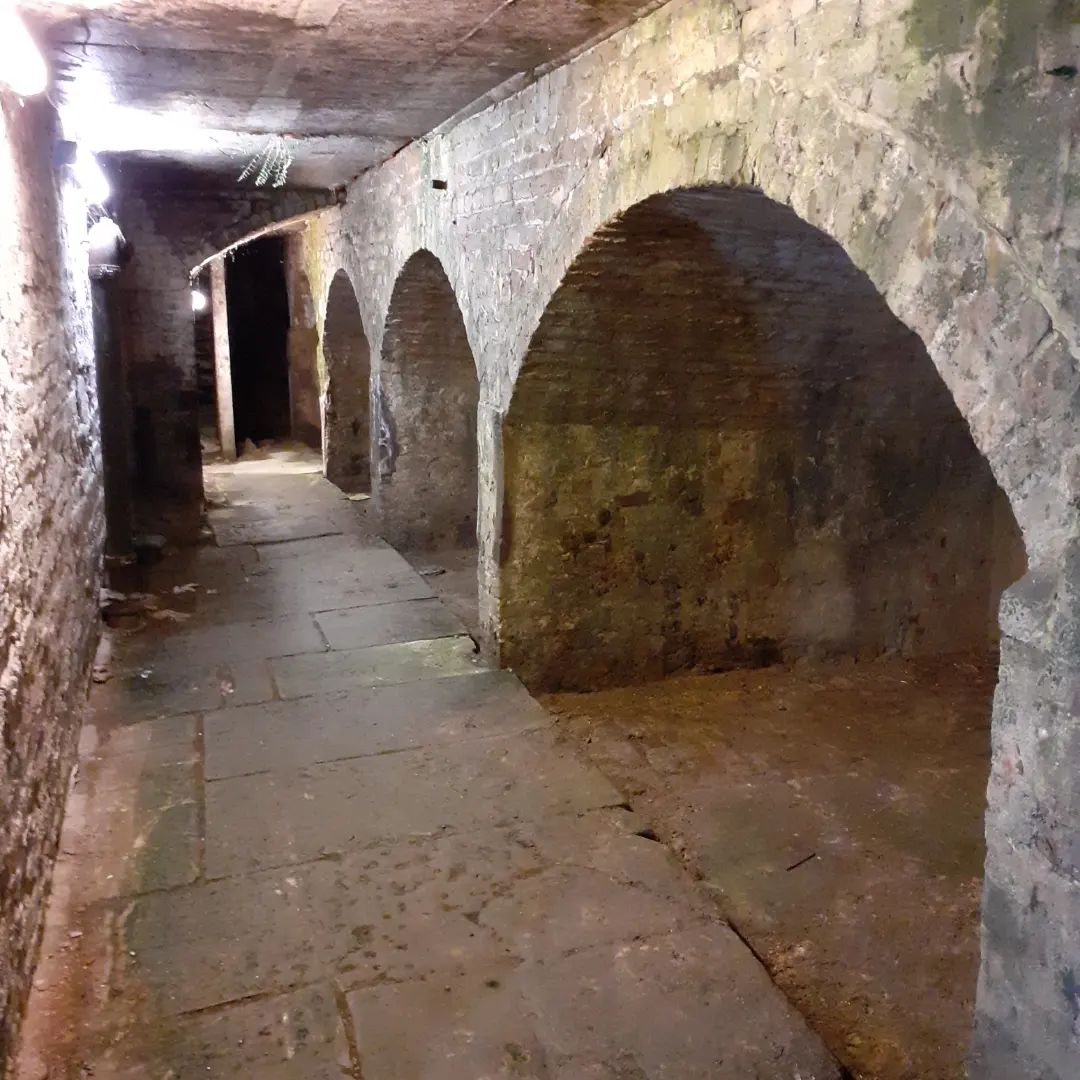 Brixton Book Jam was not my only interesting night on the town. Only three days later I attended the first meeting of the London chapter of the Crime Writer’s Association since before the pandemic. Held in the fantastic Morpeth Arms on Millbank a great group of fellow scribes chatted books, publishers, contracts, remuneration and anything else we fancied. Then Anthony, intrepid manager of the pub, asked if we would like a ‘tour’. A tour of what? It transpired that the public house had used to stand adjacent to the notorious Millbank Prison and that, beneath the ground, elements leading to that place still existed. Down steep stairs and beyond the barrels and machinery we entered a long corridor with archways on one side. The corridor had once been open to the air, the dividing line between prison and pub.
At the end of the corridor was a dark arch leading to a tunnel. This was the route used to bring convicts out of the prison down to the prison hulks moored on the Thames. They would then be removed to the transportation ships bound for Australia. The pub was, Anthony informed us, one of the most haunted in London. But the writers’ imaginations were already hard at work and one of us was already speculating aloud about a crime plot using the tunnels. This is, I guess, the sort of thing that happens when a group of Crime Writers gets together. I’ll be looking forward to the next meeting.
Writers appearing in the photos on this blog are, from the top, left to right, Just Dennis, Paul Eccentric, Leo Moynihan, Paul Bassett Davies, me, Ashley Hickson Lovence, West Camel and Zelda Rhiando. Subterranean we are Victoria Dowd, Matthew Ross, Jonathan Rigby and Anne Coates. The hands belong to Vaseem Khan. Thanks to Katie Allen for the multiple pic.
 The word ‘sherry’ is derived from the name of the the town of Jerez in Andalucia, southern Spain, formerly spelled Xeres and pronounced ‘sheres’. This year International Sherry Week, a celebration of the town’s most famous product, ran from 8th to the 14th November and I happened to be there for much of it.
 the latest in the world of sherry production, marketing and the rules governing it, it includes a competition for chefs and sommeliers from across the world, the winners being the most successful at pairing sherry and food. This competition has been going for six years and is getting a very good reputation. The entrants come from the best restaurants in Europe. This year the UK’s entry was a team from The River Cafe – Mattia Mazzi was the sommelier and Vincente Raffone the chef.
 It’s a high pressure competition, with national heats, before the grand final in the Teatro Villamarta in Jerez and it’s all done against the clock. This year’s judges include Josep Roca, the sommelier and co-owner of the triple-Michelin-starred El Cellar de Can Roca, London restaurateur José Pizarro, Quique Dacosta, owner and chef at his eponymous three-starred restaurant, Andreas Larsson, named the World’s Best Sommelier in 2007, Peer Holm, President of the German Association of Sommeliers and leading Spanish food critic, José Carlos Capel. Not an easy bunch to impress.
 his didn’t stop me from tasting, though not the super dry finos and manzanillas, for me the Autumn is a time for amontillado or, my current favourite, oloroso. (N.B. readers should note that my favourite changes from day to day.) So, meeting friends before going to lunch – a cafe solo and an oloroso goes down very nicely thank you. Some ice cream and a coffee after lunch, what better to accompany both than an oloroso ( though Pedro Jimenez poured over good vanilla ice cream is a delight ).
 Chelsea, or the
  First impression – there were far fewer people at the show. This was a huge plus for those of us who were there! Only people who’ve attended this show realise just how crushed and sometimes unpleasantly crowded it can be. There was still excitement, but much less stress. Numbers had been restricted and, even so, all the tickets had not been sold. That didn’t surprise me – at almost £100 per day ticket and taking place at the ‘wrong’ time of year. This is too expensive, oh RHS. It’s supposed to be a show for gardeners, not just for the wealthy who can afford it. Plenty of folk will simply have decided to watch the BBC’s blanket coverage on the TV instead and they won’t be returning. Aren’t you trying to appeal to more people not fewer? This is how to make your (currently very popular) product into a ghetto (albeit a well-heeled one).
  kinds, fewer show gardens, no ‘artisan’ gardens, fewer Grand Pavilion stands. The RHS had tried to fill the gaps, but, overall, rather unsuccessfully, I thought. I’ve never seen the Grand Pavilion so empty and, while it was undoubtedly the case that there was a real attempt to spread things out because of COVID, there were also some of the usual stands missing. I understand that some of regular exhibitors weren’t there because of, they said, the difficulty in preparing blooms for September, but how can it be more difficult than preparing blooms in the early and cold part of the year for display in May? So I missed stands like Bloms Bulbs, David Austen and other well-known growers.
 Harvest Moon on Tuesday night. Where were the stands celebrating that? Pumpkins and squashes appeared as a theme, but what about some of the other seasonal produce? My fig tree is producing. My roses are still blooming, in what has been a fabulous year for roses, at least in the south east of England, where were these? Didn’t the brains at the RHS come up with alternatives? Or did they do so, only to find that growers and supporters weren’t going to play ball? Missed opportunity.
 the Container Gardens, the latter more successful, in my opinion.
 Or the sound of the sea. There is nothing quite like that ever repeating, calming background pulse of water falling upon sand. Or indeed the fierce cacophony of wind whipped breakers on rocks or cliffs. Last week I was enjoying the former.
 smart central shopping area and a grand Plaza de Toro ( the people of El Puerto are keen on the traditions of old Andalucia and old Spain ). There are plush modern suburbs, like Vista Hermosa, full of large villas built in the traditional style each surrounded by private gardens, often rented out to officers from the American Naval Base at Rota. There are also holiday apartments, in Las Redes and at El Manantial, owned in part by locals, but favoured too by visitors from Madrid and Sevilla.
 El Puerto is much more of a holiday destination than Jerez, with its many beaches which, like all Spanish beaches, have names (see above). There is the town beach, with children’s play areas, soft golden sand and tiled promenade with gardens, Vista Hermosa’s beach, beyond what had used to be the Club 18 -30, which has been raised and is about to be replaced with a five star hotel; and there’s a glossy marina called Puerto Sherry. The Spanish Olympic Yachting Association sails out of here and, on the day when I visited, there were some rather expensive, ocean-going yachts moored behind the lighthouse mole.
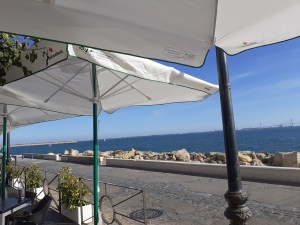
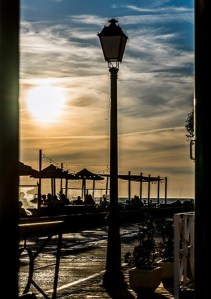 the Bay (see photos, courtesy of Deborah Powell) with a view across to Cadiz and one pays a premium for the location. When we visited there was the bonus of a tall ship. The people frequenting the bars along here are, largely, wealthy holiday makers and yacht owners, Spanish and foreign. The locals work in them. They were, however, extremely welcoming of Thai and Goa, Deborah’s two labradors. We sat and watched the sun set and the lights of Cadiz begin to glow.
 gone back to the city. The beach bars are few and far between, though the clam sellers (and sellers of sweets and snacks) push their gaily coloured carts along on the hard sand, crying their wares. Much less smart. And soon they too would pack up and leave, the season having finished. The beach would become much quieter, the bailiwick of locals only.
 Thus far, into its eleventh month, and 2020 is the year of fear. It began well enough for the UK. The out-break of an unknown ‘flu-like virus in faraway China making only the end of the foreign news. After all, we’d had bird-flu SARs and MERs and it seemed that the ebola outbreak in West Africa was now under control. Nothing to worry about in Europe. Our concerns were of a different kind, for many just dealing with the daily grind in an society increasingly uncaring and nastily polarised, for others the approaching exit from the EU.
 and April. We know a lot more about the virus than we did and, it seems, there is a vaccine coming over the horizon sooner than was at first thought possible. With the defeat of Donald Trump in the recent US Presidential election it seems that those who deny reality, thereby both belittling and increasing the suffering and death of many, are in retreat. There was much rejoicing (and some relief) in this house when Pennsylvania declared for Biden.
 But this doesn’t sit well, I am a glass half full sort of person. On a personal level this year has been good. My first crime thriller was published and well received. I have almost completed the revision of the second. My life, albeit indoors at home, is full and, generally, rewarding. There are many worse off than me.
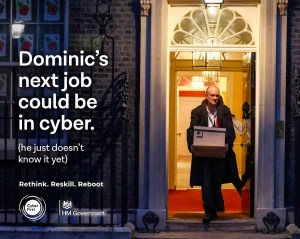 friends, via zoom if not in person. Carry on with work as best one can, taking as few risks as possible. It really is ‘Keep Calm and Carry On’, maintain one’s human decency and not give in to fear. That’s all one can do.
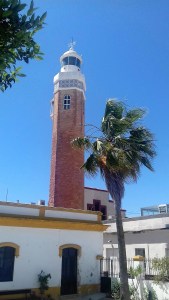 … the lighthouse or faro at Bonanza in Andalucia, to be precise, not Virginia Woolf’s Hebrides set novel of 1927. The fishing village of Bonanza is on the estuary of the Rio Guadalquivir as it reaches the Atlantic, just north of the Bahia de Cadiz. The derivation of its name is from the Spanish (and Latin) for calm sea, or tranquil waters, though it has come to mean a windfall, or unexpected piece of good fortune. It was our good fortune to be there last Sunday.
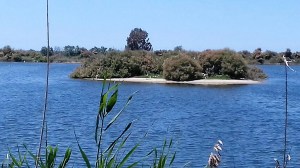 interspersed with houses whose architects certainly had exuberance and imagination, though they didn’t tend towards understatement (the Baroque featured here too, though attached to flat-roofed bungalows). If you continue along the single road you eventually gain access to that portion of the Donana National Park which lies on the south eastern side of the Guadalquivir. Here there are wonderfully tranquil forests of Iberian pines and a lagoon, complete with bird watching hides. The flamingos were displaying and we saw not one other human being.
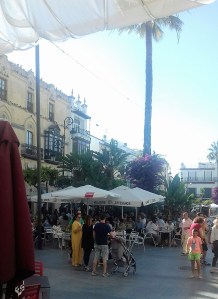 Or maybe head back to Sanlucar de Barrameda, of which I have written before ( see
  of the Barrio Alto, with its two museums and excellent views over the Barrio Bajo or take tea in the gardens of the 13th century

 The day dawned bright and this south Londoner rose early, if not quite with the lark. It was the first day of this year’s
  chance to text other members of the group. I could even see the river. Meeting up was always going to be something of a logistical issue, given that we were from all parts of the UK – from the West Country, North Wales, the south coast and Scotland. Plus, my phone seemed to throw a tantrum. Why don’t they work properly when you need them to? No matter, there was nothing for it, I would just have to wander around until I found the others – amid a crowd of thousands!
 At this time of day the betting was that some, if not all, would be on Main Avenue looking at the Show Gardens, before it became too congested to see them. And so it was. I met the West Country contingent by the Resilience Garden and we were shortly joined by those from Wales and some from Oxford, via Putney.
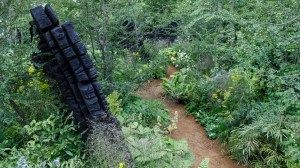 but not quite the garden meadow and sprinkled wildflower natural which has prevailed in recent times. There were a lot of mature trees, including a glorious Scots Pine, and green predominated. Andy Sturgeon’s M & G garden deservedly won Best Show Garden, in this humble gardener’s opinion, with its burnt timber formations resembling ancient rock and setting off the jewel-like colours to perfection.
 lots of talk about this year’s Clapham Book Festival ). We disperse again in the afternoon, it being impossible to keep over a dozen people together in the growing crowds.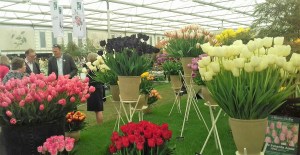
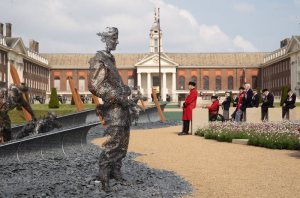 A word for my favourite gardens, the Silent Pool Gin garden ( alas no gin, but excellent planting and lovely use of copper ) and the Greenfingers Charity Garden, not for the double storey so much as for the planting, with liberal use of fennel and angelica. The D-Day sculpture garden was also immensely impressive in its own quiet way.
 which also appear on the relevant web-sites
 Julie Anderson