 I have just returned to a cold and sleety Clapham after the sunnier skies of southern Spain, where the scent of orange blossom was already in the air and the 27th edition of the Festival de Jerez filled the town with music.
My body still feels the compras, the rhythm, while my head is full of the sound of the guitar and, when I close my eyes, I see exquisite and dramatic stage pictures. Sara Calero dancing, joyously and spikily, to a jaunty Day of the Dead number, while Gema Caballero’s smoky voice sang words which prompted smiles in the audience. Flamenco with humour and wit. The intensity and athleticism of Eduardo Guerrero, in a pose beneath the spotlights with was both Christ-like and evocative of Japan. Maria Jose Franco amid a swirl of motion and fringed silk, a more traditional show, but marked out by the stunning skill of the dancer. Then, the final night, fabulous guitarist Manuel Valencia with long time collaborator, singer David Carpio, two of our favourites so obviously having as wonderful a time on stage as we were in the audience.
Sitting in Plateros we described what we had seen to friends who didn’t go to flamenco. It wasn’t ladies in polka dot dresses with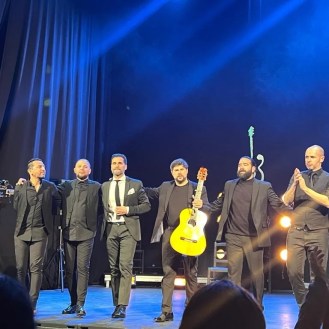 castanets dancing to black clad male guitarists, although you could see that if that was what you wanted. No, something fascinating has been happening for a number of years at this festival and this edition was no exception. Younger practitioners are examining the boundaries of what flamenco means, exploring and expanding their art.
Some of our other favourites weren’t there this year, or our timing meant that we missed them. There was no Manuel Lignan, the man who often dances in a dress and explores gender roles, nor was there Santiago Lara, the Jerezano flamenco guitarist who plays jazz a la Pat Methany and is currently writing a concerto for guitar and orchestra. We missed Rafaella Carrasco and Antonio Rey because of dates, but would have loved to have seen them.
 We did see an amazing reflection on life and death in Finitud, the aforementioned Calero Caballero collaboration. We saw the pair ten years ago when their skill and artistry was expressed beautifully through the traditional forms and we’ve looked out for them ever since. Boy, have they developed. The show included an electric base guitar as well as flamenco guitar and, astonishingly, Mozart’s Requiem. A singer, a dancer and two musicians conjured up the vibrancy of the south American Day of the Dead, the solitude of graveyard contemplation and a lot in between. We had a fun 1930s cartoon of skeletons dancing to make us laugh and ended with an auto de fe. Stunning! This show was hugely emotionally engaging and created some stupendous images which will fill my mind for quite some time. It encapsulates what a new generation of flamenco artists are doing, developing themselves and their art.
Valencia and Carpio were less unusual in their set, although I recall a tremendous concert some years ago in which Carpio and the dancer, Lignan, performed a duet, the one singing, a cappella, the other responding in dance and with rhythm (Valencia was the guitarist that day too). But their set lastr3orillas (The Three Shores) on Tuesday was wonderful and the thirteenth century church rang to the sound of shouts and applause. We’ll be back to listen to them again.
All this gave me lots of food for thought. How do artists use the creativity of other artists in developing their own work? In music, in art or, as a writer, on the page? What is creativity? I, for one, will be reflecting on this, with friend and fellow writer, Sunday Times best-selling novelist, Elizabeth Buchan in a talk for The Clapham Society at Omnibus Theatre on 20th March at 8 pm. Come and join us if you’re free.
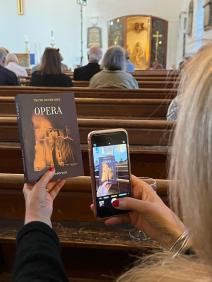 The low, autumnal sunlight slanted across the churchyard of St Paul’s Church in Clapham on a beautiful September evening one week ago. Cars drew up to the church’s railings, people walked down the winding path to the heavy church doors and inside there was a buzz of anticipation of good entertainment to come. They were there to celebrate the launch of ‘Opera‘ the third in the Cassandra Fortune series of murder mysteries, together with the music of Puccini and Tosca in particular (the opera in ‘Opera‘). I was at the door to greet them.
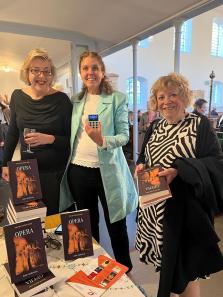 evening’s entertainment), the sound system was set up, the bar was stocked, staffed and ready to dispense and the Claret Press table was ready with signed books for sale. Programmes were handed out at the door. The church filled, gradually, with local friends, of the author or of the opera company, and with those from farther afield who had come to help celebrate. About a third of the crowd were probably also writers, many of them writers of crime fiction (see Anne Coates, author of the Hannah Weybridge mysteries, with Katie Isbester of Claret Press and myself, right). Other Claret authors, Steve Sheppard and Sylvia Vetta were there as well as reknown Clapham authors like Elizabeth Buchan. Clapham Book Festival friends were out in force, as were the members of the Clapham Writers Circle. In total there were between seventy and eight people in the beautiful church.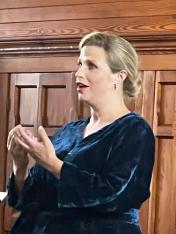

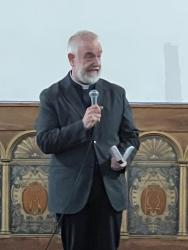
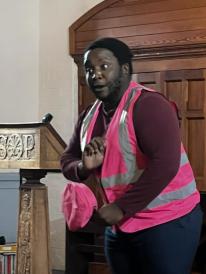 Grand opera is always intense and these two arias especially so, so a lightening of the mood was required before the interval. This was provided by an ‘interruption’ by a police constable, PC Willis, who had just arrived from the Houses of Parliament (although dressed in pink). Bass baritone Masimba Ushe delivered the sentry’s song from Gilbert & Sullivan’s Iolanthe ‘When all night long, a chap remains…’ in sonorous and amusing fashion. Laughter heralded the interval, when everyone headed to the bar (where the barkeepers were kept very busy).
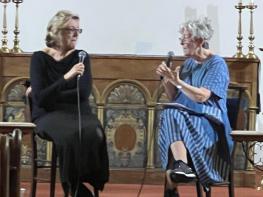 beforehand and I kept my answers short (as she had told me to, I tend to ramble). People seemed to enjoy it and, after questions from the floor, we ended to loud applause.
 bunting made of the posters and other images of Tosca which I had been collecting for months before the book was published.
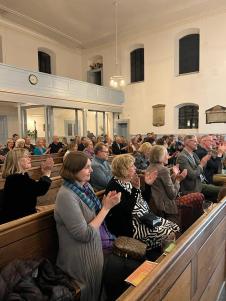 Ninian and the singers of St Paul’s Opera, which made it unique. Many of those who attended spoke or wrote to me, telling me how much they enjoyed it. Plus, my publisher sold lots of my books. It was a spectacular way to launch a title and a very special occasion.
 In April of this year I posted a piece about images of Tosca ( see ‘
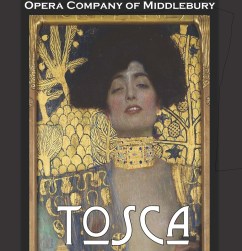 The artist most associated with Tosca, partly because he designed many posters for the Comedie Francais, where Bernhardt performed, and partly because his style is such a good example of Art Nouveau is probably Alphonse Mucha. Even the Hohenstein poster for the opera’s premiere in Rome in 1900 owed much to Mucha’s style. But his is not the only style which was copied and often other artist’s works were rifled for use on the posters. See the use of the Gustav Klimt’s ‘Judith’ in the poster for Middlebury Opera’s production (right) .
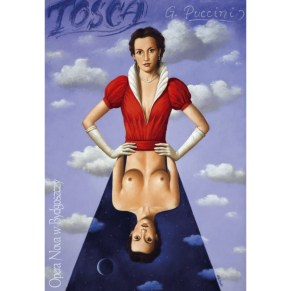 I found a very striking poster from Poland, probably for a production by the opera company of the city of Bydgoszcz which was very reminiscent of the style of Frieda Kahlo (see left). It drew many comments on social media and divided people, they either loved or hated it.
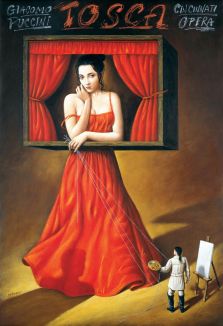 colour in the poster. I’m not sure if this was a sneaky subliminal message, but it is certainly surreal and I do not pretend to understand it, though it seems to be trying for an analysis of the opera at a subconscious level – Tosca pulling Cavaradossi’s strings.
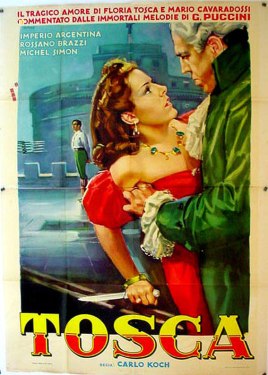 life, so there are plenty of leering Scarpias and retreating, suffering Toscas, though often clutching a dagger. The Italian ones are even more lurid than the Hollywood ones ( I suspect because Hollywood treated it as ‘high art’ ), but here is a more restrained offering – ‘The tragic love of Floria Tosca and Mario Cavaradossi commemorated in the immortal melodies of G. Puccini’. The director, ‘Carlo Koch’ is actually the noted German art historian and film director, Karl Koch, who undertook the film in 1939, jointly with Jean Renoir, at Mussolini’s invitation. Koch was Renoir’s assistant on Le Regle de Jeu
 and Renoir was instrumental in getting Koch out of Germany in 1936. Renoir eventually withdrew from the film, but Koch completed it, together with his assistant, one Luchino Visconti. Incidentally Koch and his wife settled in Barnet, north London once the war ended.
 preparation I’ve been collecting and sharing images relating to Tosca for some months and I plan to use them at the launch event. These range from copies of the original posters for the premieres of both the play by Victorien Sardou, in Paris in 1887 and Puccini’s opera in Rome in 1900, through to film posters of the 1970s and modern posters for productions of the opera. In the course of searching for these images, however, I have discovered that ‘Tosca’ is also the name given, presumably in honour of the diva and Puccini, to a number of other items, including several types of perfume, at least two cars and a cocktail.
 The Tosca Eau de Parfum can still be bought today for £16.74 and accompanied by shower gel, deodorant and moisturiser in the same fragrance. There is also an extremely expensive version by Xerjoff Casamorati, available from Harrods – a snip at £81.95 for 30ml (see above). It seems that the original perfume was created by Farina 4711 and vintage bottles are now traded on ebay and etsy (see left). The very expensive, bright pink/purple bottle of the Xerjoff is much less attractive, to my eye, but it is certainly distinctive. I have yet to discover why it was designed as it was.
 fast ( and, in most of the images I could find, red, which continues a colour theme found in the Tosca opera posters. More of a surprise is that it is a hybrid with a traditional V10 engine, as well as electric batteries. Even Italian super cars are going green these days. Just as surprising is the La Tosca, a 1955 concept car from Ford. It was designed to be remote controlled, so is driverless and in that is very modern, but it has the sort of design which owes much to aircraft and was thought to
  be ‘space age’ at the time. The pictures of it that I have seen show a car which seems to float above the ground with huge wing fins, a plexi-glass bubble over the passenger compartment and an exhaust which looks like a jet engine. The car is often a bubblegum pink, which makes me think of a sort of very sporty version of Lady Penelope’s Rolls Royce from Thunderbirds. This was the Ford La Tosca, an actual car, though it was never put into production.
 2019 production of Tosca at La Scala, Milan and was served in Il Foyer bar there. It is made with the south American spirit, Mezcal, two types of Martini (we are in Italy after all) elderflower foam and, to dress, tomato powder and chilli pepper. If it appeals you can find the recipe
 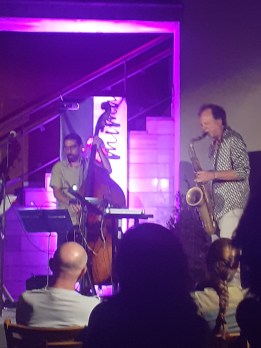 I know that there is always music to be found in Jerez de la Frontera. Usually it’s of the flamenco variety, but I have, in the past, happened across 13th century song cycles, jazz, classical, modern tribute bands (hearing ‘Radio Gaga’ resounding from the walls of the ancient Alcazar some years ago was quite something) and world music. This summer is no exception with a range of concerts, sometimes free, sometimes charged for, in some spectacular locations. July saw ‘Baile’ a series of flamenco dance performances in the 13th century Claustros de Santo Domingo and ‘Mima’ or Musicas Improvisadas En El Museo Arquelogico in the eponymous museum. I caught the wonderful jazz trio Nocturno on a sultry Wednesday night playing their own compositions, inspired by the night and Frankenstein. The music was stupendous. I wondered what Mary Wollstonecraft Shelley would have made
 of it, I’d like to think that, free thinker as she was, she would have enjoyed it as much as the audience did. Afterwards, given the temperature, musicians and audience spent the next hour or so in the Plaza Mercado (the old Moorish market place, which features in my novel Reconquista ) drinking excellent wine.
 part-flamenco-part-arabian (you could say the first comes from the second anyway), modern rock-style electric guitar and the wonderfully fluid arpeggios of the kora. These concerts run into the 55th Fiesta de la Buleria de Jerez, a stunning series of gala concerts with the cream of flamenco performers – Manuel Lignan, Gema Moneo, David Carpio, Antonio El Pipa, Manuela Carrasco and more. The buleria was invented in Jerez, it is very rapid and complex, with demanding changes in rhythm for all performers. Guitarists consider it possibly the most virtuosic of the soleas. Lively and intense, it is also great fun, often performed at parties and as a dance at the end of a show, when all the performers (not just the dancers) join in. With origins in the nineteenth century it was popularised outside of Jerez and other corners of Andalucia in the twentieth century by ‘cross-over’ artists like the guitarist Paco de Lucia and singer Camaron. Still going strong, it is celebrated annually in Jerez, just before the beginning of the vendimia, the wine harvest. This, and the other series of concerts have been augmented by free concerts and dance performances in Plaza Ascuncion, in front of the 13th century church of San Dionysio and the neo-classical town hall.
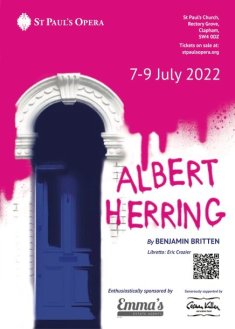 the May Queen. But there’s not a virtuous maid to be found. Shock, horror! Too many have erred ( being seen ‘out after dusk’, or ‘wearing short skirts’ ). So a King of the May is preferred, the virtuous (and virginal) Albert Herring.
 We filed inside, carrying cushions ( those pews can be unforgiving to the rear end ) to find the colour scheme continued. The musical director and conductor, Panaretos Kyriadzidis took up his position, with pianist Francesca Lauri and the story began. Florence Pike (mezzo, Natasha Elliott), housekeeper to Lady Billows (soprano, Charlotte Brosnan) was preparing milady’s parlour for the meeting of the May Day committee – Miss Wordsworth (soprano, Anna Marmion), mayor Mr Gedge (baritone, Adam Brown), vicar Upfold (tenor, Peder Holterman) and Superintendent Budd (bass, Masimba Ushe) to choose the May Queen.
 sensible, if ponderous and all defer to milady, who is ‘overbearingly enthusiastic’ (as described by Britten and his librettist, Eric Crozier). Yet Albert (tenor, Hugh Benson) is decided not upper class, being the greengrocer’s son and neither are his friends, Sid, the butcher’s boy (baritone, Alfred Mitchell) and Nancy, his girlfriend (mezzo, Megan Baker). One of the delights of this opera is the demotic, everyday language which Britten insisted upon. It is used well and wittily – after his night of debauchery which the May King prize money affords him, Albert thanks the shocked villagers ‘And I’d like to thank you all, for giving me the wherewithal.’
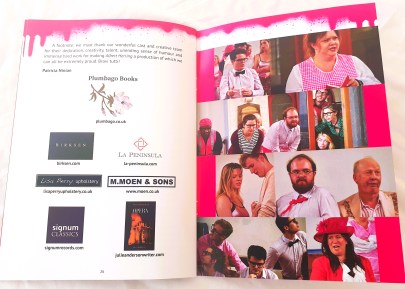 The opera is funny and this production is full of energy, verve and wit. The audience become participants, urged, at specific moments to rise for Lady Billows (as if in church) or to applaud. There are ‘Missing Person’ handbills circulated and beach balls thrown. Throughout, however, the music is spikily superb. Another great success for St Paul’s Opera and a triumphant excursion outside their usual repertoire. The auditorium was almost full last night and the next two night’s are sold out completely.
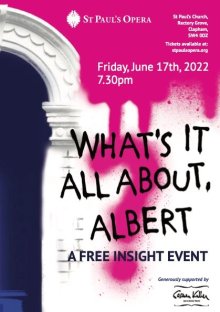 … but rather Albert Herring, by Benjamin Britten. This year’s Summer Opera from St Paul’s Opera Company, Clapham. Last night was the ‘Insight’ evening, designed to introduce the opera to those who may not know it and to stimulate discussion among those who did. I learned a lot.
 serious piece The Rape of Lucretia. Albert Herring a chamber opera in three acts, was the result.
 The following morning, with Albert missing, the villagers discover his May crown in the well and everyone is thrown into mourning. In its midst Albert turns up, rather the worse for wear and thanks the village committee for funding his night of pleasure. All are, needless to say, outraged, but Albert carries it off, standing up to his mother in the process. The opera was an immediate success, receiving performances in the U.S., Copenhagen, Oslo and Moscow. It has since been performed all over the world.
 Wintle, Panaretos Kyriatzidis (musical director of St Paul’s Opera) and Annemiek van Elst (Director of Albert Herring) facilitated by Jonathan Boardman. The evening closed with questions from the audience (which could have gone on for far longer ). Sadly, dusk had well and truly fallen and the evening drew to a close.
 connected with it.
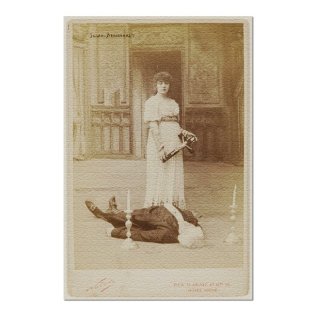
 Puccini’s opera was based. The first performance of the opera was in 1900 in Rome and the poster was by Adolfo Hohenstein who also designed the stage sets. It is very much in the Art Noveau style of Mucha and features the same scene as the Bernhardt postcard, a scene which was to feature again and again in images of the opera. The pious Tosca sets candles at the head of the Baron, whom she has just killed ( in self-defence, as he has just tried to rape her ) and places a crucifix on his chest.
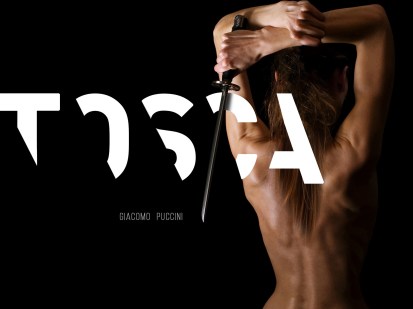 Many of the more modern images are explicit about the subject matter and the link the opera makes between sex and death (see left). The dagger is a recurring motif, as is blood – red is the most popular colour. The Castel Sant’Angelo appears too. Tosca herself, as in Bernhardt’s time, is often the the central image, although other posters prefer to concentrate on Scarpia, like that for Florida State Opera (right). Only a few depict Cavaradossi, the hero. Ordinarily one might say that this is an example of
 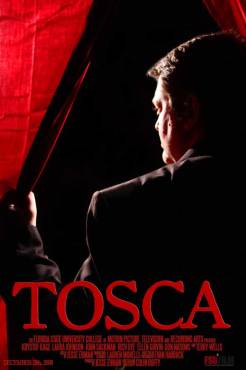 ‘the devil has all the best tunes’, except that in the opera itself, it is the tenor arias, belonging to Cavaradossi, which are most memorable.
 In particular the language we use when we talk about singing.
 to the crescendo, was described as the ‘luxury version’. ‘Don’t be polite, don’t apologise for the note’ signified not to sing it lightly, not giving it due sound, but to sing it loudly, the quality of loudness being needed in a theatre. Also, ‘complete the note’, indicated holding it for as long as necessary. Easily understood, though less easy to define.
 It’s at the Hootananny, 95 Effra Road, Brixton, SW2 1DF and doors open at 7.30 pm on 7th March, where I’ll be appearing alongside William Ryan, Ashley Hickson-Lovence, Leo Moynihan, West Camel, Paul Bassett Davies and Paul Eccentric. It’s free to attend and there’s booze and books on sale. If you’re in south London why not come along?
 It will take a while for the complex rhythms of flamenco to leave my head. The interlacing of voice with the clapping of hands, the stamping of feet and various musical accompaniments, but especially the guitar, has been ubiquitous for me over the past nine days. From wonderful professional performances by masters of their art to the joyous dancing of the students of the schools of flamenco on Plaza Belen before an appreciative, local crowd, it has been a delight. This morning’s grey south London has nothing to compare with the vibrancy and colour of Jerez de la Frontera, where the scent of orange blossom is already in the air.
 Two amazing guitarists were the bookends to our festival this year. We began with Salvador Gutierrez in the converted 16th century church of the Sala Compania. He played a loose and fluid form of flamenco guitar, often varying completely from the melodic into atonality and jazz, only to return to the melody later with supreme artistry. Our festival was closed by Daniel Casares, (left) whose recordings I will seek out. His playing was more traditional in style but he too ranged widely, interweaving with the light and liquid flute of a flautist whose name I didn’t catch and who isn’t credited on the official programme. This was a very informal type of show, with people climbing up on to the stage from the audience to join in. I’ve attached a clip below (starts after five seconds).
 In between we were treated to some remarkable dancing. Manuel Linan, darling of the Festival, was back at Teatro Villamarta with a new show Pie de Hierro. Named for and dedicated to his father, who was injured in a road traffic accident which curtailed his career as a bull fighter, but who placed his own heavy expectations on his youngest son, Linan; this complex and difficult relationship is explored in terms of conformity and rebellion, tradition and personal expression. Linan likens this to his relationship with flamenco. There’s a full interview in Lavozdelsur
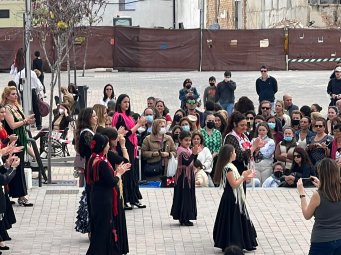 Much more laid back (though probably not for the participants) was our Andalucia Day morning in Plaza Belen watching the students of the various flamenco schools strutting their stuff. Everyone got their turn in the spotlight and everyone received applause from the predominantly local crowd sitting in the amphitheatre and standing near the stage (proud relatives included). Then we all went off to eat venison at an open air cinema. Perfect.
 Julie Anderson