Question – which of the following is true?
- Stories which deal with political ideas need not be stories about politics.
- Stories which show the struggles, jealousies and rivalries, or alliances and betrayals of politicians, may not be about political ideas.
- Most fiction is about power and its balance, so all fiction is about the political.
 All three, as far as I’m concerned. It depends, of course, on how you define politics and the political. The dictionary definition is ‘the art or science of government or governing, especially the governing of a political entity, such as a nation; and the administration and control of its internal and external affairs. ‘
While that encompasses an awful lot, it is actually quite a narrow definition.
Yet, as Orwell said in Politics and the English Language his essay of 1946, ‘There is no such thing as ‘keeping out of politics’. All issues are political issues, and politics itself is a mass of lies, evasions, folly, hatred, and schizophrenia.’ Since 2019 the UK has had a prize, the Orwell Prize for political fiction.
I will be addressing these questions and lots of similar, related ones in Politics & Prose, a talk for the Royal Borough of Kensington and Chelsea and Westminster Libraries on Monday 25th January at 18.30 GMT. It’s a FREE event, but you have to register with Eventbrite if you want to attend ( you can do so HERE ).
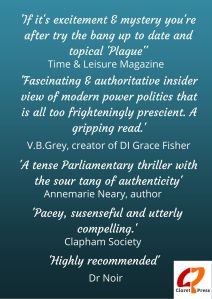
My novel Plague (Claret Press, 2020) has been described as a ‘Westminster novel’, and, I am proud to say, a page-turning read, but is it political fiction? It’s commercial, not literary fiction, but that shouldn’t prevent it dealing with ideas. It deals with crime, with torture and murder, but also, something of very topical moment, crony capitalism. As my hero says to the villain, ‘you’re ensuring the contracts go to the right companies so you can reward your friends and allies.’ (P246) There are real legal cases underway claiming that the current government is using the COVID emergency to indulge in exactly that.
As the pandemic began early last year I believed that Plague had lots of resonance with reality and, of course, its title attracted attention. Yet, as time has gone on, it has been the politics, not the pandemic, which resonates more. The crony capitalism, the link between political policy and making money on the financial markets and manipulating the media to influence  the public that seems more apposite. Plague‘s successor, Oracle, is much more of a ‘classic murder mystery’, though I hope it has the same page-turning quality. Yet it too has the political at its heart and, already, some of its themes are hitting the real-life headlines, like questions about the politicisation of the police, something which surfaced again after the assault on the U.S. Capitol. I suspect that this issue is something crime writers will be incorporating in their stories for the next few years.
I’d also like to answer the following question; in an age in which the novel is 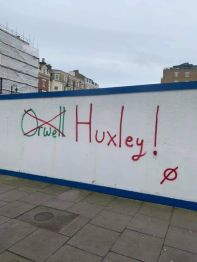 arguably no longer the dominant force in story telling and when social media allows us all to be citizen journalists and political commentators, what place does political fiction have? An important and relevant one, in my view. And I’m not alone – see this piece of graffiti, found in London, NW7 earlier this week ( thank you John Johnston for the photo ). Is the political image of our age the age of the boot on the face, or the pill and the palliative? Orwell or Huxley?
I hope some readers of this piece might come along and contribute on Monday. Here’s a book list of books which will be mentioned.
 On Wednesday the world watched as an enraged mob, whipped into action by their leaders, including the outgoing President of the United States, stormed the U.S. Capitol in order to derail the process of endorsing the recent and overwhelming Presidential election results. As the attempted overthrow of legitimate government took place, elected representatives were removed to or found places of safety and thugs ransacked offices, stole Capitol ‘souvenirs’ and took selfies. Pipe bombs, molotov cocktails and guns were found and a policeman, a female insurrectionist and three others died.
 preparedness among those whose job was to protect the Capitol ( the Capitol Serjeant at Arms has already resigned and the Chief of Capitol Police is going ). Many of the questions relate to events which lead up to the insurrection, which didn’t occur spontaneously ( a quick look at QAnon substantiates that ) and the attitudes and beliefs of the people involved. Mistaken and sometimes reprehensible beliefs which have been encouraged by lies in social and mainstream media and by Republicans. There were plenty of Damascene conversions and, as someone on Twitter pointed out, a ‘traffic jam on the Damascus road’ in both Houses, so keen were Republicans to condemn what happened.
 tyranny. This is basic level Civics, but something which seems to need restating. These are also ideas which I explore in Oracle.
 seeks to generate real world action in pursuit of justice.
 events like Grenfell become referred to as a ‘tragedy’ or a ‘tragic accident’, yet they were foreseeable and avoidable and these events and others like them will continue to occur until the law adapts to make punishment of those who enable such events both possible and direct. Zemiology presupposes that isn’t likely to happen, as the powerful have co-opted the law and the legal system to protect their power and interests. An idea not unfamiliar to readers of Plague.
 Christmas period.
 For now, may I wish everyone reading this a happy and peaceful Christmastide, where ever and with whomever, you are managing to keep it. Here’s hoping for a much better 2021.
 Oracle, the next book in the series following the adventures of Cassandra Fortune, is set in Delphi, Greece near the Temple of Apollo. When revising it recently I revisited some old favourites, the gods and goddesses of ancient Greece.
 dominant.
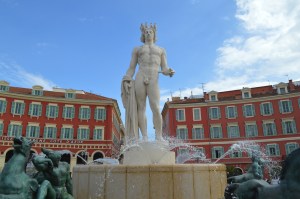 primordial mother, have been found in Delphi, in the Corycian Cave above the Temple to Apollo from the Neolithic period (about 12,000 years ago). Gaia and her daughter, Themis, ruled at Delphi and there was a chapel to her there, though it was long ago absorbed into the larger Temple complex. As Nico, the museum employee in the novel, explains, in legend, the god Apollo arrived at Delphi to wrestle with the Python, the giant snake belonging to Gaia, and won; so he became the ruler of Delphi. It is thought that this represents a change of dominant culture as migrants, whom we now know as the Hellenes, came into Greece from the north. They eventually settled all of Greece and their gods were the Olympians.
  Nonetheless the older gods continued to exist along side the new, as did their off-spring (unless they were thrown into the pit of Tartarus). These included some groups, or sets, of minor deities, like the Fates and the Furies. The latter trio, called the Erinye, were three women, often, especially in more modern times, portrayed with snakes for hair and flashing eyes, their hands dripping blood. The image, right, is of Clytemnestra attempting to wake the slumbering Furies to chase down Orestes in the Orestaia on a vase dating c.350 BCE. Delphi, it was believed, was the centre of the world and it is to the Temple of Apollo there that Orestes flees, calling upon the god to save him from the Furies.
 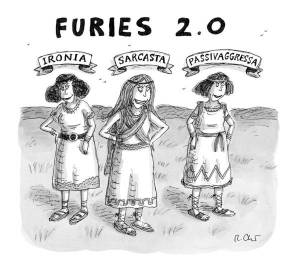 I don’t know if the books which I read are still read today, I hope so, even as new games and films bring the ancient heroes and deities to life for another generation. This Pantheon is firmly anchored within western sensibilities. So much so that we even replicate the old jokes in new ways ( see image left ).
  beings, regardless.
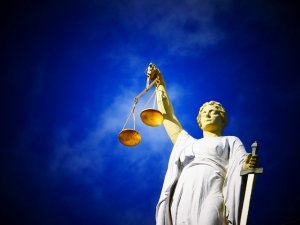 Ginsberg and the scramble to replace her with someone partisan towards a specific political position also highlighted the link between justice and politics.
 criminal organization, systematically attacking migrants and leftists. The court also announced verdicts for sixty-eight defendants including the party’s political leadership. Nikolaos Michaloliakos and six other prominent members and former MPs, charged with running a criminal organization, were found guilty. Verdicts of murder, attempted murder, and violent attacks on immigrants and left-wing political opponents were also delivered. Golden Dawn held 17 seats in the Hellenic Parliament only five years ago. An independent investigation by the Council of Europe found disturbing links between Golden Dawn and the police.
 Julie Anderson