Given the recent 80th anniversary of VE Day, I have chosen three books with a World War Two setting. They are all standalone mysteries but are also part of a series. Settle into an armchair and immerse yourselves in a world made dangerous by bombs and Nazis, as well as criminals.
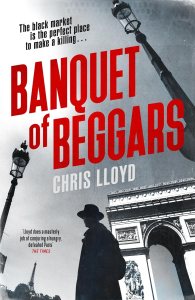 My first book is Banquet of Beggars by Chris Lloyd (Orion, £9.99). This is the third in his Occupation series, the first of which, The Unwanted Dead, won the Historical Writers Association Gold Crown Award for the best historical fiction in 2021. The next two books are just as good. Lloyd’s hero is Inspector Eddie Giral, Parisian cop. Once a First World War veteran and family man, once a nightclub bouncer and cokehead, now a laconic and cynical flic who is dangerously close to self-destruction. In 1940, Eddie, all of Paris, is under the rule of the occupying German forces.
Lloyd conjures a bitterly cold and hungry city, where the streets are empty of all but bicycles and German transport. Parisians grow truculent and rebellious as their overlords begin to show the iron fist. While Paris starves, the Germans, and some French, enjoy the very best that the city can offer. The general population resorts to the thriving black market and it is that black market which Eddie investigates after a murder, determined to find a measure of justice, despite the criminal complicity of the occupiers – a complex and dangerous mission. The Parisian underworld is evocatively drawn, as are the minor transgressions forced upon ordinary citizens so as to survive. This is a city where there are few moral certainties.
Eddie is a multi-layered protagonist, trying to do the right thing in impossible circumstances. He is despised by both the Germans and the Parisians, who see him as a coward and collaborator. His sparring with the German who is the liaison officer with the French police, the urbane and menacing Major Hochstetter, is one of the most intriguing relationships in the book. Lloyd entangles the reader in the politics of the occupiers, their ambitions, loyalties and internecine quarrels, as the Gestapo and SS attempt to take over command of the city, but it is Eddie, imperfect but humane, who captures the reader.
My next two recommendations have British settings.
Death of an Officer by Mark Ellis (Headline, £10.99) is set in post-Blitz London in Spring 1943. His protagonist is Detective Chief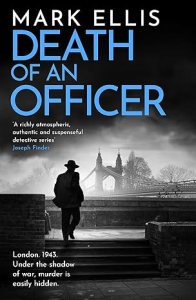 Inspector Frank Merlin, incorruptible Scotland Yard policeman. Merlin doesn’t quite fit with the establishment, he’s the half Spanish son of an East End chandler and his cockney wife, yet he commands respect amongst the gangland underworld and his fellow coppers (many of whom are corrupt). There are two murders for him and his small team, depleted because of wartime conscription, to solve. First, that of a respected consultant surgeon of Indian extraction, killed in his Kensington flat and, later, the discovery of an unidentified corpse on a bombsite in Limehouse, an apparently well-to-do, young man dressed for a night out ‘up West’.
The investigations take in the high and the low, London clubland and London gangland. The latter is in the person of Jakey Solomon, a fictional rendering of the real-life gangster Jack Cohen (who also appears, incidentally, as Zack Caplan, in my own A Death in the Afternoon). The cases touch upon the intricacies of war-time relations with the Americans and MI5, especially when an international aspect is discovered. Soon, however, Merlin is inexorably led towards the upper echelons of British society, the Army and the Navy. Ellis is very strong on the British class system, its internal gradations and marital arrangements and how these dovetail with the services during wartime.
Very evocative of the times, Death is above all an intricate whodunnit, the plot strands weave though and around each other, drawing in a colourful, well-drawn cast of characters. Never short of revelations, the pacing is, nonetheless, gradual, as both investigations progress and become intertwined. The final resolution is very satisfying. A postscript reveals how justice is eventually served, sometimes in court, sometimes by the only way out.
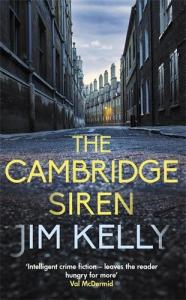 Finally, The Cambridge Siren by Jim Kelly (Allison & Busby, £9.99). As the title suggests this is set in war-time Cambridge, a strange city when denuded of its student population, its colleges standing empty or used for war-time research. Kelly, like Lloyd with Paris, or Ellis with London, clearly knows this cityscape like the back of his hand. His ’tec is Detective Inspector Eden Brooke, as with Eddie Giral, a survivor of World War One, albeit with permanently damaged eyesight. So, he must wear heavily tinted spectacles and prefers the hours of darkness. This different way of seeing is a metaphor for Brooke’s investigative thinking as well as requiring him to be a ‘nighthawk’ and the series is called the Nighthawk series.
Brooke is a family man and it is his son-in-law, a serving submariner, who first identifies a crime, when he’s asked to fix an apparently faulty periscope. It has been deliberately sabotaged and the factory it was made in is in Cambridge. There is also a mysterious death to deal with, the apparent suicide of a man found in an air-raid shelter. A man with a tropical suntan and Brooke’s telephone number written upon his hand.
The crimes in Siren are distinctly war-time crimes, when greedy, venal and ambitious people seek to exploit the wartime situation to their advantage. It features a ‘funk hole’, where those who are not fighting retire to the countryside and avoid the war in relative luxury, various war-time scams and some deadly crimes, including a, real, Cambridge science project. Brooke and his trusty, if depleted band of coppers at the Borough handle them all and this gives the book a much more ‘small town’, feel when compared to my other two, capital city based, recommendations.
Three wartime books set in three, very different, locations: all gripping and immersive. Put your feet up in front of the fire while the rain pours down and enjoy.
This review first appeared in Time and Leisure Magazine. Since it was written Death of an Officer by Mark Ellis has won the inaugural Cob and Pen Award at Bloody Barnes Book Festival.
 I have just returned to a cold and sleety Clapham after the sunnier skies of southern Spain, where the scent of orange blossom was already in the air and the 27th edition of the
  castanets dancing to black clad male guitarists, although you could see that if that was what you wanted. No, something fascinating has been happening for a number of years at this festival and this edition was no exception. Younger practitioners are examining the boundaries of what flamenco means, exploring and expanding their art.
 We did see an amazing reflection on life and death in Finitud, the aforementioned Calero Caballero collaboration. We saw the pair ten years ago when their skill and artistry was expressed beautifully through the traditional forms and we’ve looked out for them ever since. Boy, have they developed. The show included an electric base guitar as well as flamenco guitar and, astonishingly, Mozart’s Requiem. A singer, a dancer and two musicians conjured up the vibrancy of the south American Day of the Dead, the solitude of graveyard contemplation and a lot in between. We had a fun 1930s cartoon of skeletons dancing to make us laugh and ended with an auto de fe. Stunning! This show was hugely emotionally engaging and created some stupendous images which will fill my mind for quite some time. It encapsulates what a new generation of flamenco artists are doing, developing themselves and their art.
 in art or, as a writer, on the page? What is creativity? I, for one, will be reflecting on this, with friend and fellow writer, Sunday Times best-selling novelist,
 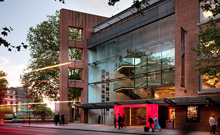 So to Sadlers Wells Theatre for the annual Flamenco Festival in north London. This time I had only returned from Jerez de la Frontera the day before and I went to see Santiago Lara and Mercedes Ruiz who hail from that city. I have written about this married couple before ( see
 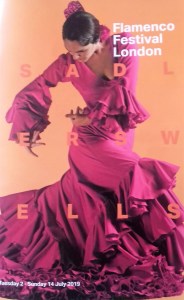 and Eduardo Guerrero, who I have tried to see several times at the Jerez Festival, only to be stymied by the schedule. Accompanied by rising singing star Maria Fernandez Benitez, known as Maria ‘Terremoto’, and male singers, Emilio Florido and Ismael ‘el Bola’. They were billed as the Gala Flamenca and it was excellent.
 The programme began with Morena dancing an alegria. As is always the case with British theatre audiences, while the dancing was well received, there was little feedback between performer and audience until the end of each piece. This contrasts with watching flamenco in Jerez, when the audience is supposed, even obliged, to clap, shout encouragement and cheer during the performance. I was very pleased therefore when a particularly spectacular series of steps ended with a sweeping flourish and a spontaneous cheer from the audience. I noticed Lara, who was nearest the edge of the stage, start to smile. The performance had ‘taken’ and the audience were bound in.
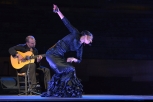 Mercedes Ruiz. Ruiz, dressed in black, male garb performed accompanied only by the singing and her own castanets and stamping feet. She was outstanding. The audience was well and truly captured by now, so much so that Ruiz could be playful, making us laugh as well as astounding us with her artistry. How could anyone top that?
 Well, then came Eduardo Guerrero, long black hair flying, in a stunning Cana. Guerrero’s arabesques were straight out of the Miguel Linan playbook, athletic, fluid and captivating. What was not was the truly amazing footwork which followed, which had the audience, by now half way to behaving like Jerezanos, applauding and cheering with every flourish. As a female member of our group said afterwards, he was gorgeous and absolutely commanding ( and the dancing was pretty good too ).
 as a young man, not the James Joyce novel but Tate Britain’s summer exhibition, on Vincent Van Gogh and his time in in south London. Van Gogh arrived at the age of twenty in 1873 and lodged in Brixton ( though it’s described here as Stockwell ) where he fell in love with his landlady’s daughter. He worked for two years at the offices of Covent Garden art dealers Goupil, before turning to both teaching and preaching, when he was dismissed from his job.
 paintings, drawings and washes, but also many works of contemporary, or near contemporary, artists who were living in London at that time or which Van Gogh would have seen while he was here. It includes works and prints which Van Gogh owned and there is cross-over here with the Tate’s winter exhibition of 2017/18
  Francis Bacon, who acknowledged their debt to Van Gogh ( see study, by Bacon, left, of his painting of Van Gogh in the sun-bleached landscape of the south of France ).
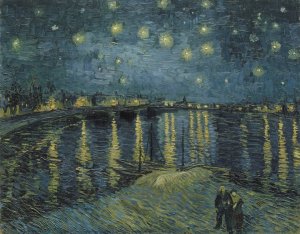 obvious, indeed they may seem tenuous to the untrained eye, though I have no doubt that the scholarship behind this exhibition is excellent.
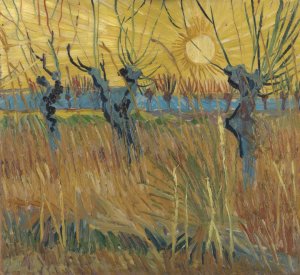 visited at 4 o’clock on a Friday, when we thought it would be quiet, yet it was anything but. Afterwards a steward told me that, in relative terms this was quiet! So beware the crowds. Entry costs £22, with concessions for students, seniors etc. and if you are not a member you will have to book. It’s well worth a visit.
 …is the name of an excellent, fascinating exhibition in Jerez de la Frontera (until 10th March) and Cadiz, from 21st March until 28th April 2019. I saw it at the Claustros de Santo Domingo, the 13th century monastery which is now an exhibition and performance space in Jerez. It is, in Jerez, FREE to enter and I recommend, if you are in the vicinity, that you go and see it.
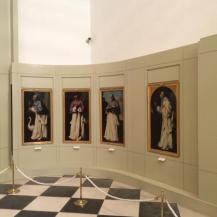 attempt to recreate the stunning light and shade of the originals, the chiaroscuro which earned Zurbaran the nickname ‘the Spanish Caravaggio’. The paintings are astonishingly clear and precise, with knife sharp edges to the drapery and the photographs capture this amazingly well. They also recreate the human portraits, often to great effect ( the modern faces taking on a timeless quality ). As the accompanying leaflet says, however, Zurbaran had only the ‘trickeries’ of paint and light to help him with his creations.
 For us another fabulous Festival de Jerez is over. We have all gone our separate ways, though performances at the 2019 Festival continue until next weekend. Yet again we have been astounded and amazed by the quality, as well as the variety, on offer.
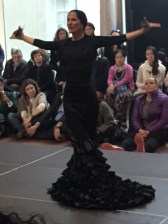 Sanlucar, re-interpreted by Santiago Lara as music director ( see
 remarkable Coy acting as muse, creative idea and, possibly creation. I do not pretend to have understood it all, but I enjoyed it a lot and look forward to see what this talented dancer does next.
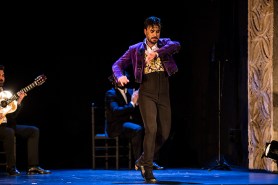 performance and out on the town. A terrific end to our sojourn at the 2019 Festival.
 In this case that part of it found in SW7. Specifically, the Flett Theatre (formerly the Jerwood Gallery) in the Darwin Centre at the Natural History Museum, to see David Morton’s new play about the young Charles Darwin, The Wider Earth.
 The drama catches the intellectual climate of the time, with Lyell’s geological theories already challenging Christian orthodoxy. Debate rages aboard the Beagle, stimulated by the presence of a clergyman, travelling to Tierra del Fuego to take God to the natives, as well as a native Fuegan, Jeremy Button, taken by Fitzroy from the south Atlantic to be ‘educated’ in Britain. It shows the experiences – of volcanic eruption, of earthquakes and mountain making, of the differences in species from the various Galapagos islands – which inform Darwin’s thinking.
 Julie Anderson