 The 2022 Clapham Book Festival is all but over. It began on a gloriously sunny autumn day on 9th October, walking around the Common on the Literary Trail, something which was repeated this Saturday last. It was a lovely day again, but, as the walk neared its end, the sky grew black. People dispersed and I headed for home to change for my afternoon session when the heavens opened. I got soaked through.
Undaunted, I dried, changed and strode off for Omnibus Theatre where the team had already gathered. Books were laid out for sale, mainly those written by Abir Mukherjee, with a few of mine too. This was the first afternoon session, which began at 3 pm. Abir was tremendous, a joy to interview, in that he has a huge fund of anecdotes and amusing tales which makes life very easy for the interviewer. He grew up in Hamilton, just outside Glasgow to Bengali parents and talked about schooldays tribalism – ‘Are you a Catholic or a Protestant?’ ‘I’m a Hindu.’ Silence, followed by, ‘Yes, but are you a Catholic Hindu or a Protestant Hindu?’. The hour flew by and there was little time for questions, but everyone was entertained and impressed. The books practically flew off the counter, all signed by Abir.
Given that I had been working since ten o’clock that morning, I took a rest and didn’t go in to see Dame Jenni Murray, in conversation with Elizabeth Buchan, but members of the sizeable audience seemed very appreciative as I took in flowers and chocolates for the participants. The contents of the book table, meanwhile, had been swapped over, to hold Dame Jenni’s and Elizabeth’s books, which were being bought with enthusiasm.
 The cafe/bar at Omnibus had been packed all afternoon, not just with Festival goers, but also a ‘New Mums n’ Dads’ club meeting, but this ended by about five thirty, which was a relief, as we knew we had a completely full house that evening for Sir Antony Beevor and Dr Piers Brendon. The Cafe/bar is a super space, but it would be creaking at the seams with eighty Festival folk, let alone the new parents. We need not have worried. Although crowded, this leant the whole evening an excited buzz.
Ably steered by Dr Piers, Sir Antony exhibited a comprehensive knowledge of all things Russian and the remarkable ability to render the very complicated accessible and easy to understand. Why did the ‘Reds’ win the Russian Civil War? What did he think would happen in Ukraine? Why was the Russian Civil War so full of atrocities and were we seeing a repetition in Ukraine? The hour, as with Abir Mukherjee, flew past, though for different reasons, this was intellectual engagement of a high order. Afterwards the queue for both presenters was long, with people anxious to get their books signed before the evening closed.
But that wasn’t the end. Last night (Monday 17th October) the first of our online events took place.  Hosted by Lucy Kane from media partners Time & Leisure Magazine, I was ‘In Conversation’ with West Camel, a local novelist. West’s first novel was listed for the Polari Debut Prize and long listed for The Guardian’s ‘Not the Booker Prize’ Prize. We had a very enjoyable time chatting about his latest novel ‘Fall’ set in Deptford, brutalist architecture, magic realism and twins.
There’s one more online event, on 22nd November, when the conversation is with local, award-winning travel writer Shafik Meghji about his book ‘Crossed Off the Map; Travels in Bolivia’. Tickets are only a fiver and I can guarantee the quality of the discussion.
If you want to listen to last night’s broadcast click here.
 Today’s the day and ‘Opera’ is let loose upon the world. There are, already, plenty of posts on social media – Twitter mainly, but Insta and old favourite, Facebook, too – I haven’t ventured into the unknown territory of Book-Tok or the dragon-lands of Twitch and Discord ( no, me neither ). Kelly Lacey at
  Clapham Society Newsletter (circulation about 1,400) though I know there are a number of print critics who will be reviewing the book. These are in the regional press, or in literary publications, no national dailies ( without a prize listing or a shed load of publisher’s support, i.e. money, that is unlikely ). There are regional and local broadcast interviews lined up too, starting with Radio Tamworth ( Tamworth Books ) on Wednesday and following up with local radio here in south London.
 There are plenty of online events arranged and ‘Opera’ and I should be reaching audiences from Devon to the north of England, through regional library networks, like Devon or Staffordshire Libraries. I’ll also be doing some Festivals, live as well as virtual, not just the Clapham Book Fest, which takes place in October, but also Newcastle Noir ( 9th – 11th December ) as well, as, potentially, a number next year. Indeed my diary for 2023 is already being filled with online talks and discussions and live events, some of them for societies and clubs which I have visited before with ‘Plague’ or ‘Oracle’. I never imagined I would be doing quite so much.
 Helen and Sue ( they know who they are ). Also to my fellow authors who have been kind enough to wish me well on this Publication Day and to the bloggers and supporters, who, unpaid, contribute so much to the life of books. Finally thank you to my longsuffering husband, who cooks the meals and makes the tea while I am away in my head concocting yet another mystery.
 In April of this year I posted a piece about images of Tosca ( see ‘
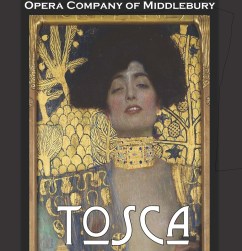 The artist most associated with Tosca, partly because he designed many posters for the Comedie Francais, where Bernhardt performed, and partly because his style is such a good example of Art Nouveau is probably Alphonse Mucha. Even the Hohenstein poster for the opera’s premiere in Rome in 1900 owed much to Mucha’s style. But his is not the only style which was copied and often other artist’s works were rifled for use on the posters. See the use of the Gustav Klimt’s ‘Judith’ in the poster for Middlebury Opera’s production (right) .
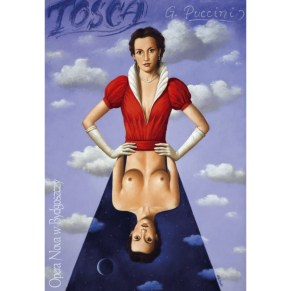 I found a very striking poster from Poland, probably for a production by the opera company of the city of Bydgoszcz which was very reminiscent of the style of Frieda Kahlo (see left). It drew many comments on social media and divided people, they either loved or hated it.
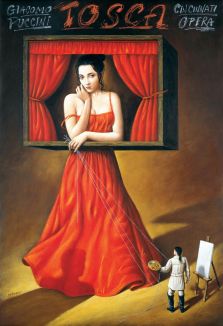 colour in the poster. I’m not sure if this was a sneaky subliminal message, but it is certainly surreal and I do not pretend to understand it, though it seems to be trying for an analysis of the opera at a subconscious level – Tosca pulling Cavaradossi’s strings.
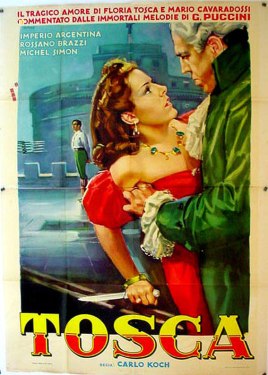 life, so there are plenty of leering Scarpias and retreating, suffering Toscas, though often clutching a dagger. The Italian ones are even more lurid than the Hollywood ones ( I suspect because Hollywood treated it as ‘high art’ ), but here is a more restrained offering – ‘The tragic love of Floria Tosca and Mario Cavaradossi commemorated in the immortal melodies of G. Puccini’. The director, ‘Carlo Koch’ is actually the noted German art historian and film director, Karl Koch, who undertook the film in 1939, jointly with Jean Renoir, at Mussolini’s invitation. Koch was Renoir’s assistant on Le Regle de Jeu
 and Renoir was instrumental in getting Koch out of Germany in 1936. Renoir eventually withdrew from the film, but Koch completed it, together with his assistant, one Luchino Visconti. Incidentally Koch and his wife settled in Barnet, north London once the war ended.
 The
The 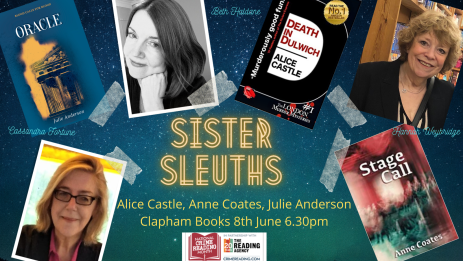 south London – Clapham in my case, where Cassandra Fortune lives, Dulwich, home of Hannah Weybridge in Anne’s series and Dulwich, Herne Hill and Belsize Park, among others, for Beth Haldane in Alice’s. The tales range across the capital, taking in Westminster, Theatreland, Fleet Street and the yummy mummy nappy valleys of south London as well as rather less salubrious locations, like King’s Cross and Elephant and Castle.
 First stop on the ‘Sister Sleuths’ tour is at
  is already five books long and Alice’s Beth Haldane (and her on-off boyfriend DI Harry York) has appeared in even more, beginning with Death in Dulwich. I am lagging behind with only two, though that will be increased in the Autumn when Opera, the third Cassandra Fortune is published.
 First at the famed
  fabulous side room wall-papered with posters of previous performers. It’s terrifically nostalgic and much time was spent spotting bands we recognised or knew from more youthful days. Zelda Rhiando, herself a published writer and the organiser of the Jam, was there to calm our nerves and point out the beers in the little fridge and the bottles of wine. I swore not to touch a drop before I went on.
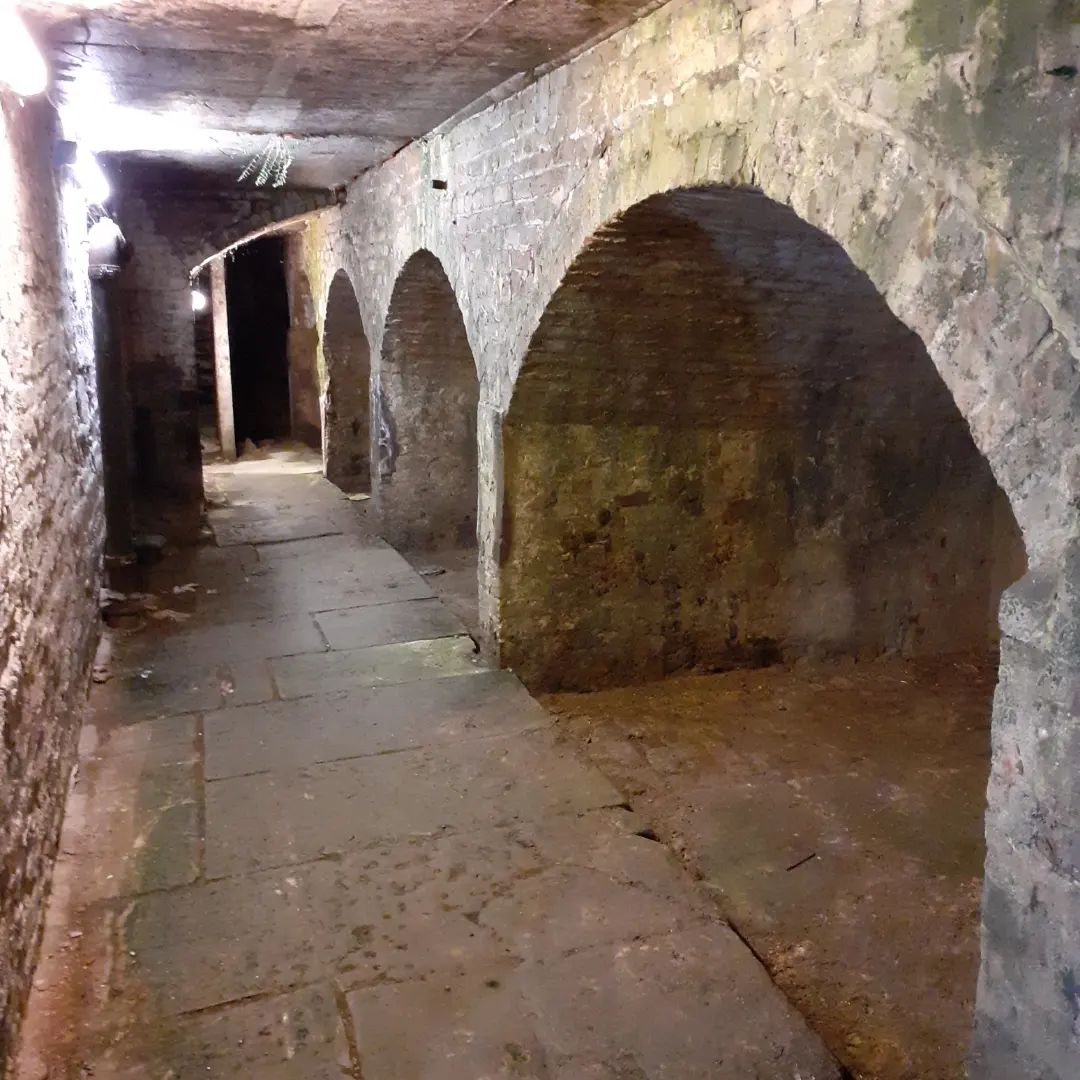 Brixton Book Jam was not my only interesting night on the town. Only three days later I attended the first meeting of the London chapter of the
  out of the prison down to the prison hulks moored on the Thames. They would then be removed to the transportation ships bound for Australia. The pub was, Anthony informed us, one of the most haunted in London. But the writers’ imaginations were already hard at work and one of us was already speculating aloud about a crime plot using the tunnels. This is, I guess, the sort of thing that happens when a group of Crime Writers gets together. I’ll be looking forward to the next meeting.
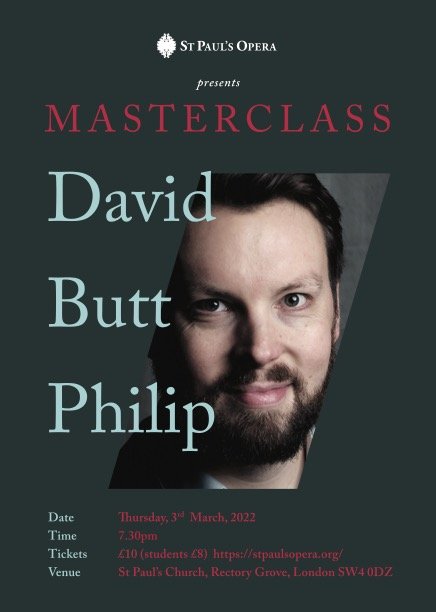 In particular the language we use when we talk about singing.
 to the crescendo, was described as the ‘luxury version’. ‘Don’t be polite, don’t apologise for the note’ signified not to sing it lightly, not giving it due sound, but to sing it loudly, the quality of loudness being needed in a theatre. Also, ‘complete the note’, indicated holding it for as long as necessary. Easily understood, though less easy to define.
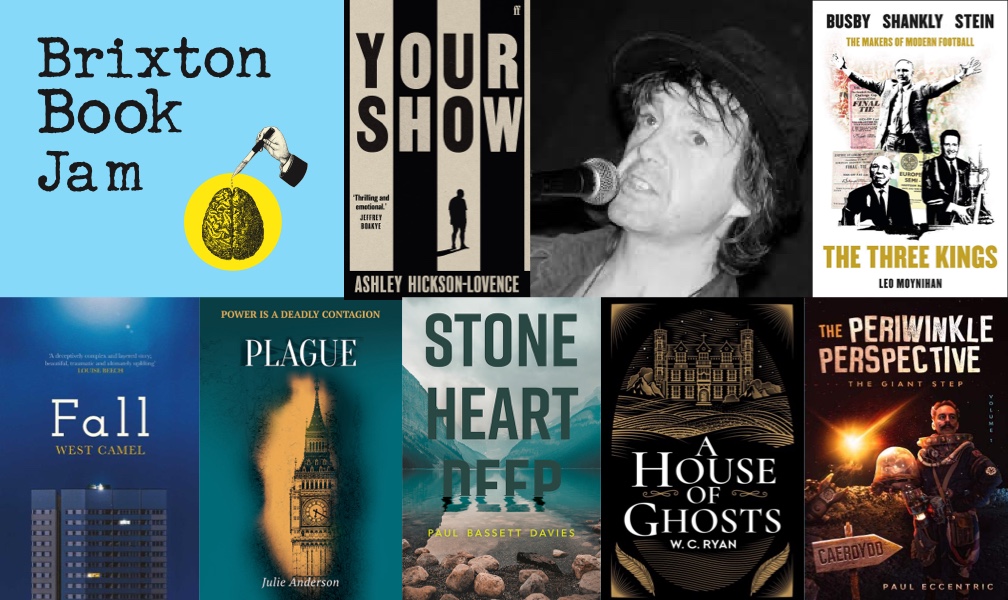 It’s at the Hootananny, 95 Effra Road, Brixton, SW2 1DF and doors open at 7.30 pm on 7th March, where I’ll be appearing alongside William Ryan, Ashley Hickson-Lovence, Leo Moynihan, West Camel, Paul Bassett Davies and Paul Eccentric. It’s free to attend and there’s booze and books on sale. If you’re in south London why not come along?
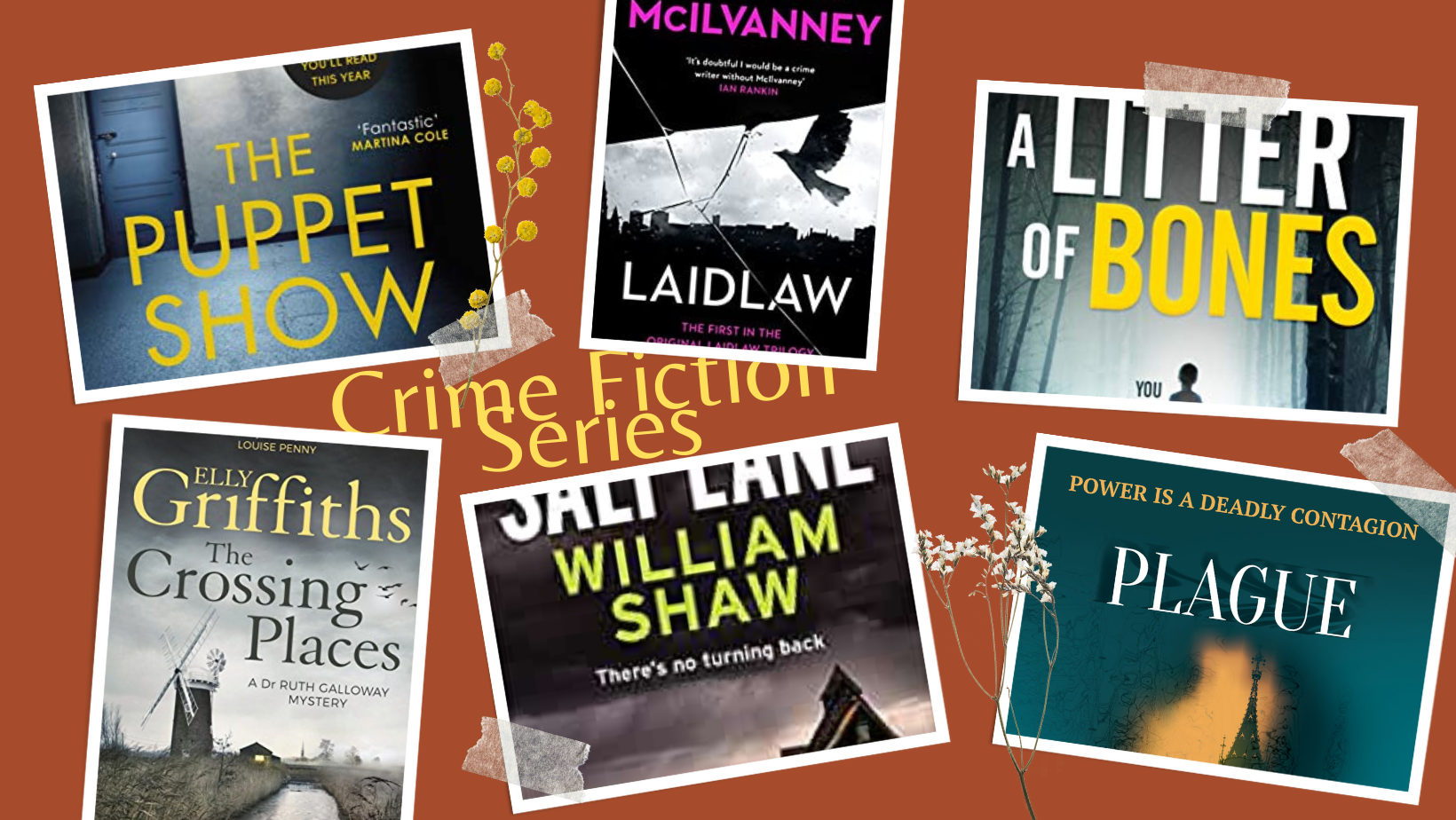 I recently wrote a piece for Time and Leisure Magazine recommending the first books in a number of crime fiction series, each series running to between three and thirteen books at time of going to press. A good series is a fine thing in deep mid-winter, especially when one isn’t going out so much and I know crime fiction readers, in particular, are always on the look-out for ones they haven’t tried yet.
 fiction the puzzles must differ and the twists must be new, or at least fresh. The contexts and locations can change (at least I can send Cassie anywhere, she isn’t tied to a place or one type of job) but there’s a risk that, in trying to introduce new thrills, dangers and surprises a story can become too contrived, or unbelievable. There is also a delicate balance to be struck, readers want some more of the same, as well as something different.
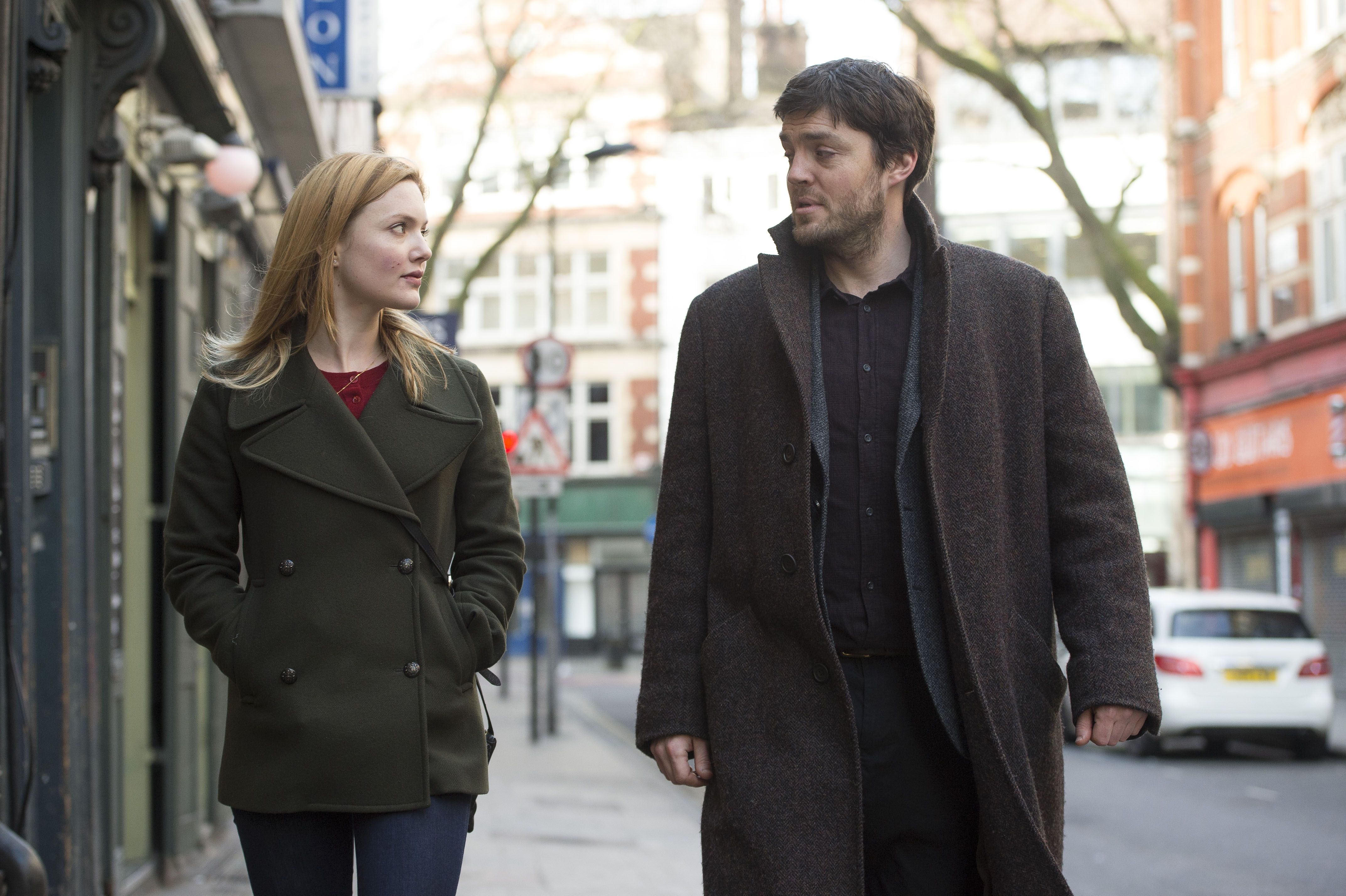 Some of the most addictive crime series are linked by an ongoing and developing relationship, often of a romantic nature. So, when, if ever, will Cormoran Strike and Robin Ellacott get together? The same goes for Dr Ruth Galloway and DCI Harry Nelson (I haven’t read all the books in this series yet). Readers are attracted by the crime puzzle and stay with the series to follow the relationships. Having killed off my potential romantic lead in my first book (and there are readers who still haven’t forgiven me for doing that) and made the central relationship of the next two books as being between two people who can only destroy each other, precludes that from happening to Cassandra.
 ‘Gird up your loins‘ is one of those recognisable phrases, but one can’t quite remember where from. In my mind it’s close to ‘Screw your courage to the sticking place‘, although I know that’s Lady Macbeth exhorting her husband to be bold and resolute. Both mean to prepare for the task ahead. In fact it’s from the Bible, where it’s used on a number of occasions, mostly in the Old Testament. In the New Testament we find ‘Wherefore gird up the loins of your mind, be sober, and hope to end for the grace that is to be brought unto you.‘ from 1, Peter, 1:13. So, it’s about getting ready, bracing oneself for the future.
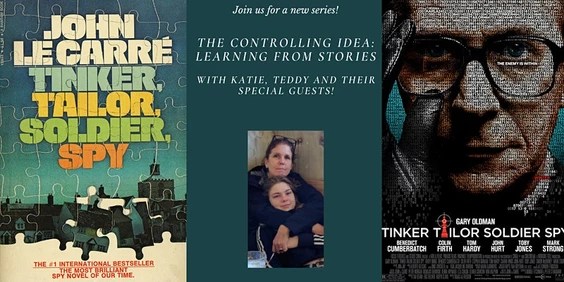 year ahead. Despite the COVID prompted cancellation of several events outside of London which I was to attend, I’ll still be busy on zoom, starting with a discussion on 17th January for Royal Borough of Kensington & Chelsea Libraries. ‘The Controlling Idea’ is a series of discussions sponsored by my publishers, Claret Press, about books which have been made into films and the first is about Le Carre’s Tinker, Tailor, Soldier, Spy. This is where I come in, as an expert guest, talking about Whitehall and the structure surrounding the security services, it’s where Opera is set, after all.
 In addition, I’ll soon be finalising Opera for the last time, for publication in September, going through the final proofs, the front and back matter and so on. There is a publicity schedule to be agreed with Claret Press too, including an online book tour and dispatching review copies, plus all the events around a book launch, including talks for libraries, book clubs and societies and, COVID permitting, an actual book tour of real bookshops. It’s exciting. Especially as Claret has a new distributor. We are already talking about flyers being handed out at Westminster and Vauxhall Cross Underground stations – an idea originally for the publication of Plague which got completely derailed by the initial outbreak of COVID. Of course, at the same time, I’ll be continuing to publicise Oracle and Plague.
 committee meeting is later this month when we hope to be able to discuss the potential programme for the event. A date for your diary is 15th October, our flagship Festival day, though we’ll be planning events around it, probably including another literary walk in Clapham and some events online with our media partners Time & Leisure magazine before and after the Festival Day.
 First, Hag-Seed by Margaret Attwood, one of the Hogarth Shakespeare series of retellings of Shakespeare plays and published back in 2016. I’d been keeping it in Spain to read there but, given that I’ve always been writing when in Spain I’d never got around to reading it. I have now and I’m very glad I did. Set in a Canadian Correctional Facility this is both utterly different to The Tempest and absolutely true to it. It manages to be a recreation as well as a commentary on the play via the means of a ‘play within a play’ something very Shakespearean in itself. It is criminally easy to read ( within a 24 hour period for me) and is also funny! An absolute must read.
 Papers of Tony Veitch and Strange Loyalties). Written in the 1970s and 80s and recognised as the precursor to that wave of amazing Scottish crime-writing talent which followed – think Ian Rankin, Val Macdermid, Denise Mina and many others – these show a many-sided Glasgow, from aspiring suburbs to crumbling tenements through the eyes of Jack Laidlaw, philosopher cop and almost as hard as nails. McIlvanney is a true heir of Raymond Chandler, the prose jumps out at you and slaps you round the face, before sliding slowly away, drawing you ever further in after it.
 women at the centre of the first village witch trials during the English Civil War in 1645. Focusing on Rebecca West, daughter of the fearsome and belligerent Beldam West and the arrival of young Matthew Hopkins, the man who will become the Witchfinder General, we are treated to a rich portrayal of the fault lines exposed in a rural village during a period of famine and war.
 a fiendish mystery to solve and, because it’s important to me, a strong sense of place. William’s Shaw’s Salt Lane (2018) the first of his Alex Cupidi series is set on Romney Marsh and the area around it. Aside from being a cracking crime novel it tackles difficult issues, like immigration, refugees and rural poverty. These crimes are grounded in modern reality with immediacy and authenticity, I will certainly read more.
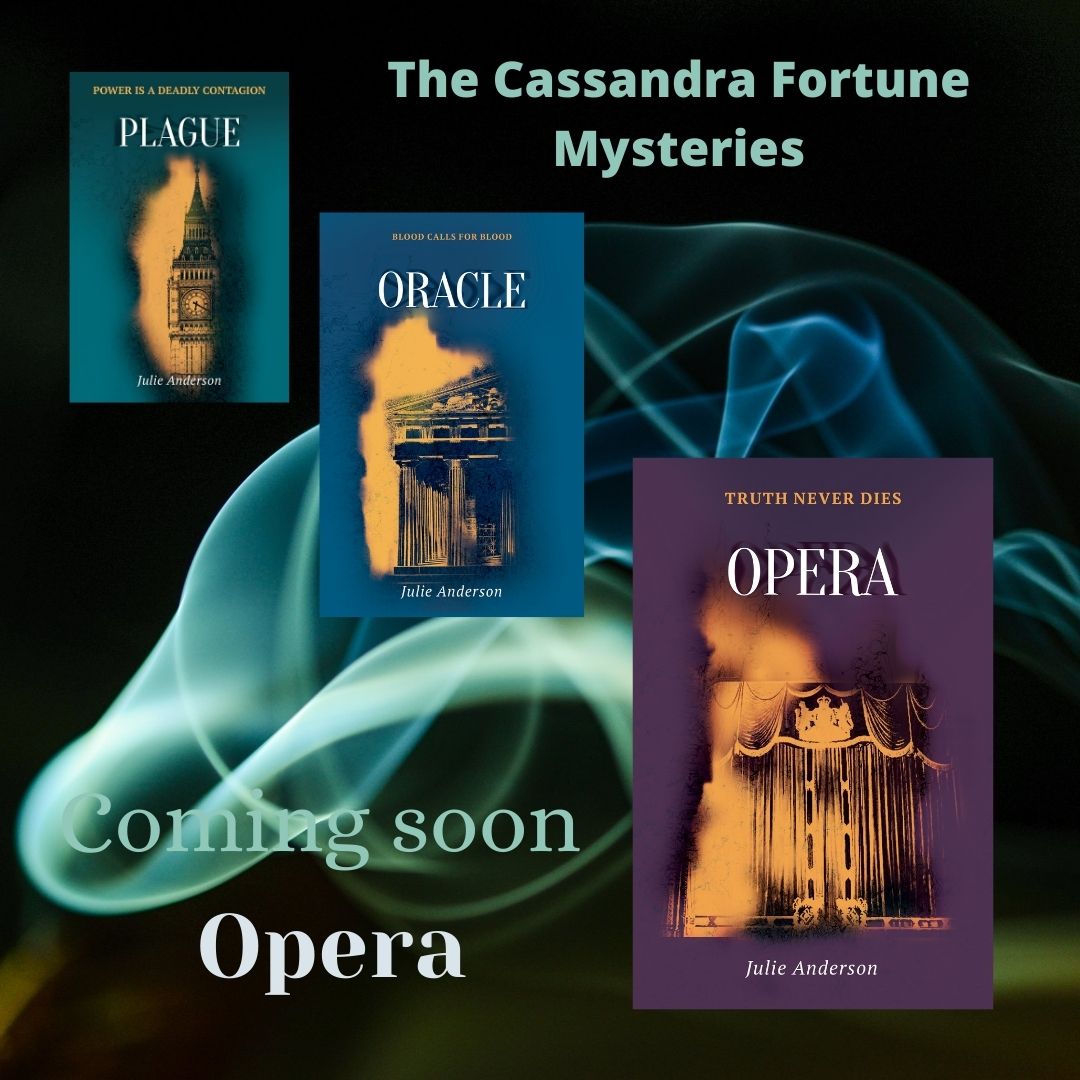
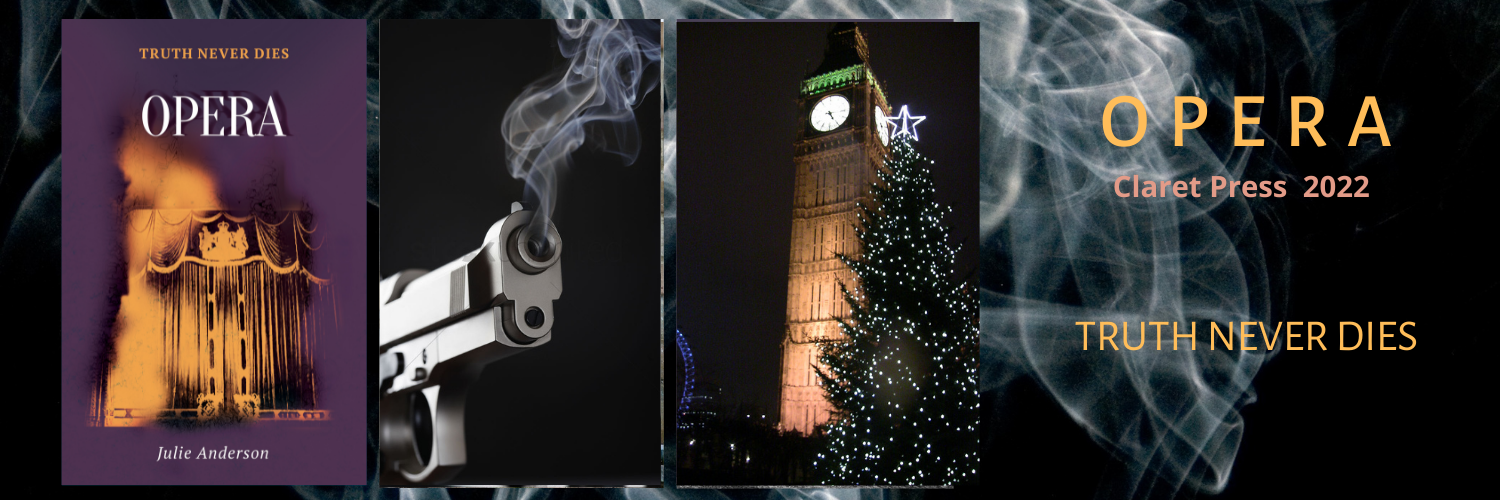 two other images set against an atmospheric background and with the tag-line in bold. This was the tenth version! Others were rejected as ‘too feminine’ and ‘insufficiently threatening’ (see the images below). I had to choose between the Downing Street sign and Big Ben too, because both weren’t needed, so I went for night and the Christmas tree, with the addition of a smoking gun! Readers of Plague and Oracle will know that each book takes places over a fixed period of time and they follow one after another, with about a month in between. Opera
 does the same, so its events happen during the fortnight before the Christmas holiday. It was only when we were playing around with the designs that the tag-line ‘Truth Never Dies’ finally emerged, though it seems particularly appropriate at the moment. GIFs will be my next challenge, but a couple of mini-MP4 videos have already been produced, building on the ‘smoking gun’ imagery (these are being kept under wraps, but see below for my Instagram post). All part of the package pre-release of the book and for distribution to the book bloggers who will review it and post reviews on social media. Animated pictures, whether on Instagram or other SM have been
 shown to have greater impact and attract more attention than non-animated content – including the attention of the algorithms which determine which posts get shown first when a hashtag is used. Good news therefore for publicists.
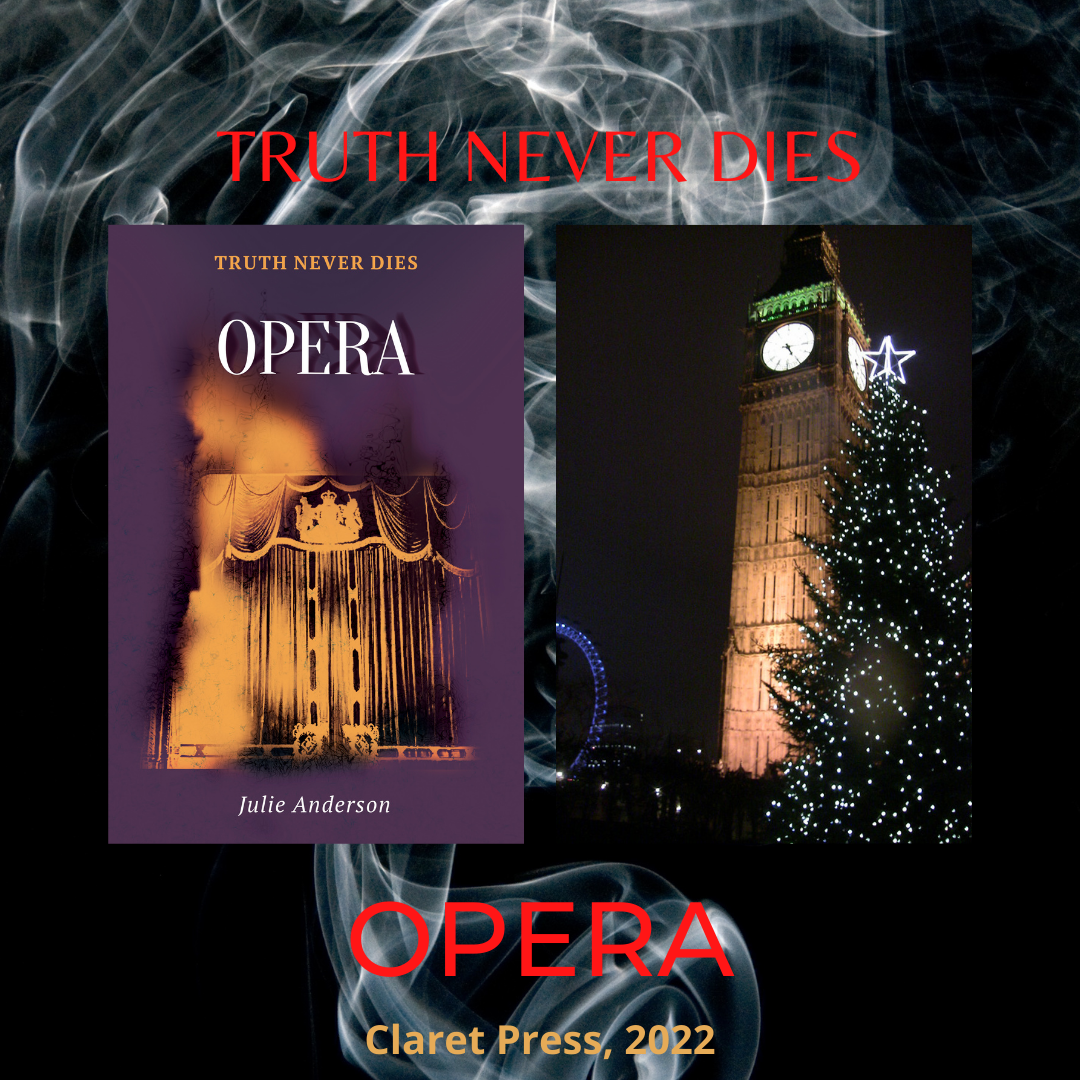 Claret and I will sit down in the New Year and agree a full publicity strategy, including pre-release publicity, whether or not to use NetGalley again (probably not), whether or not to have an online book tour (probably) and, COVID permitting, a schedule of actual bookshop signings. Publication date has been agreed as 5th September and both ebook and paperback versions will be available for pre-order in Spring. The author events with libraries, online and in person, are already being arranged. And, with Claret Press about to sign with a new distributor, this time my book will be launched into bookshops across the UK. All good news. So here is the design for my Instagram feed. Maybe next week I’ll be back to editing.
 Julie Anderson