No, I didn’t know either. At least I knew nothing of it until I looked it up.
Zemiology is the study of social harms, from the Greek zemia, or harm. It’s a relatively new academic discipline, which grew out of critical criminology and it  seeks to generate real world action in pursuit of justice.
That’s where I come in, as justice is the theme of Oracle. I found out more when I had a chat with Sharon Hartles, of the Open University’s Harm & Evidence Research Collaborative (HERC). She is also a member of the British Society of Criminology (BSC) and a researcher and postgraduate with the University of Strathclyde. A published critical criminologist, Sharon is currently conducting research on Primodos.
As I understand it, too often the crimes of the powerful are difficult to address under our current law and legal system, referred to as ‘black letter law’. Actions which have a harmful impact on others in society, like ignoring safety regulations ( or watering them down ) in pursuit of profit, or despoiling the planet, are not ‘crimes’ in law ( though they may breach certain regulations ). As an example, even after the appalling events at Grenfell Tower there are still no prosecutions and, indeed, it is becoming difficult to find a ‘crime’ with which to prosecute anyone, individually or as representing an institution or corporation. Yet facts were known, the wishes of the residents were ignored and the likelihood of fire foreseen.
Thus,  events like Grenfell become referred to as a ‘tragedy’ or a ‘tragic accident’, yet they were foreseeable and avoidable and these events and others like them will continue to occur until the law adapts to make punishment of those who enable such events both possible and direct. Zemiology presupposes that isn’t likely to happen, as the powerful have co-opted the law and the legal system to protect their power and interests. An idea not unfamiliar to readers of Plague.
Sharon was a mine of information about this new discipline. I think it’s going to have to feature somewhere in Oracle, probably among the young idealists protesting against environmental damage who Cassie encounters at Delphi. Perhaps the charismatic protest leader is a zemiologist? We shall see.
I await the return of the final edit of Oracle, which has to be fully revised and returned to Claret Press by 31st January, complete with drawn image. I sketched the Palace of Westminster for the pages showing the start of each ‘daily’ section in Plague and I have undertaken to do something similar for Oracle, as that too is organised over a small number of days. Something I’ll be thinking about over the  Christmas period.
Good news from elsewhere, however, as I learn that the recording of the audiobook of Plague has begun. I will write separately about this as it nears completion, suffice to say for now that Essential Audiobooks of New York are producing the audio book which is being read by actress, voice coach and associate of the Royal Shakespeare Company, Alison Bomber. Alison has just moved to the Czech Republic, but is already working on the recording. More on this later.
 For now, may I wish everyone reading this a happy and peaceful Christmastide, where ever and with whomever, you are managing to keep it. Here’s hoping for a much better 2021.
 Phew! I finally get to look forward to Christmas after the whirlwind of activity – talks, discussions, events, giveaways – which has accompanied the publication of my first crime thriller back in September. All something of an eye-opener to this writer, whose adventure books set in 13th century Spain never generated this much activity and interest. Even in a world reduced by COVID I’ve been very, very busy, almost always online. It’s been tremendous fun, by and large, and I’ve worked with and met some great people, online, on social media and, not least, the readers of my book.
 from a U3A crime fiction reading book group who have chosen Plague as their book for March and want me to do a talk for them, which I’m happy to do. The Royal Borough of Kensington and Chelsea and Westminster people also seemed pleased, they have asked me to do another talk in January, this time about ‘Politics and Prose’ – political fiction in a time of increasing citizen journalism and social media commentary. That’s something I’ve blogged about in the past ( see
  genuine enthusiasm shine through. I’m definitely more comfortable when interacting, either with other speakers or with questioners. That is, in part, why the Secrets of Subterranean London discussion worked so well. If you haven’t watched it, you can find a link
  Fortunately, it worked out well.
 Like any place inhabited by humans for centuries, London is a multi-layered city, its history piled up beneath the feet of the people who walk its streets. This was the subject of last night’s tremendous discussion with Dr Tom Ardill of the Museum of London and award-winning Blue Badge Guide Fiona Lukas.
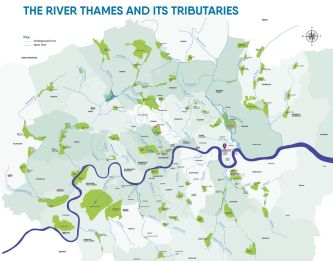 that, by the thirteenth century Londoners of the City were seeking for a fresh water supply further afield and they lighted upon the Tyburn. In order to bring its waters to the City they constructed the Great Conduit which ran south then east across London.
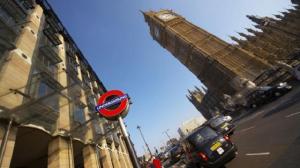 Fiona’s description of the modern travails of London Transport with new London Underground stations was very interesting, especially the example of the new, very deep and very modern, Westminster station . I never knew that the two District line tube tunnels were on top of one another not along side, but, when I thought about it, this made sense of the way the inside of the station was designed. I certainly wasn’t aware of the difficulties encountered because of the proximity of the station to the Houses of Parliament, not least the secrecy about why designs for the new station were repeatedly vetoed.
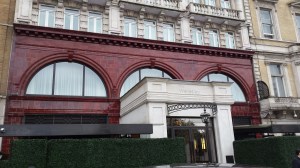 where Churchill’s wartime cabinet used to meet when the Cabinet Office War Rooms were unavailable, or Brompton Road. There is also Aldwych, formerly Strand, a station I used to walk past every day on my way to work in Bush House, close to, yes, a bona fide Roman Baths.
 Actually, there were twelve of them, all members of the UK Crime Book Club, from Perth to Hampshire, Denbighshire to London and many points in between. Twelve signed copies of Plague have been parcelled up and despatched.
 Craven, former CWA Dagger winner, who is currently sitting atop the Best Seller lists with his latest crime thriller ‘The Curator’. A darling of the UK Crime Book Club, ‘The Curator’ has just been voted the Club’s Book of 2020. Good fortune again that it was an easy question for me to answer ( so not about writing best sellers then ) and something of an honour for this crime writing debutante. The whole hour whizzed by, with people sending in questions via Facebook – and telling me that they’d bought the book, which was very good news.
 There was one small problem, one individual, a gentleman from Wales, didn’t respond to my messages of congratulation, indeed, didn’t respond at all. I left it a couple of days and then contacted the Facebook site administrator and said that I would try once more but might need their help. Fortunately, my message yielded a result, though not the expected one. A few minutes after I put up my plea I received a reply from a woman – ‘Dad! You won!’.
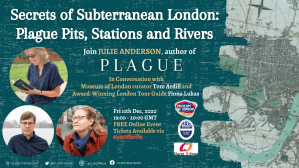 Claret Press is organising an online event which may be of interest to readers of this website. On 11th December, from 7 – 8 in the evening, I will be speaking with Tom Ardill, Curator at the Museum of London and Fiona Lukas, award-winning Blue Badge guide and expert on the London Underground.
 the time. Did you know, for example, that there is a Tyburn Angling Society, set up to try and ‘restore’ the river so as to fish in it ( an almost impossible task since it has been subsumed into Bazalgette’s wonderful London sewer system, but a charming, if quixotic, idea )? He is also a fellow river traveller, having followed the course of the Tyburn, as I did, but taking the southernmost arm, down to Pimlico and he ran it, rather than walked. You can read about his run
  The other contributor is Fiona Lukas, an award-winning Blue Badge Guide, ( she was Guide of the Year for the City of Westminster and City of London ) whose speciality is London Underground. She regularly hosts the popular tour The Lure of the Underground ( listen to her podcast about it
  the novel, although I expect Tom to have far more knowledge than I about the Tyburn itself. I’ll be touching on Plague Pits, Roman Remains – like the baths at North Audley Street, completely unmarked on the surface, the Great Conduit which runs along Oxford Street and, of course, the Palace of Westminster, with all its idiosyncrasies.
 looking forward to participating in the UKCFBC Pub Quiz ( Just Not In A Pub ).
 which keeps my publisher happy ).
 Thus far, into its eleventh month, and 2020 is the year of fear. It began well enough for the UK. The out-break of an unknown ‘flu-like virus in faraway China making only the end of the foreign news. After all, we’d had bird-flu SARs and MERs and it seemed that the ebola outbreak in West Africa was now under control. Nothing to worry about in Europe. Our concerns were of a different kind, for many just dealing with the daily grind in an society increasingly uncaring and nastily polarised, for others the approaching exit from the EU.
 and April. We know a lot more about the virus than we did and, it seems, there is a vaccine coming over the horizon sooner than was at first thought possible. With the defeat of Donald Trump in the recent US Presidential election it seems that those who deny reality, thereby both belittling and increasing the suffering and death of many, are in retreat. There was much rejoicing (and some relief) in this house when Pennsylvania declared for Biden.
 But this doesn’t sit well, I am a glass half full sort of person. On a personal level this year has been good. My first crime thriller was published and well received. I have almost completed the revision of the second. My life, albeit indoors at home, is full and, generally, rewarding. There are many worse off than me.
 friends, via zoom if not in person. Carry on with work as best one can, taking as few risks as possible. It really is ‘Keep Calm and Carry On’, maintain one’s human decency and not give in to fear. That’s all one can do.
 It’s November – remember, remember – and the next lockdown has started in England. Not that it’s too draconian a lockdown, with schools and colleges continuing to function, as well as manufacturing industry and construction. Restaurants and other shops are allowed to open for takeaway only. This includes book shops and my local independent, Clapham Books (logo left), remains open for collection of orders, though not for browsing ( additional copies of Plague were delivered to them this morning, to replenish stocks ).
 people to buy books via their local book shop rather than through the corporate giants.
 Another excellent authorial initiative, one which I missed, is the Children in Need
  Oracle, the next book in the series following the adventures of Cassandra Fortune, is set in Delphi, Greece near the Temple of Apollo. When revising it recently I revisited some old favourites, the gods and goddesses of ancient Greece.
 dominant.
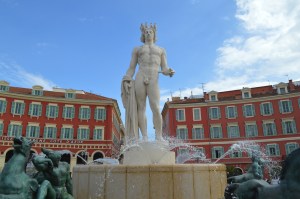 primordial mother, have been found in Delphi, in the Corycian Cave above the Temple to Apollo from the Neolithic period (about 12,000 years ago). Gaia and her daughter, Themis, ruled at Delphi and there was a chapel to her there, though it was long ago absorbed into the larger Temple complex. As Nico, the museum employee in the novel, explains, in legend, the god Apollo arrived at Delphi to wrestle with the Python, the giant snake belonging to Gaia, and won; so he became the ruler of Delphi. It is thought that this represents a change of dominant culture as migrants, whom we now know as the Hellenes, came into Greece from the north. They eventually settled all of Greece and their gods were the Olympians.
  Nonetheless the older gods continued to exist along side the new, as did their off-spring (unless they were thrown into the pit of Tartarus). These included some groups, or sets, of minor deities, like the Fates and the Furies. The latter trio, called the Erinye, were three women, often, especially in more modern times, portrayed with snakes for hair and flashing eyes, their hands dripping blood. The image, right, is of Clytemnestra attempting to wake the slumbering Furies to chase down Orestes in the Orestaia on a vase dating c.350 BCE. Delphi, it was believed, was the centre of the world and it is to the Temple of Apollo there that Orestes flees, calling upon the god to save him from the Furies.
  I don’t know if the books which I read are still read today, I hope so, even as new games and films bring the ancient heroes and deities to life for another generation. This Pantheon is firmly anchored within western sensibilities. So much so that we even replicate the old jokes in new ways ( see image left ).
  There are so many ways in which place is important to writers – we explored the subject in the first Clapham Book Festival back in 2016 ( see
  Elephant & Castle tower block. The Victorian streets of Clapham are home to my protagonist, while homeless character, Spikey Fullman haunts Shepherd’s Market, but bemoans the recent changes there as not conducive to a good night’s sleep. The venerable Palace of Westminster is a focal point, as are the streets close by – the Georgian terraces as well as the concrete civil service buildings. There are vistas from and of towers and high rises as well as the scenes beneath the earth and the main players walk all the major Westminster thoroughfares between Whitehall, the Embankment and St James, Bond Street and Pimlico.
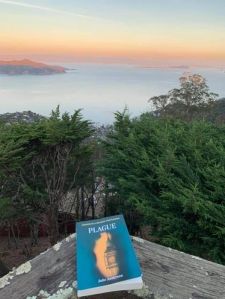
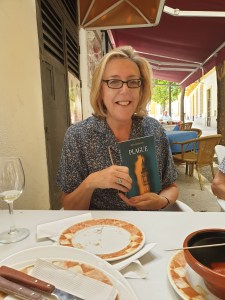
 One point to make about Plague is how far it has travelled, only six weeks into its published life. I have received snapshots of it on the Isle of Skye, in deepest Dorset, in the flatlands of East Anglia and in various parts of the north of England. I have yet to see it in Wales, Scotland or Northern Ireland (though I know it has been read there, because I have seen reviews on Goodreads and Amazon from readers who live there). Plague has also travelled internationally, from the lawn of a Normandy chateau (left) to a Californian balcony over-looking San Francisco Bay (above), from an American Naval Base to a tapas bar in Jerez (admittedly, that one, below, was with me).
 entered the novel for the Ondaatje Prize. This award from the Royal Society of Literature is for a work of fiction, non-fiction or poetry, evoking the spirit of a place. The 2019 winner,
  I, meanwhile, am busy writing the sequel (earlier this week while awaiting a late flight at Sevilla airport, see left, which prompted the thoughts for this article ). Oracle takes place in a very different location to London, at an isolated cultural centre half-way up Mount Parnassus in Greece, close to the ancient site of the Temple of Apollo at Delphi. It is a place both very dramatic and beautiful and is timeless. Its location is central to the novel, not just to the plot, but that’s because place is very important to me as a writer.
 Julie Anderson