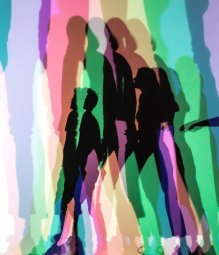
 …exhibition by Olafur Eliasson In Real Life at Tate Modern. It ends on 5th January, so if you live in or near to London and have a little spare time I strongly recommend that you go (but check ticket availability first, this is a VERY popular show and there are only a few days left so tickets might be hard to come by ).
People may remember Danish-Icelandic Eliasson’s brilliant, single The Weather Project bringing sunrise to the Turbine Hall of this same gallery some years ago and he has returned since then with his blocks of Greenland ice melting on the Thames-side forecourt in Ice-Watch to illustrate and draw attention to global warming, but this is 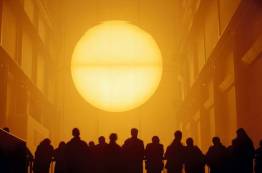 a major show. It can be found on Level 2 of the newer part of the Tate ( although there is also a waterfall/fountain to be seen outside in courtyard ).
The first room is a collection of Eliasson’s models for larger works, often created with mathematician collaborator Einar Thorsteinn. Many of them are beautiful in themselves with lots of natural shapes, based, one imagines, on fibonacci sequences. One model is of a finished work Your spiral view (2002) shown later in this exhibition. Room 2 contains early works and already we see the cleverness and simplicity of Eliasson. Window projection (1990) has the silhouette of a window shone, in light, on to a wall. At first sight the viewer imagines the light is coming through a window from outside, but no, there are no windows it’s just a lamp with a cutout on its lens. In Rainwindow (1999) the artists  uses a real window but recreates the effect of the weather. These are typical of Eliasson’s interest in light and weather.
Room 2 also contains trickery in mirrors and glass, an insect’s eye glass and a mirror which is actually a hole. This leads on to the Kaleidoscopes Room ( via a very interesting corridor which challenges the senses – I’ll say no more ). Here there are hanging reflective spheres and a walk-through corridor of reflections. Thence to a room with a projected, slowly transmuting image – all calm and tranquillity – followed by a room full of energy in which viewers find themselves part of an ever-changing art work on one of the white walls. It is so simple it seems effortless, but of course it isn’t. Like Big bang fountain which is found in a small curtained-off 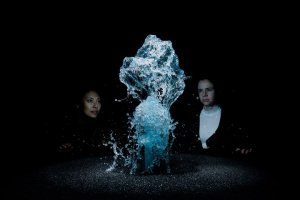 room with no light at all save for a periodic strobe which illuminates a fountain, freezing the water into silver metallic images before the viewers’ eyes.
This exhibition is child friendly and there were plenty there today, many eagerly experiencing the changing light and reflections, most especially in the room with the mirrored ceiling and an, apparently, circular sculpture. This exhibition is also great fun (but heels are not a good idea ).
There are serious points to be made with the twenty year sequence of photographs showing the withdrawl of the ice-cap in Iceland and very beautiful works capturing the impact of melting ice on paint wash and colour discs which use the palette from two of Caspar David Friedrich’s romantic nature paintings. In The Expanded Studio room we see the genesis and development of a number of projects, the design and creation of a solar powered light, the measuring of the disappearing ice and other environmentally engaged work, through film, artefact and notes.
It’s impossible to describe it all. Suffice to say that the visitor will come away with a new perspective on how one uses one’s senses, especially sight, as well as having learned a lot ( I certainly did ). I have been wanting to see this exhibition since it opened and I’m glad I caught it. I’m only sorry that I didn’t go before and could return again!
Olafur Eliasson In Real Life is at Tate Modern until 5th January. It costs £18 for non-members and is worth every penny.
For more on Art see Portrait of an artist Bonnard Colours Zubaran Impossible Light
 … that’s the time a potential reader gives to the cover of each book when scanning a bookshop display or online screen. So say the publishers. In that time the individual takes in the design, the title and whatever is written – tag-line or glowing review – on the front cover. If it doesn’t get their attention, their eye moves on to the next. So the pressure to make the cover arresting and appealing is intense.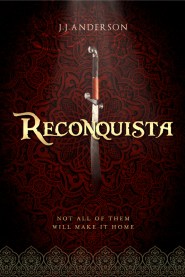
 Incidentally, both books in the Al Andalus series can be had half-price, for less than the price of a cup of coffee, at the Smashwords Christmas Sale which runs from Christmas Day until the New Year.
 2022! )
 Calling all lovers of books and reading! The countdown to the annual south London celebration of both has begun.
 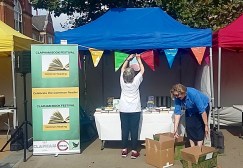 were, by and large, pristine copies at knock-down prices and some of them signed by the authors as well. One woman was delighted to find the signature in the book she had just purchased. We had a superb hand-made chocolate cake to raffle off as well (congratulations John, I hope it tasted as good as it looked).
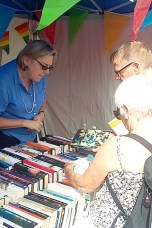 the events ( and having fun talking about books and writers ). Clapham Writers has at least three new members, who we hope to see at the Meet & Greet event after this year’s Fest.
 voucher for an overnight stay for two in that boutique hotel as a prize in our Festival day raffle. Last year’s winner was a Clapham resident who, as the occupant of a one-bedroom flat, was able to have his parents to stay by using the voucher. Thank you The Windmill and Young’s Brewery.
 the Society of Authors, in the Sunday Times On-line and in a veritable cornucopia of local media of various kinds. There’s also a podcast coming out on 1st October. Henry Hemming – Our Man in New York – had a double page spread in the Sunday Mail and Elizabeth Buchan – The Museum of Broken Promises – an excellent review in The Times. Aida Edemariam and Ursula Buchan won the plaudits when their books, The Wife’s Tale and Beyond the Thirty-Nine Steps, respectively, were first published. That’s not forgetting our opener – Professor Kate Williams on the relationship between the Rival Queens, Elizabeth I and Mary Queen of Scots – and Frank Gardner OBE, BBC Security Correspondent to close the Festival.
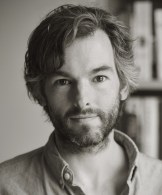 about, then reading from, his latest book Our Man in New York.
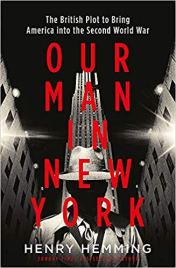 World War II espionage finally has its expert chronicler.”
 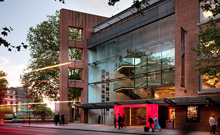 So to Sadlers Wells Theatre for the annual Flamenco Festival in north London. This time I had only returned from Jerez de la Frontera the day before and I went to see Santiago Lara and Mercedes Ruiz who hail from that city. I have written about this married couple before ( see
 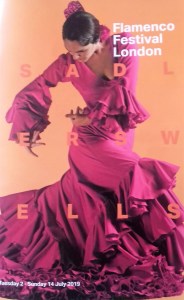 and Eduardo Guerrero, who I have tried to see several times at the Jerez Festival, only to be stymied by the schedule. Accompanied by rising singing star Maria Fernandez Benitez, known as Maria ‘Terremoto’, and male singers, Emilio Florido and Ismael ‘el Bola’. They were billed as the Gala Flamenca and it was excellent.
 The programme began with Morena dancing an alegria. As is always the case with British theatre audiences, while the dancing was well received, there was little feedback between performer and audience until the end of each piece. This contrasts with watching flamenco in Jerez, when the audience is supposed, even obliged, to clap, shout encouragement and cheer during the performance. I was very pleased therefore when a particularly spectacular series of steps ended with a sweeping flourish and a spontaneous cheer from the audience. I noticed Lara, who was nearest the edge of the stage, start to smile. The performance had ‘taken’ and the audience were bound in.
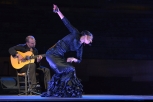 Mercedes Ruiz. Ruiz, dressed in black, male garb performed accompanied only by the singing and her own castanets and stamping feet. She was outstanding. The audience was well and truly captured by now, so much so that Ruiz could be playful, making us laugh as well as astounding us with her artistry. How could anyone top that?
 Well, then came Eduardo Guerrero, long black hair flying, in a stunning Cana. Guerrero’s arabesques were straight out of the Miguel Linan playbook, athletic, fluid and captivating. What was not was the truly amazing footwork which followed, which had the audience, by now half way to behaving like Jerezanos, applauding and cheering with every flourish. As a female member of our group said afterwards, he was gorgeous and absolutely commanding ( and the dancing was pretty good too ).
 LastSaturday my local church had its annual fete, smaller this year, as the event has grown in recent years ( see
 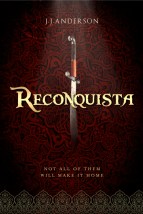 end of that month you can find J.J.Anderson’s ‘e’ books at a major discount. In the Al Andalus stories , Reconquista will be FREE to download until the 31st July. The next book in the series, The Silver Rings, will have 25% off RRP at $2.45 or less than £2. The Village; A Year in Twelve Tales will be discounted by 50% to $1.99 or £1.50. So, if you want to make a journey in the imagination on your holiday, why not travel to 13th century Al Andalus, or to a contemporary English village, you can do so for free or at a major discount on Smashwords as part of its summer sale!
 In the meanwhile it’s time to submit my latest manuscript to the publishers. A real departure from the historical adventures written previously, Plague is a contemporary thriller set in Westminster, which draws upon my own experience working in Whitehall and the rich history of Westminster and Thorney Island. On the basis that informed and independent criticism is worth its weight in gold, I have been fortunate enough to have the members of three different book clubs read the manuscript. Any author will tell you that, however objective your friends try to be, they will, invariably, be less critical than people who don’t know the writer
 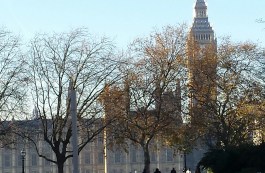 personally. Their comments have been insightful and very useful, helping me refine the novel before submitting it to the publishers. Now I await the editor’s comments.
 as a young man, not the James Joyce novel but Tate Britain’s summer exhibition, on Vincent Van Gogh and his time in in south London. Van Gogh arrived at the age of twenty in 1873 and lodged in Brixton ( though it’s described here as Stockwell ) where he fell in love with his landlady’s daughter. He worked for two years at the offices of Covent Garden art dealers Goupil, before turning to both teaching and preaching, when he was dismissed from his job.
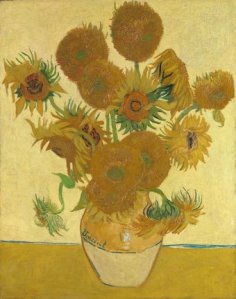 paintings, drawings and washes, but also many works of contemporary, or near contemporary, artists who were living in London at that time or which Van Gogh would have seen while he was here. It includes works and prints which Van Gogh owned and there is cross-over here with the Tate’s winter exhibition of 2017/18
  Francis Bacon, who acknowledged their debt to Van Gogh ( see study, by Bacon, left, of his painting of Van Gogh in the sun-bleached landscape of the south of France ).
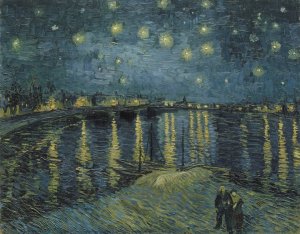 obvious, indeed they may seem tenuous to the untrained eye, though I have no doubt that the scholarship behind this exhibition is excellent.
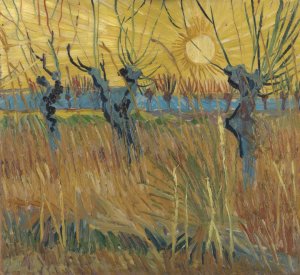 visited at 4 o’clock on a Friday, when we thought it would be quiet, yet it was anything but. Afterwards a steward told me that, in relative terms this was quiet! So beware the crowds. Entry costs £22, with concessions for students, seniors etc. and if you are not a member you will have to book. It’s well worth a visit.
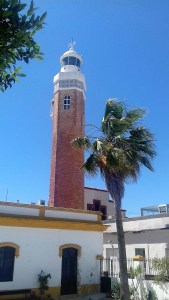 … the lighthouse or faro at Bonanza in Andalucia, to be precise, not Virginia Woolf’s Hebrides set novel of 1927. The fishing village of Bonanza is on the estuary of the Rio Guadalquivir as it reaches the Atlantic, just north of the Bahia de Cadiz. The derivation of its name is from the Spanish (and Latin) for calm sea, or tranquil waters, though it has come to mean a windfall, or unexpected piece of good fortune. It was our good fortune to be there last Sunday.
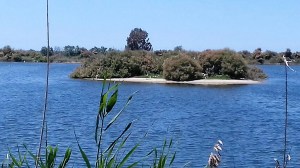 interspersed with houses whose architects certainly had exuberance and imagination, though they didn’t tend towards understatement (the Baroque featured here too, though attached to flat-roofed bungalows). If you continue along the single road you eventually gain access to that portion of the Donana National Park which lies on the south eastern side of the Guadalquivir. Here there are wonderfully tranquil forests of Iberian pines and a lagoon, complete with bird watching hides. The flamingos were displaying and we saw not one other human being.
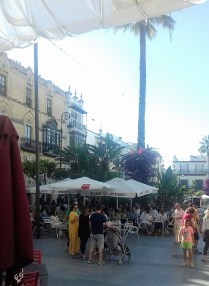 Or maybe head back to Sanlucar de Barrameda, of which I have written before ( see
 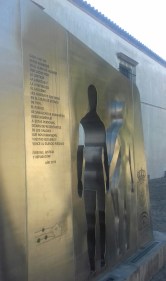 of the Barrio Alto, with its two museums and excellent views over the Barrio Bajo or take tea in the gardens of the 13th century
 …is what one gets at the Dennis Severs House, or 18, Folgate Street, Spitalields, E1. Not quite a fleeting glimpse of those people who have just left the room, who were eating that meal just before you walked in, or smoking that pipe, or baking that loaf. Whose wig sits on the wing of the chair? Or whose floral perfume scents the formal withdrawing room?
 and storyteller, who died, aged only 51, in 1999. Twenty years after purchasing the house he saw the Spitalfields Trust buy the house and commit to keeping it going, when on his death-bed. It’s still going twenty years later.
 inhabit the house and it is their homely detritus (and comestibles) that one comes across as one climbs the narrow stairs, either down to the kitchen and cellar, where there are the supposed fragments of St Mary’s, Spital (1197) and the warmth of an iron range and the smell of…what is that smell? Or upwards, through fashionable London entertaining to the elaborate boudoir and then up beneath the eaves to the penurious lodgers’ rooms.
 There are wordless guiders, who will direct you if you go wrong.
 The day dawned bright and this south Londoner rose early, if not quite with the lark. It was the first day of this year’s
  chance to text other members of the group. I could even see the river. Meeting up was always going to be something of a logistical issue, given that we were from all parts of the UK – from the West Country, North Wales, the south coast and Scotland. Plus, my phone seemed to throw a tantrum. Why don’t they work properly when you need them to? No matter, there was nothing for it, I would just have to wander around until I found the others – amid a crowd of thousands!
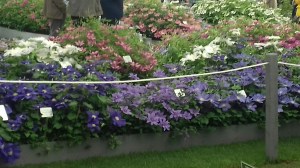 At this time of day the betting was that some, if not all, would be on Main Avenue looking at the Show Gardens, before it became too congested to see them. And so it was. I met the West Country contingent by the Resilience Garden and we were shortly joined by those from Wales and some from Oxford, via Putney.
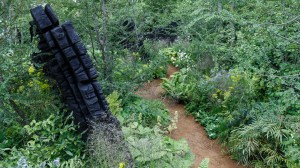 but not quite the garden meadow and sprinkled wildflower natural which has prevailed in recent times. There were a lot of mature trees, including a glorious Scots Pine, and green predominated. Andy Sturgeon’s M & G garden deservedly won Best Show Garden, in this humble gardener’s opinion, with its burnt timber formations resembling ancient rock and setting off the jewel-like colours to perfection.
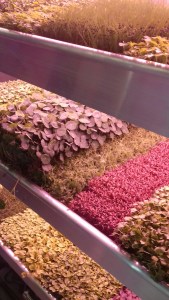 lots of talk about this year’s Clapham Book Festival ). We disperse again in the afternoon, it being impossible to keep over a dozen people together in the growing crowds.
 A word for my favourite gardens, the Silent Pool Gin garden ( alas no gin, but excellent planting and lovely use of copper ) and the Greenfingers Charity Garden, not for the double storey so much as for the planting, with liberal use of fennel and angelica. The D-Day sculpture garden was also immensely impressive in its own quiet way.
 Julie Anderson