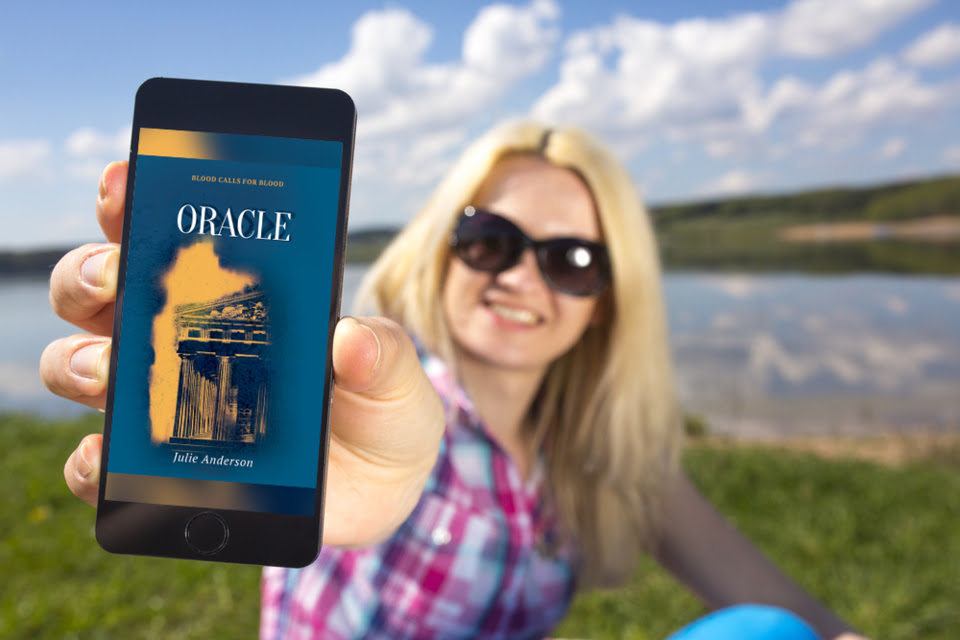
 So ‘Oracle’ is loose upon the world, at first with a tentative snuffling, a rootling, then a leaping and bounding – into reader’s hands, hearts and minds, I hope. There isn’t a launch, not even a virtual one, there are better ways to spend one’s energy and time right now, though I would like to give a heartfelt thank you to all those people who have supported me and the book and congratulated me and wished the book well.
It’s now available on bookshop.org and via the Claret Press web-site ( postage & packing of paperbacks is free, while stocks last ) as well as on Mr Besos’ ubiquitous platform ( which still sells more books than anywhere else online ) and Waterstones. Both paperbacks and ebooks are available costing £9.99 and £3.99 respectively ( though Amazon alters the price it charges unilaterally, I was surprised to see the ebook up for pre-order for £5.99 at one point – proof that there were pre-orders at any rate ). If you happen to live in south London the book can be found at Clapham Books and Herne Hill Books ( and several other local book emporia ). It can be ordered from all good book shops.
And I’m busy. I had great fun this afternoon being interviewed for ‘The Doctor Will See You Now’ by Jacky Gramosi Collins, also known as Dr Noir  ( Jacky founded Newcastle Noir, was instrumental in the Edinburgh Noir at the Bar and most recently, has been deeply involved with Gwyl Crime Cymru, Wales’ first Crime Fiction Festival ). This will be broadcast on Thursday 6th May – it’s free to air and you can find it here, when I get the link. I’ve also been chatting on StreamYard with Sam Brownley of the UK Crime Book Club. I’ll be doing a talk for the Royal Borough of Kensington & Chelsea and Westminster Libraries too, on 17th May. It’s free but you need to register ( tickets from Eventbrite ). I’ve enjoyed preparing for that – it’s all about Delphi, ancient and modern and its myths and literature, as well as ‘Oracle’. In the meanwhile there are a number of events for book clubs and subscribed podcasts and some radio interviews coming up too, the Events page of this web-site will be kept up to date.
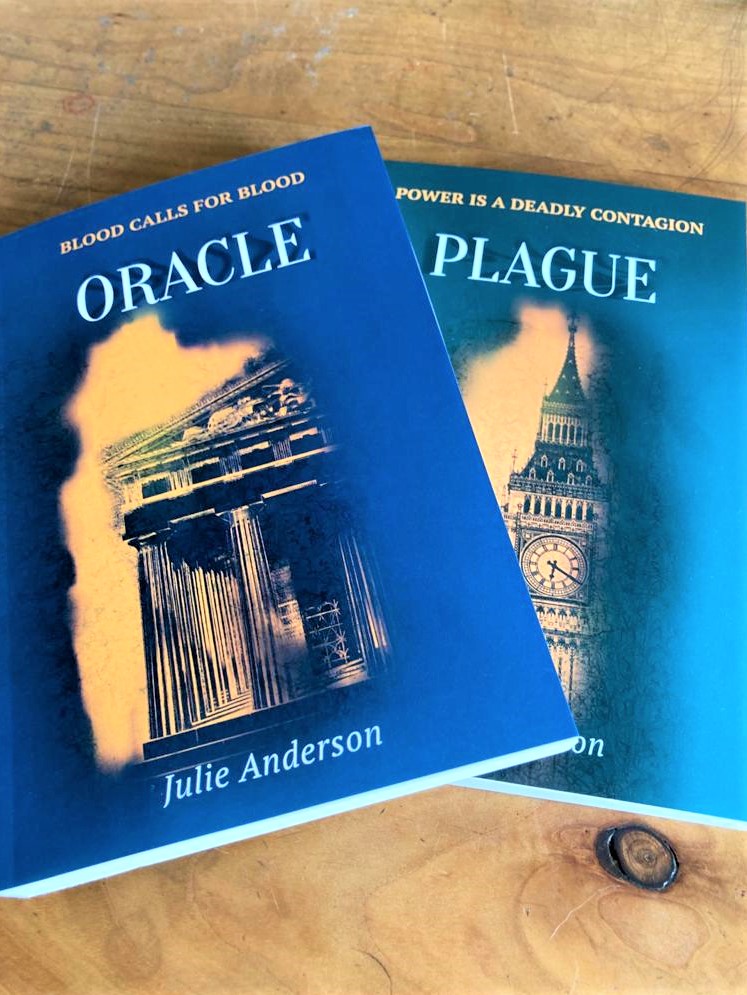 There will be some fizz drunk this evening, which is probably my only concession to the traditional response to publication. Releasing two books in two years, only eight months apart, but into a world wracked by COVID has not been what I would have expected or wanted. Nonetheless, readers seemed to enjoy ‘Plague’ and, I hope, will also enjoy ‘Oracle’ although it is a very different type of book, much more the ‘classic’ murder mystery. I am already hard at work on ‘Opera’ the third in the series, which sees Cassie return to London determined to lay some old ghosts to rest after her experience in Delphi.
If any of you reading this are about to read ‘Oracle’ please do write a review when you have done so, on Goodreads and Amazon or Waterstones, wherever you purchased the book. That will help other potential readers and, if you enjoy reading it, TELL EVERYONE ABOUT IT!
In the meanwhile, I raise a glass to you all.
 This weekend, with three days to go until ‘Oracle’ is published, I had planned to do another ‘run down’ type post. Something I came across on Twitter, however, changed my mind. This piece is written in gratitude to all those book bloggers who have reviewed ‘Oracle’ and/or ‘Plague’ before it, or carried articles or other pieces about either of those books.
 or virtual. It tells you that the book is out there and carries a simple message about it (see above). It’s pure publicity. This, like a billboard ad, can prompt people into buying. But if a potential reader wants to know more and whether or not the book is for them before they buy, detail is required and the limited length of Instagram posts precludes this. Step forward the book blogger, offering a considered review of a book’s strengths and, if necessary, less strong areas ( though most book bloggers won’t post negative reviews ).
 It’s also in the wider interests of publishers, publicists and authors to encourage discussion about books, to widen reader’s horizons and engage more people in reading. This is what book bloggers do, sometimes via Blog Tours, or by just posting their own thoughts about what they are reading. And, in the time of COVID, both have been important in drumming up publicity and support for books which would, otherwise, have sunk without trace.
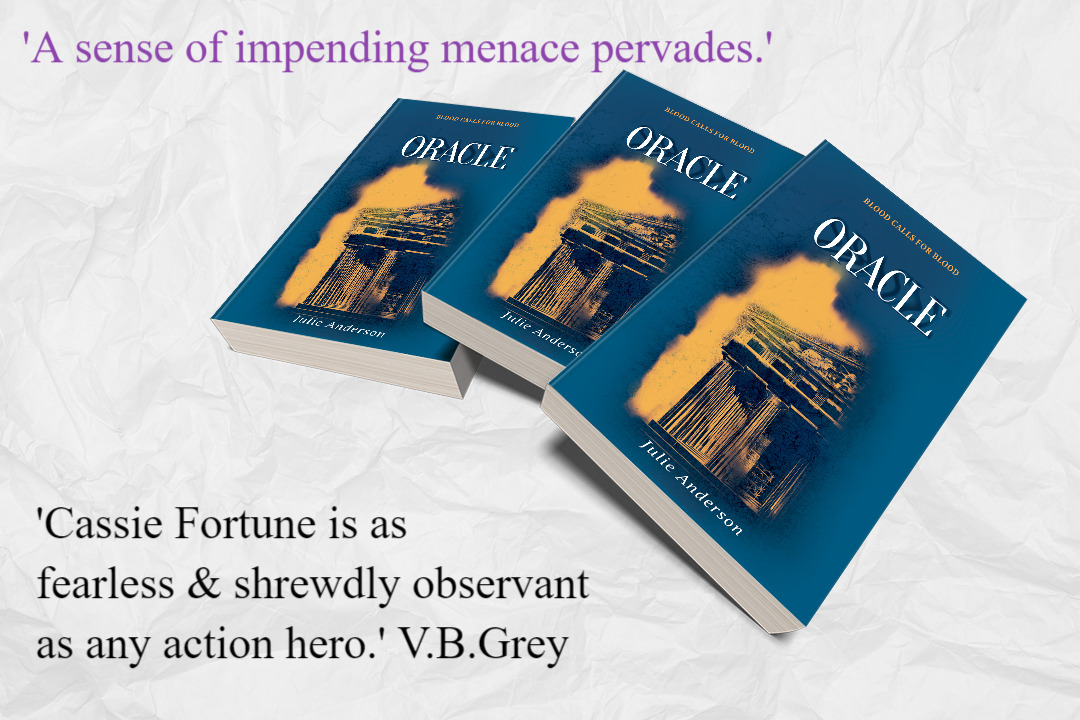
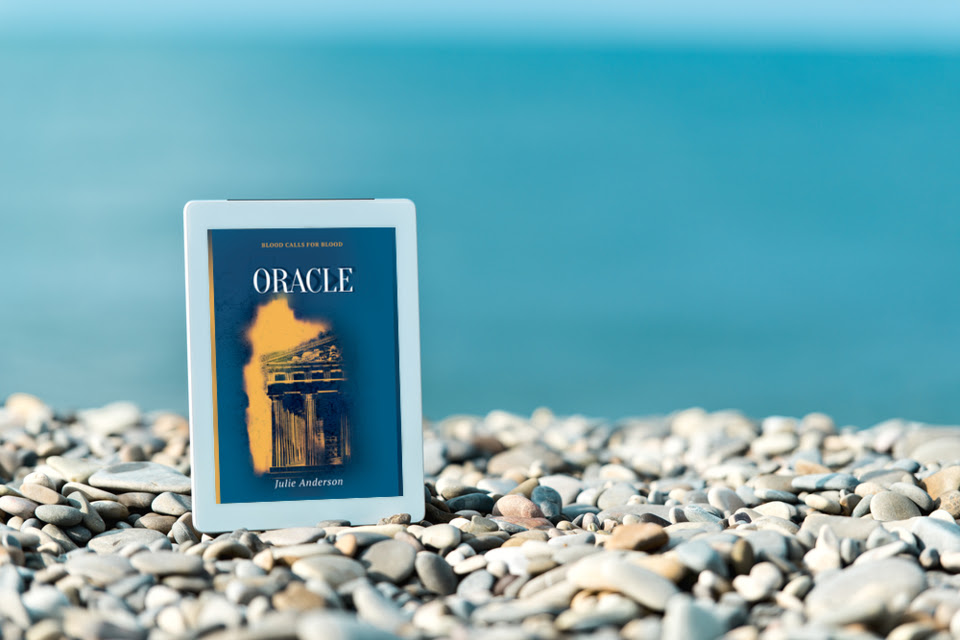 So, it’s just ten days before ‘Oracle’ the second of the Cassandra Fortune books is released on to an unsuspecting world. Actually, it’s not that unsuspecting, as review copies have been out for some time and people are saying nice things about it. So, Isabelle Grey, author of the DI Grace Fisher stories, whose latest ‘Tell Me How It Ends‘ (Quercus) is set in London in the early sixties said ‘Cassandra Fortune is as fearless and shrewdly observant as any classic action hero , yet also intriguingly able to admit vulnerability. Will the Furies catch up with her in this very modern political thriller set amid the ruins of ancient Greece?’ Jacky Gramosi Collins, aka the famous Dr Noir, described ‘Oracle’ as ‘a text that reminds us of the way the past resonates in the present and the lessons we all need to learn’. Steve Sheppard, author of ‘A Very Important Teapot‘ said ‘Plague was gripping and original, and Oracle is a masterful sequel. The plot keeps us guessing right to the end as the intriguing cast of characters are handled with skill and care.’ ( Steve is a fellow Claret Press author ) and the playwright David Armstrong described it as ‘a page-turner, an engaging and absorbing read’.
 ‘There are more twists, turns and unexpected revelations in this story than the path leading to the Corycian Cave and they will keep readers guessing until the unexpected end’. NetGalley reviews have been favourable too, with plenty of five and four star reviews. I will, however, be making some last minute amendments, after having received detailed comments from Maro Nicolopolou of the European Cultural Centre at Delphi, for which I am very grateful.
 And in the real, physical, world? Things are gradually opening up but not quickly enough for the traditional book launch to take place and I shall have the dubious distinction of having launched TWO books during COVID restricted life. Unfortunately, though local London bookstores will carry the book, it’s unlikely to get a wider distribution, as my publisher’s distributor has, like so many other businesses, fallen foul of the economic disaster that is COVID. It is available, however, and listed with Neilsen’s so can be ordered from other stores and can be purchased from Bookshop.org, the site which gives more of its profits to independent book shops and publishers, on the Claret Press
 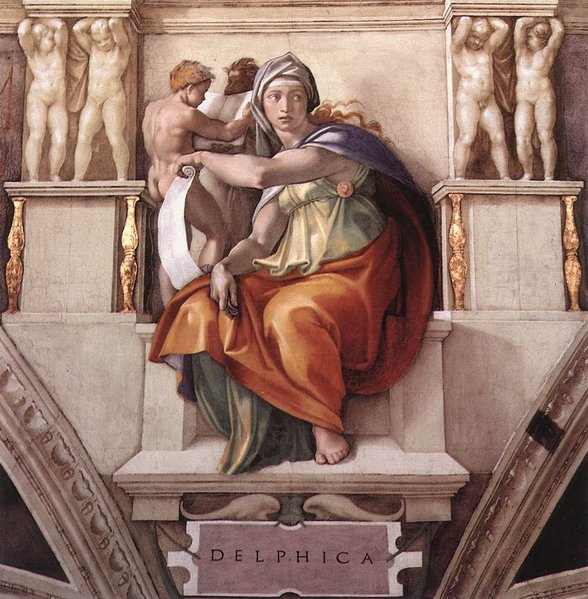 At Delphi it was the Pythia who spoke for the god Apollo – ‘prophet’ or prophetess’ originally meaning ‘spokesperson’. At Cumae it was the similarly Apollonian Sibyl and at Siwah in Egypt another sibyl, supposedly of the line of Poseidon and related to Nile, spoke for Zeus-Ammon. The first two were real women and, unusually for much of the ancient world, women who had power. They were actually a succession of women who filled the ‘office’ of Pythia or Sibyl ( although it is said that the most famous of the latter was granted extra long life and lived until very old, shrunken and wizened ). They certainly helped determine policy. As Cicero says of the Delphic Pythia, there wasn’t a important decision taken in the ancient Greek world without consulting her.
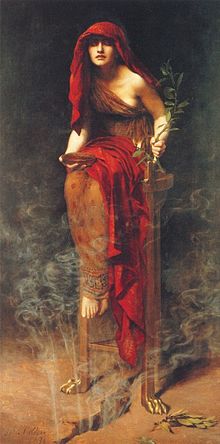 most famous prediction was probably that given to King Croesus of Lydia ( the Croesus who was so rich that his name became a byword for wealth – ‘as rich as Croesus’ ). Croesus, who had clearly hoped to find favour with the Pythia by sending her vast quantities of gold, was pondering whether or not to invade the neighbouring kingdom of Persia, then ruled by Cyrus. She advised him that, should he do so, he would destroy a great empire. Croesus duly launched his campaign in 547 BCE. After some inconclusive fighting, Cyrus defeated Croesus at Thymbria in 546 and Croesus took refuge in his capital of Sardis. The Siege of Sardis resulted in his capture and the Persians went on to annex Lydia. It was then clear that the empire which the Pythia foresaw Croesus destroying was his own.
 The Pythia’s fame was assured and she features in drama, poetry, histories and other writings from about the sixth century BCE onwards ( although there was a priestess of legend supposedly at Delphi before then ). The Sibyl of Cumae may not have been quite as well known, but she had her adherents too, especially in the Roman period, and legendary stories grew up around her. The most famous was probably that involving Tarquin, the supposed last king of Rome, and the Sybilline books. An unknown woman arrived in Rome and offered to sell the king nine books of prophesies. Given the enormous sum she asked for them Tarquin refused to buy. She burnt three of them and asked the same price for the remaining six. Again Tarquin refused and she burned another three. Only three books remained, but Tarquin relented and bought them, for the original asking price for the nine. At which point the woman disappeared and the books were stored in the temple of Capitoline Jove on the Capitol. They were burned in a subsequent fire.
 too was visited by Alexander the Great after his conquest of Egypt and though history doesn’t record how he treated the people there, it does say he went away content. The Siwah Oracle, wisely, forbade its supplicants from discussing what the Oracle had said, which pre-empted the examination of its prophesies which other prophetic Oracles were subject to. Unfortunately this also means we don’t have the wonderful stories about this oracle that we have about the other two. The legendary Sybil at Siwah was supposedly the daughter of Lamia, herself the daughter of Poseidon, God of the sea ( and she appears in Euripides play, Lamia ).
 In Aethiopica, an ancient novel by Heliodorus, a central character who is a priest of the Egyptian goddess Isis, describes Delphi as where the divine can be found, a natural fortress, beloved of Nature. Other ancient writers commented on its hidden aspect. It’s certainly true that the mountain itself seems to protect the sanctuary, denying the visitor any faraway view, hiding the site until the traveller rounds the last craggy outcrop and sees the Temple nestling in a bowl of the mountain, the harsh, grey granite rising up behind. It must, in the days of its full splendour, have been a truly stunning sight. The marble of its many buildings reflecting the sunlight and glowing golden at dusk as the pilgrims climbed the paths to the Temple, to petition the Oracle of the God Apollo for answers, the last rays of the sun glinting in the gold which topped many of the monuments. It’s still fairly impressive now.
 As Nico, an employee of Delphi Museum and a character in my novel, says ‘The temple ruins you’ll see today date back to 320 BCE. It’s the sixth Temple of Apollo to stand here, ‘though the site has been sacred for millenia.’ The Sacred Way, the stone pathway which zigzags across the mountain slope, rising towards the Temple Terrace, is a relatively modern addition, in the 5th and 6th centuries CE and, though this is the route followed by modern visitors, the Temple site BCE would have had several entrances and paths and sets of steps between paths, not unlike those in the town of Delphi today.
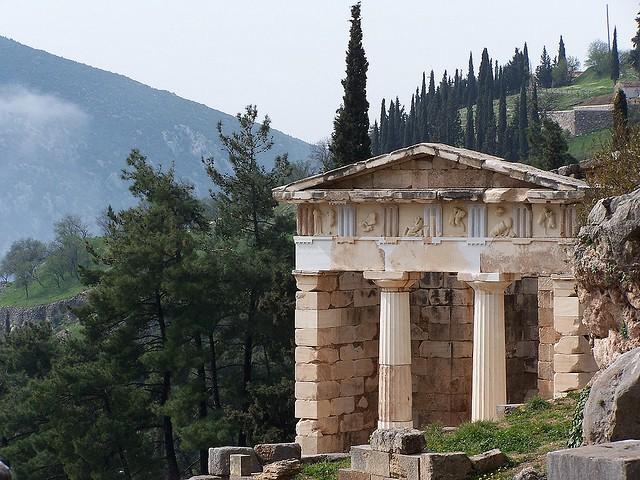 boundary walls constructed in the sixth century BCE. The square addition of the Roman Agora is on the right and the ancient Amphitheatre is directly behind the massive Temple itself. The Temple was the heart of the sanctuary, its Terrace packed with monuments, statuary and other offerings to the God. Many of the box-like buildings you can see on the slopes below it were Treasuries, belonging to city states, islands, countries, where their special offerings were stored. The Treasury of the Athenians, which features in ‘Oracle’ is the best restored. Originally dedicated after the victory at Marathon the restoration took place in the early twentieth century with money raised from the modern city of Athens.
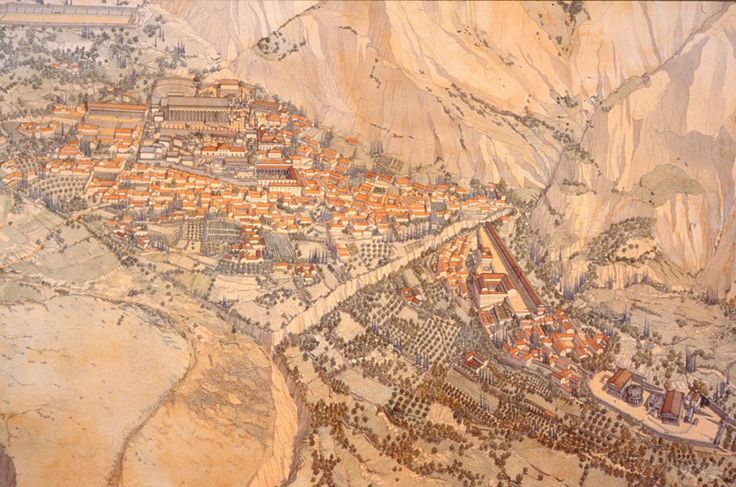 version of Golvin’s watercolour. This stands at the bottom right of the picture (right) just beyond the Gymnasium – you can see the long running track – and plunge pool. This was where athletic members of the public would work out and train. The Sanctuary Stadium, where the Pythian Games were held, is much higher up the mountain, its edge can be seen in the top left hand corner of the larger picture. It is from the Stadium that my heroine looks down on the precinct – ‘It was easy to understand why this place had been sacred for so long’ she says. ‘It was so still, a sense of the divine so near to the surface. It had astonishing drama and beauty.’ And it still does.
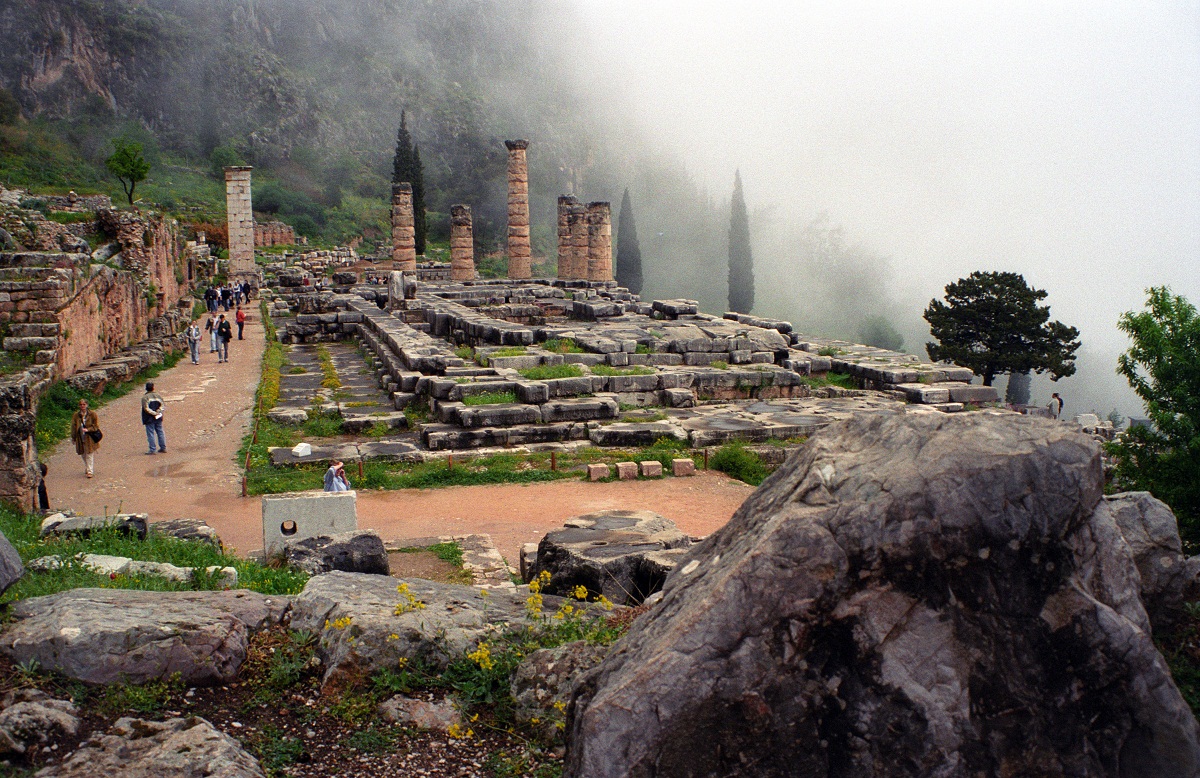 various forms of a council representing, at least nominally, all of Greece. There was a decided element of outshining the competition, with cities and other dedicatees, building ‘bigger and better’ than their fellows. Not least of the rivalries was that between Athens and Sparta, as you would expect, but there were others, often reflecting the political tensions of the day. In all there were three Sacred Wars for the prize of virtual overlordship of Delphi, dominating the council, and more than one political enemy was flung from the top of the Phaedriades cliffs as a blasphemer (planting evidence of stolen goods which had been dedicated to the God was a common trick).
 Mount Parnassus, at over eight thousand feet high, is one of the highest and largest mountains in Greece and it towers over the Gulf of Corinth. Its name means the mountain of the house of the god and that god is Apollo. Believed by ancient Greeks to be the centre of the world, Delphi and the area around it on Parnassus has been a place of habitation since Neolithic times. It was already old when the Hellenic Apollo arrived to wrestle with the Pytho, the snake of the Goddess Gaia, the Great Mother and to take over the sanctuary.
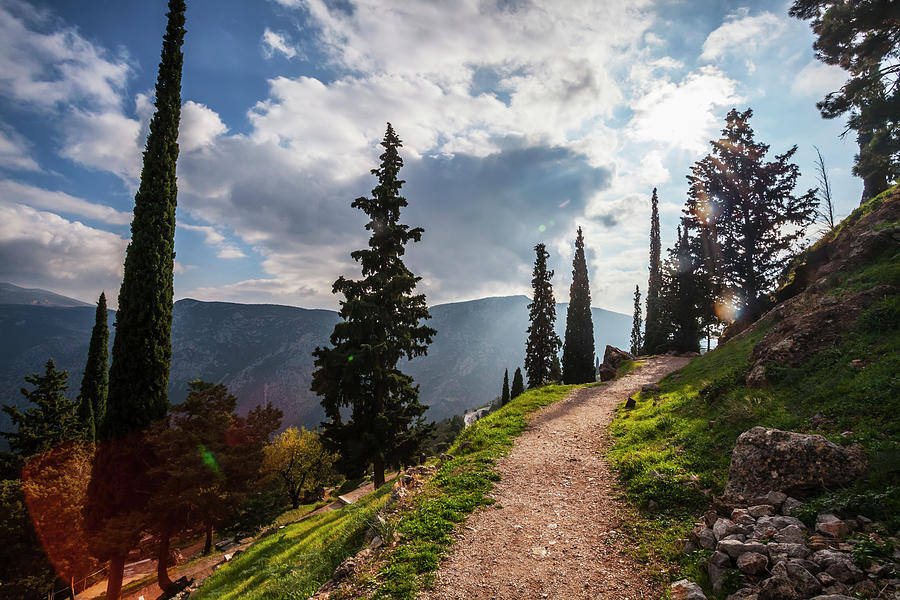 The mountain is a great place for walking, with many accessible trails and much of it, about 36,000 acres, designated as a National Park. Some of its flora is of protected species and birds of prey, wolves and boars are not uncommon. There are plenty of viewpoints and small walker’s lodges to aim for. You can walk to the ancient Corycian Cave where people have lived since Neolithic times or trek across to stand at the top of the Phaedriades, huge cliffs called the ‘shining ones’ which tower above the temple site. Or visit the Castalian Spring at the foot of the Phaedriades, where the Pythia
 bathed in ritual purification before she entered the Temple and became the Oracle of the God. I like that this place was dedicated to Gaia the Great Mother before it passed to Apollo and that it was a woman, or women, who spoke with the God’s voice even after Apollo took over. I’m not sure I’d have fancied the ritual outdoor bathing in non-summer months though, it can be cold this high up. In Winter Parnassus has its ski centre, the largest in Greece with sixteen ski-lifts. Athenians flock their for the winter sports.
  been very difficult, so the Temple, in effect, shut down until spring came ). Parnassus was also said to be the home of the Muses and it was the supposed presence of these semi-deities which prompted some nineteenth century French poets to give the mountain’s name to their literary movement, Parnassism. This was a reposte to Romanticism, calling for a return to classicism and classical forms. Primarily, though not exclusively, influential among poets it was particularly strong in Paris and the place south of the Seine where the poetry readings were held was commonly referred to using the mountain’s name. This subsequently became the Parisian district known as Montparnasse. In the early part of the twentieth century this area became the vibrant artistic hub of the French capital, migrating from Montmartre, which had, by then, become more establishment. So the ‘mountain of the home of the god’ is also a Parisian suburb, noted, today, for its tower and its huge cemetery, where many famous writers are buried.
 My fiction is very much located in real places – place is very important to me. So ‘Plague’ is a novel of London, it couldn’t really take place anywhere else. So much so that I have created a ‘Walk of the Book’ – there’s a free leaflet showing you how to visit the locations which feature in the book and walk the course of the ‘lost’ River Tyburn, if you’re ever in London and want to do a city walk. You can find it on the Welcome page of this website.
 read physical books, an object which is in my hand and which I do not look beyond. Many people don’t read this way, they use Kindles or similar devices which link to the internet. So there’s plenty of software available, Open Street, Bing, Google or OS, which will find them a map on their device.
 Club. I explained my dilemma and asked their opinion. This prompted many comments ( one hundred and forty two people contributed ) overwhelmingly in favour of maps. Some fellow writers disagreed, however, saying, for example ‘I prefer to have my readers follow where I take them.’ and ‘If a book needs a map to make sense of the story or plot then the story/plot isn’t clear enough.’ Some readers gave maps the thumbs down too e.g. ‘Don’t like a map and timeline etc. It complicates and distracts from just naturally drinking in the narrative of the book.’ but the vast majority were in favour.
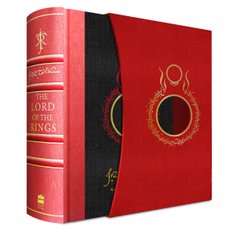 of where everything is in relation to everything else.’
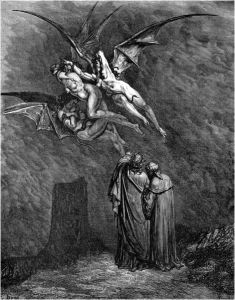 Given the antiquity of the Temple of Apollo at Delphi and the cultural influence it has had over the millennia it’s not surprising that large numbers of visual artists have been inspired by it. Followers of my twitter feed will know I have been collecting and sharing images of Delphi, the Temple of Apollo and the various historical or mythical beings who came there, drawn or painted by famous artists. So, we’ve had Gustave Dore’s Dante and Virgil encountering the Erinyes or Furies (left), Edward Lear’s water colour of the Phaedriades, the massive cliffs which loom over the Temple site and William Blake’s illustration for ‘On the Morning of Christ’s Nativity’ showing ‘The Overthrow of Apollo and the Pagan Gods’.
 events or characters from Greek drama set at Delphi. On Greek redware (right) for example, showing the sleeping Erinyes being roused from their Apollo-induced slumber by the vengeful spirit of Clytemnestra, urging them to hunt down her son, and murderer, Orestes ( from Eumenides by Aeschylus ). Later paintings include Orestes being pursued by the same furies by, among others, John Singer Sergeant, William-Adolphe Bouguereau, John Flaxman and Franz Stuck, until we’re up to date with John Wilson (after Bouguereau).
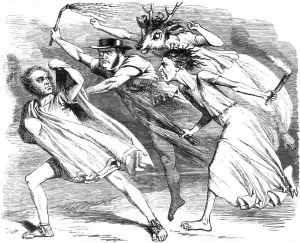 own versions, like that in Puck magazine (1877) or in Punch (left). In this instance it is the Rt. Hon. John Bright MP who is in the Orestes role, being pursued by the vested interests which he opposed through the Anti-Corn Law League. It was Bright, famous for his oratorical skills among other things, who coined the phrase ‘Mother of Parliaments’. He is also credited with first using the phrase ‘flogging a dead horse’ to illustrate the pointlessness of certain activities (in Bright’s case this meant getting the House of Commons to consider Parliamentary reform – ’twas ever thus).
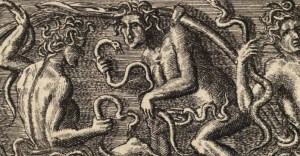 Wenceslas Holler etched them in the seventeenth century (right) and they have re-emerged in modern day gaming ( though with a rather different, sexy, look which speaks to who it is who plays those games rather than any mythological authenticity ). Naked the furies may have, traditionally, been, but not looking like a set of pouting, come-hither dominatrices.
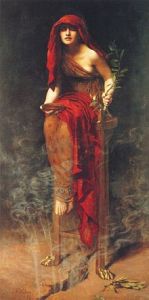 The Pythia, or priestess of Apollo who spoke, as the Oracle, with Apollo’s voice is also a favourite subject in paint and in sculpture. Eugene Delacroix showed Lycurgus consulting her, John Collier made her a hooded, pre-raphaelite religious perched high on her tripod or three-legged stool (left). Note the gases swirling upwards from the crack in the floor of her underground room, the inhalation of which led to her madness and prophecies. No such crevice has been found at the Temple site, but, as a character explains in the book “geologists have found that two geological fault lines cross beneath Delphi, with fissures under the Temple itself which allow small amounts of naturally occurring gas to rise to the surface. Rock testing showed ethane, methane and ethylene − formerly used as an anaesthetic − to be present. These would create a calm, trancelike state and, if a lot was consumed, a form of wild mania.”
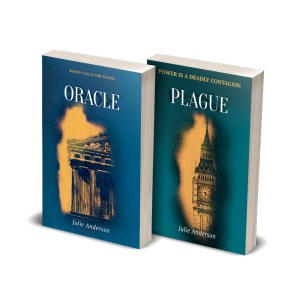 That’s my heroine, Cassandra Fortune, according to Claret Press, my publishers. They are referring to my her as ‘the world’s most intrepid civil servant’.
 the Department for Old Age Pensions, who first appeared in Festering Lilies in the 1990s. Agatha Christie, no less, wrote a series of short stories featuring a retired civil servant named Parker Pyne in Parker Pyne Investigates (1934). I’m sure there must be others and there are probably real civil servants who are more intrepid, though they may not meet with murders and villains with such regularity as Cassandra does.
 e.g. like Kate, in Sarah Vaughn’s best-selling Anatomy of a Scandal (2018)
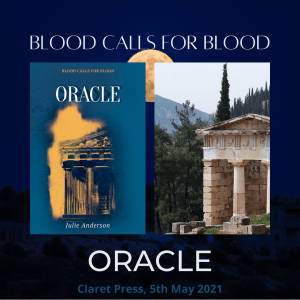 these days such images come in various forms – Facebook banners, Instagram posts and Twitter headers – and some come with animation. The one on the right is an Instagram post, which uses a photograph of the Treasury of the Athenians at the Temple of Apollo, Delphi, as well as a copy of the cover and its tagline – ‘Blood calls for blood’ on a background of a full moon rising above a hillside. There is an animated version of this too.
 dramatic. I think it’s eye-catching. I just hope that the book isn’t mIstaken for a vampire novel (because of that tag-line). A number of early readers of Plague thought, from the blurb, that it was about a pandemic. No fear of misunderstanding the title this time, the blurb makes reference to the ancient oracle, but who knows what else people with think of.
 There are some differences too, in part because I’ve learned from experience. So, for example, there’s an Oracle postcard to send out with review copies (last time I exhausted my personal stock of notelets). Claret is having the ARCs printed at the moment and I’ll be looking to take receipt of boxes of books in the next week or so. The other, more exciting thing is that readers are telling me that they’re waiting for the book to come out ( the virtue of having a series ). Also, it seems, there are a lot more media events – interviews, talks, blogs, podcasts – than last time. In part, I suspect because I have more media contacts now (and I’m good value i.e. or the most part, free), but also because I’m no longer an unknown. That Oracle is ‘the further adventures of…’ helps.
 Julie Anderson