 The Crime Writers Association, in partnership with The Reading Agency, is sponsoring National Crime Reading Month in June. There will be a fabulous launch at Waterstones, Piccadilly on 1st June (I’ll be posting photographs) and a whole tranche of events are already scheduled (see link). It is hoped that more will follow, in local libraries and book groups and the CWA has listed crime writers ready and willing to participate in said events on the crimereading.com web-site.
Here in south London one of the NCRM local Ambassadors, Anne Coates, is teaming up with fellow south Londoner, Alice Castle and myself to produce ‘Sister Sleuths’. Each of us has books set in London, often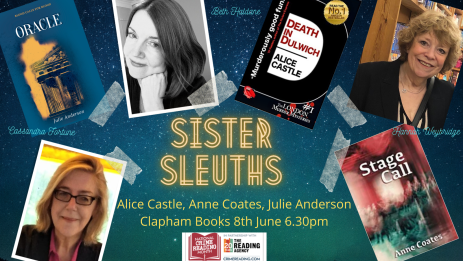 south London – Clapham in my case, where Cassandra Fortune lives, Dulwich, home of Hannah Weybridge in Anne’s series and Dulwich, Herne Hill and Belsize Park, among others, for Beth Haldane in Alice’s. The tales range across the capital, taking in Westminster, Theatreland, Fleet Street and the yummy mummy nappy valleys of south London as well as rather less salubrious locations, like King’s Cross and Elephant and Castle.
As you can see all our protagonists are women, hence the name. Cassandra is a civil servant, Hannah an investigative journalist and Beth an office worker; two of them are single mums. All of them get drawn into investigations by circumstances (though Cassie is more than willing in Plague, in order to get her career back on track).
 First stop on the ‘Sister Sleuths’ tour is at Clapham Books on 8th June, doors open at 6.30pm for a 7 o’clock start, later in the month we’ll be at Chener Books, on Lordship Lane in East Dulwich and, it is planned, more south London venues (details will be available on the Events page of this site). The events will be free to attend and should be fun. Anne’s Hannah Weybridge series which started with a tale inspired by Anne’s real-life journalism in Dancers in the Wind
 is already five books long and Alice’s Beth Haldane (and her on-off boyfriend DI Harry York) has appeared in even more, beginning with Death in Dulwich. I am lagging behind with only two, though that will be increased in the Autumn when Opera, the third Cassandra Fortune is published.
I’ll also be speaking about researching both Plague and Oracle at the Riverside Book Club in Sunbury on Thames on 16th June. It is a long-standing date in the diary, but, as serendipity would have it, now part of NCRM. There will almost certainly be an event near you, across the country. But the idea behind NCRM is to encourage readers to create events for themselves and, at time of writing, the site currently includes over sixty crime writers of different types and sub-genres ( a figure that will grow as June approaches ) who are prepared to participate in these events. The website includes tips and hints on organising and promoting events, together with NCRM literature and templates. So contact your local library or book group and suggest an event. Or come along to one of mine.
 Today’s news media is full of stories about the casual misogyny and sexually predatory culture of the Palace of Westminster ( not just the Commons, though that features more often than the Lords ). This isn’t new. When I was writing Plague (Claret Press, 2020) I was taken to task by one of the readers of an early manuscript. She commented on my depiction of a male dominated, testosterone fuelled, hard drinking place, in which women MPs were treated as decorative, or routinely verbally abused and female civil servants and Parliamentary researchers ‘fair game’, saying it was incorrect to such a degree that no one would believe it in the twenty-first century. I begged to differ.
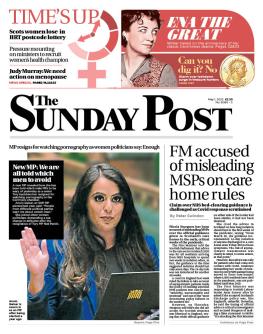 significant minority who do, as recently confirmed by the current, female, Attorney General, and witness the recent resignation of Neil Parish. The Palace is an unique and strange workplace, with MPs often far from home and under tremendous pressure, from their peers as well as the Whips. There is many an decent, family man (and they do tend to be men, but this isn’t exclusively male) in his constituency who lives a rather different life in Westminster. The ready availability of alcohol (or the stimulant of your choice) doesn’t help either. Catherine Bennett’s article in today’s Observer newspaper lists some examples from the Tory benches (see
 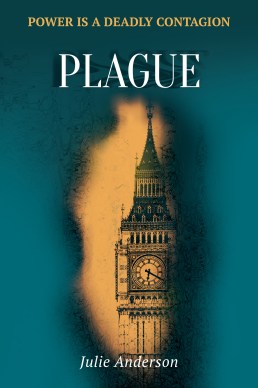 But back to Plague. We have been here before, when the media, or those parts of it more interested in fact than propaganda, reported on the scandals around PPE (and other) contracts handed, without competition, to cronies and the special ‘VIP lane’ of government procurement. There have been successful court cases branding the behaviour of the government unlawful.
 All the published writers I know (except one) accept the need to promote their books, whether they are contractually obliged to do so, as a traditionally published author, or understand that they must get themselves and their book out there as a self-published author. Only those established enough to command a hefty advertising and promotion budget within their publishing house can sit back and even they can’t relax. Sir Michael Morpurgo, who is as established as they get, was on the road promoting his latest book at the Clapham Book Festival in October.
 exception, with Christmas around the corner, in the book world. The ebook of Plague has been reduced to 99p online across stores (and on the Claret Press website) and I am publicising that at the same time as organising ‘giveaway’ competitions for free copies of Oracle within online book groups, like The Motherload. It happens also to be six months since Oracle came out, so there is a bona fide reason to do the giveaway, aside from Black Friday.
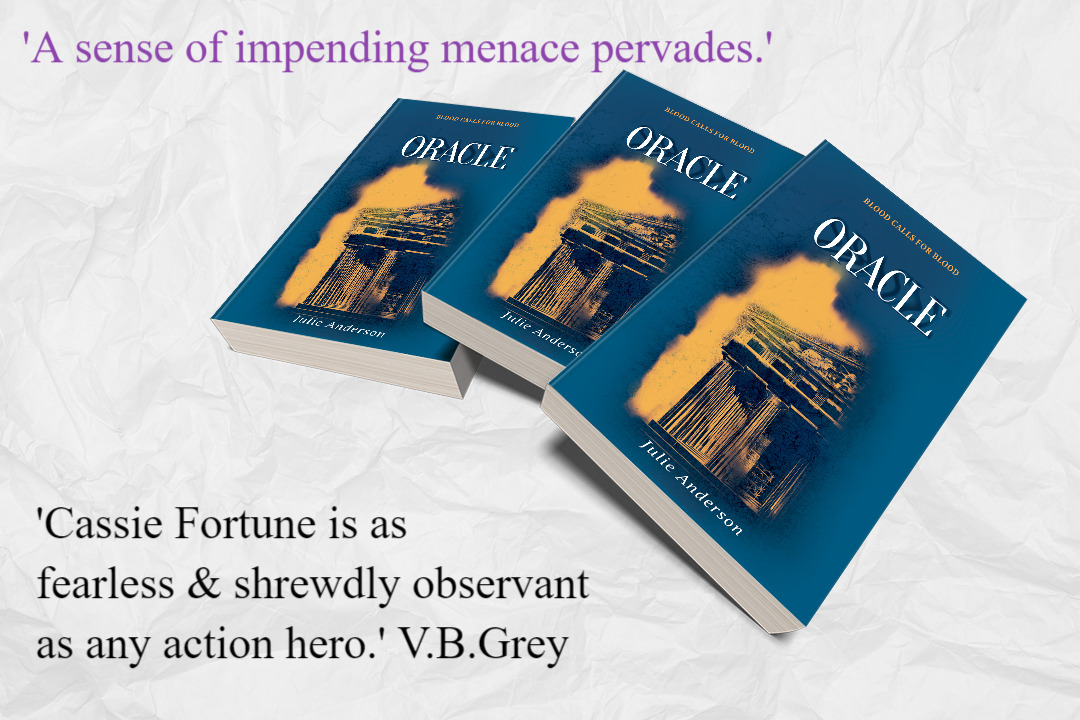
 For a small publisher like Claret this is a neat way to get free advertising. For example in this ‘giveaway’ via Facebook of three books ( at cost and with postage of approximately £3 per book ) Oracle’s cover and blurb, as well as some quoted reviews, has reached 174,000 people in the last twenty four hours. Mostly these are via Twitter but the Club itself has 12,000 members. At time of writing over eighty people have ‘entered’.
 complete with Oracle postcard and message congratulating them, hoping that they enjoy reading the book and asking, if they do enjoy it, if they would pass the word on, by way of a review or a post in the Facebook Book Group and/or on Goodreads. If they do so this will generate more publicity. Oracle is, of course, readable as a standalone novel, but it may also encourage some folk to buy Plague, especially given its reduced price.
 My contemporary crime fiction is set in the world of high politics ( and low sleaze ), of ministers, conferences, lobbyists and business interests. Activists of various kind also feature, particularly in Oracle. In that book a contemporary political issue also impacts upon the plot; the politicisation of the police. This is specifically regarding the Greek criminal organisation Golden Dawn, which formerly styled itself a political party and to which many police belonged in the real world. There are other examples of politics intruding on police work, most notably in the U.S., where former President Trump deployed ‘private’ police forces funded with federal money in cities where demonstrations were taking place ( see pic left ). A ‘defund the police’ movement began as a result of this and of the repeated deaths in custody of black people. So far, so scary.
 tarnished. In the US the Vietnam War, in the UK the three-day week and ‘the sick man of Europe’ made for a more sceptical and hard boiled sensibility. The Day of the Jackal, The Andromeda Strain, Six Days of the Condor are three crime/conspiracy novels, turned into major films, which spring to mind. Then there was police corruption, found in crime fiction like Lawrence Block’s NYPD stories, Leonardo Sciascia in Sicily ( long before Montalbano ) or countless Hollywood films, the Dirty Harry movies, Serpico, The French Connection. Is the politicisation of the police going to be something similar?
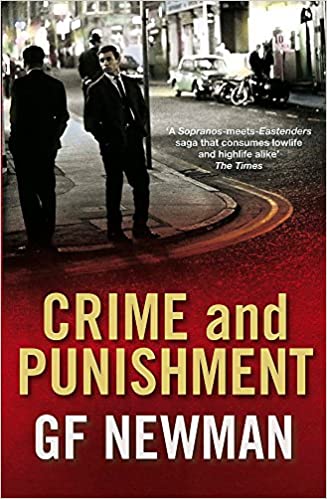 having the politics of policing threaded though it (as it happens these also arose during a discussion I had on Sunday ). Then a series I had never heard of but will definitely try – Ausma Zehanat Khan’s duo detectives Esa Khattak and Rachel Getty. Khan is a British born Canadian and now lives in the U.S. and her pair are Community Police Officers in Toronto, but the books range across the world. One series I remembered as soon as it was suggested was the Law & Order TV series based on four plays by G F Newman, which were also published as books A Detective’s Tale, A Villain’s Tale and A Prisoner’s Tale. HarperCollins reprinted them in an omnibus edition in 1984. These were controversial at the time, as they depicted a corrupt UK policing and legal system and shouldn’t be confused with the US TV series of that name. The UK series was altogether harder and grittier and caused ructions. As did Newman’s later Crime and Punishment, which involved a criminal bankrolling the Conservative party ( where have I heard that before )?
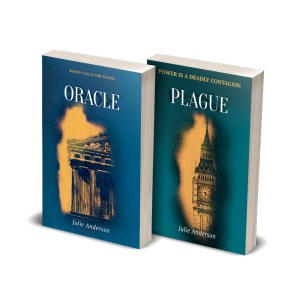 That’s my heroine, Cassandra Fortune, according to Claret Press, my publishers. They are referring to my her as ‘the world’s most intrepid civil servant’.
 the Department for Old Age Pensions, who first appeared in Festering Lilies in the 1990s. Agatha Christie, no less, wrote a series of short stories featuring a retired civil servant named Parker Pyne in Parker Pyne Investigates (1934). I’m sure there must be others and there are probably real civil servants who are more intrepid, though they may not meet with murders and villains with such regularity as Cassandra does.
 e.g. like Kate, in Sarah Vaughn’s best-selling Anatomy of a Scandal (2018)
 It’s Valentine’s Day on Sunday and the media company who do the promotional images for Plague had a Valentine’s Day version in the series relating to topical dates and days. Now, we all know about star-crossed lovers, but I’m not really sure that either of Cassandra’s ‘romantic’ relationships fits this bill. ‘A plague on both your houses,’ Mercutio cries as he lies dying, which is probably the closest Romeo & Juliet comes to Plague.
 real life shenanigans in government. Last week’s COVID, Corruption & Crony Capitalism discussion for Claret Press has sparked quite a lot of interest and not a few compliments. There were lots of good questions on the night and there have already been plenty of views of the recording. If you missed it you can see that on the Claret Press YouTube Channel
  There are a couple more Plague events lined up for March and some in the pipeline for April. The first is for
  Back to Sunday, 21st January 1855 in a Trafalgar Square deep in snow, where about fifteen hundred people are gathering. They’re meeting to protest at the mismanagement and needless loss of life in the Crimean War, but can’t help larking about and they pelt passing traffic (and pedestrians) with snowballs. The police ask them to stop, but the protesters pelt the police too.
 but the failure to provide troops with the most basic necessities of life and the dreadful death rate resulting.
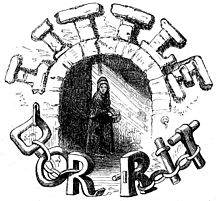 Like many others the novelist Charles Dickens was angered by this. Dickens fans will recognise the name of this article as belonging to the government office in his Little Dorrit, where Arthur Clennam goes to discover the details of William Dorrit’s incarceration in the Marshalsea debtors’ prison. The Circumlocution Office was Dickens satirising the parlous state of what passed for the civil service in those days. Totally dominated by the Barnacle family (a not so subtle metaphor on parasites clinging to the ship of state) it is ‘0ne of the principles of the Circumlocution Office never, on any account whatever, to give a straightforward answer.’ You can read Chapter 10, in which the Circumlocution Office features
 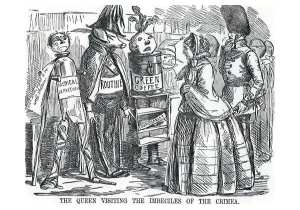 passed a vote demanding a full investigation. Lord Aberdeen, the Prime Minister, resigned on 30th January 1855.
  That’s what Britain still has. There are some service failures today – nothing is perfect – but these are often driven by politicians not civil servants, however much politicians seek to blame them (sometimes aided and abetted by the press). We touched on this in last night’s panel discussion on COVID, Corruption and Crony Capitalism, but we ran out of time before we could discuss why cronyism is so damaging to public service provision and so destructive of human lives. This article is by way of a reminder; January 1855 is where we were. Let’s not go back there.
 institutions of democracy including Parliament. He says ‘Democracy is so easy to pervert, why replace it? Money can buy anything. If a government gets difficult another can be sponsored. Sometimes it takes time, sometimes it’s easier, but there are always people willing to take over. When national or global institutions fail to serve the purpose they are destroyed, distorted or hollowed out from the inside.‘ (P236). Money, the media, the connivance of powerful individuals, inside and out of those institutions, enable him to do this, together with leverage over others who are hungry for power.
 In real life, the Good Law Project, the Runnymede Trust and a non-partisan collection of MPs from various parties have sought judicial review of the Department of Health and Social Care’s awarding of billions of pounds worth of contracts since April 2020 to private companies e.g. for Personal Protective Equipment. That is, they’ve asked the judiciary to adjudicate on the legality of the contract awarding process. Of these contracts, many millions remain unstated and have not been made public as regulations require. The Labour Party has raised this issue in Parliament and via the media ( see
  exercise in disclosure, not required by the courts. The GLP, funded by small donations, will be unable to accept such a financial risk and has sought a cap on costs from the court. If this isn’t granted the litigation will have to be abandoned. Perhaps the villain was right and ‘Money can buy anything.’ even the law. I hope not.
 All three, as far as I’m concerned.
 the public that seems more apposite. Plague‘s successor, Oracle, is much more of a ‘classic murder mystery’, though I hope it has the same page-turning quality. Yet it too has the political at its heart and, already, some of its themes are hitting the real-life headlines, like questions about the politicisation of the police, something which surfaced again after the assault on the U.S. Capitol. I suspect that this issue is something crime writers will be incorporating in their stories for the next few years.
 arguably no longer the dominant force in story telling and when social media allows us all to be citizen journalists and political commentators, what place does political fiction have? An important and relevant one, in my view. And I’m not alone – see this piece of graffiti, found in London, NW7 earlier this week ( thank you John Johnston for the photo ). Is the political image of our age the age of the boot on the face, or the pill and the palliative? Orwell or Huxley?
 It is estimated that audiobook sales have more than doubled in the last six years, with a significant rise during the pandemic. There has been double digit sales growth in the English speaking markets for the last three years ( the US is by far the biggest market for audio books, but the UK and Australasian markets are growing rapidly ) and more audiobooks are being produced than ever before. UK book sales are still overwhelmingly (80%) of printed books, but the digital market has grown at the expense of print during the pandemic, possibly after the Treasury reduced VAT on digital books to zero, in line with printed books, in May 2020. Digital fiction sales is the fastest growing element of this market.*
 particular, this is tapping into a new market, good news for the book industry.
 Los Angelina, Elizabeth now lives in North Carolina, so we had been corresponding during the recent US elections. Originally from south London, she was over to visit her sister for Christmas. She gave me lots of tips about online speaking, having listened to my recent talk for the Royal Borough of Kensington & Chelsea and Westminster Libraries ( she thought my delivery poor ). I learned a lot, for example about
  The good news is that Essential Audiobooks provide a ‘taster’ for promotional purposes, so I’ll make that available here as soon as I have it. I don’t know if the upsurge in audio will continue into this new lockdown period, when only essential workers will be commuting, but there will be plenty of joggers, like me and plenty of walkers and gardeners too, who will be outdoors at the first sign of spring.
 Julie Anderson