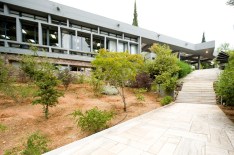
 My new crime thriller Oracle is set in Delphi, Greece, close to the ancient Temple of Apollo half way up Mount Parnassus. The crimes happen during an international conference taking place at the European Cultural Centre which lies just outside the town of Delphi. The ECCD is a real place, which I visited at the end of last century when I attended a conference there.
The Centre was founded in the 1970s, as a way of taking forward the modern Festivals held at Delphi in the 20s and 30s which were, in turn, a revival of the Festivals and Games held here in classical times. Now the Centre is home to the Delphi Academy of European Studies which hosts symposia on European subjects, puts on performances of Greek drama ( in the ancient Theatre as well as the new, purpose built one ) and has an excellent collection of modern art. You can read more about it here.

It has a stunning and scenic position, high up and looking down to Itea on the Gulf of Corinth. The Conference Centre and Guesthouse nestle among the cypress trees on the mountainside and there are private suites (one of which is occupied, in the novel, by a government Minister and his party).
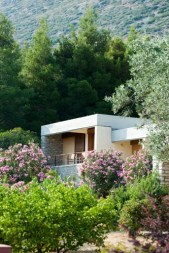
 Aside from the view and the nearby ancient Temple, I remember its fine, confident modern architecture, using local stone as well as concrete and lots of glass – making the most of those spectacular views. My heroine, Cassandra, occupies one of the rooms in the Guesthouse (left) above the restaurant on the ground floor.
It was November when I was there and the weather wasn’t kind – it was mostly raining, but the mountain peaks were snow covered. As I sat in that same restaurant with a storm raging outside and the lights flickering, briefly, a fellow conference goer suggested that it would be a tremendous place for a murder mystery. Over twenty years later, when Claret Press suggested that I write one, the ECCD and the beautiful ancient temple nearby immediately sprang to mind.
 So it was Delphi, not London, which was the setting which I thought of first, but it soon became apparent to me that my first book, introducing the recurring character of my detective and her associates, should be set where most of the books would be taking place and that was London. From there on it had to be Westminster and Thorney Island, places which I knew very well, having trodden the streets there for years. Thus was Plague born. At the end of Oracle it is where Cassie returns to for the third book in the series, Opera, although I confess that I do have a yen to take her off to Rome at some point in the future, another city which I know very well.
I should point out that the title of this article is misleading, however. The ECCD is not, in fact, the scene of the crime, although it is there that both murderer and victim(s) meet. And that, I’m afraid, is all you will get out of me about the plot.
Oracle (Claret Press) will be published on 5th May 2021. It will soon be available for pre-order on Amazon and via the Claret Press website.
 Back to Sunday, 21st January 1855 in a Trafalgar Square deep in snow, where about fifteen hundred people are gathering. They’re meeting to protest at the mismanagement and needless loss of life in the Crimean War, but can’t help larking about and they pelt passing traffic (and pedestrians) with snowballs. The police ask them to stop, but the protesters pelt the police too.
 but the failure to provide troops with the most basic necessities of life and the dreadful death rate resulting.
 Like many others the novelist Charles Dickens was angered by this. Dickens fans will recognise the name of this article as belonging to the government office in his Little Dorrit, where Arthur Clennam goes to discover the details of William Dorrit’s incarceration in the Marshalsea debtors’ prison. The Circumlocution Office was Dickens satirising the parlous state of what passed for the civil service in those days. Totally dominated by the Barnacle family (a not so subtle metaphor on parasites clinging to the ship of state) it is ‘0ne of the principles of the Circumlocution Office never, on any account whatever, to give a straightforward answer.’ You can read Chapter 10, in which the Circumlocution Office features
 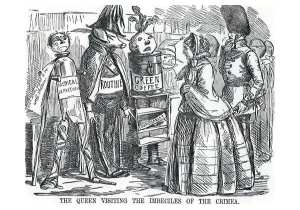 passed a vote demanding a full investigation. Lord Aberdeen, the Prime Minister, resigned on 30th January 1855.
  That’s what Britain still has. There are some service failures today – nothing is perfect – but these are often driven by politicians not civil servants, however much politicians seek to blame them (sometimes aided and abetted by the press). We touched on this in last night’s panel discussion on COVID, Corruption and Crony Capitalism, but we ran out of time before we could discuss why cronyism is so damaging to public service provision and so destructive of human lives. This article is by way of a reminder; January 1855 is where we were. Let’s not go back there.
 Phew! I finally get to look forward to Christmas after the whirlwind of activity – talks, discussions, events, giveaways – which has accompanied the publication of my first crime thriller back in September. All something of an eye-opener to this writer, whose adventure books set in 13th century Spain never generated this much activity and interest. Even in a world reduced by COVID I’ve been very, very busy, almost always online. It’s been tremendous fun, by and large, and I’ve worked with and met some great people, online, on social media and, not least, the readers of my book.
 from a U3A crime fiction reading book group who have chosen Plague as their book for March and want me to do a talk for them, which I’m happy to do. The Royal Borough of Kensington and Chelsea and Westminster people also seemed pleased, they have asked me to do another talk in January, this time about ‘Politics and Prose’ – political fiction in a time of increasing citizen journalism and social media commentary. That’s something I’ve blogged about in the past ( see
  genuine enthusiasm shine through. I’m definitely more comfortable when interacting, either with other speakers or with questioners. That is, in part, why the Secrets of Subterranean London discussion worked so well. If you haven’t watched it, you can find a link
  Fortunately, it worked out well.
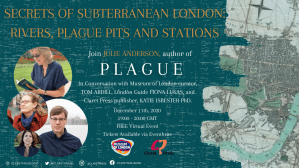 Like any place inhabited by humans for centuries, London is a multi-layered city, its history piled up beneath the feet of the people who walk its streets. This was the subject of last night’s tremendous discussion with Dr Tom Ardill of the Museum of London and award-winning Blue Badge Guide Fiona Lukas.
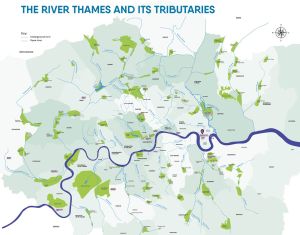 that, by the thirteenth century Londoners of the City were seeking for a fresh water supply further afield and they lighted upon the Tyburn. In order to bring its waters to the City they constructed the Great Conduit which ran south then east across London.
 Fiona’s description of the modern travails of London Transport with new London Underground stations was very interesting, especially the example of the new, very deep and very modern, Westminster station . I never knew that the two District line tube tunnels were on top of one another not along side, but, when I thought about it, this made sense of the way the inside of the station was designed. I certainly wasn’t aware of the difficulties encountered because of the proximity of the station to the Houses of Parliament, not least the secrecy about why designs for the new station were repeatedly vetoed.
 where Churchill’s wartime cabinet used to meet when the Cabinet Office War Rooms were unavailable, or Brompton Road. There is also Aldwych, formerly Strand, a station I used to walk past every day on my way to work in Bush House, close to, yes, a bona fide Roman Baths.
 Claret Press is organising an online event which may be of interest to readers of this website. On 11th December, from 7 – 8 in the evening, I will be speaking with Tom Ardill, Curator at the Museum of London and Fiona Lukas, award-winning Blue Badge guide and expert on the London Underground.
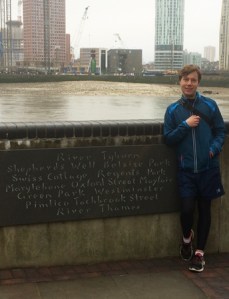 the time. Did you know, for example, that there is a Tyburn Angling Society, set up to try and ‘restore’ the river so as to fish in it ( an almost impossible task since it has been subsumed into Bazalgette’s wonderful London sewer system, but a charming, if quixotic, idea )? He is also a fellow river traveller, having followed the course of the Tyburn, as I did, but taking the southernmost arm, down to Pimlico and he ran it, rather than walked. You can read about his run
  The other contributor is Fiona Lukas, an award-winning Blue Badge Guide, ( she was Guide of the Year for the City of Westminster and City of London ) whose speciality is London Underground. She regularly hosts the popular tour The Lure of the Underground ( listen to her podcast about it
 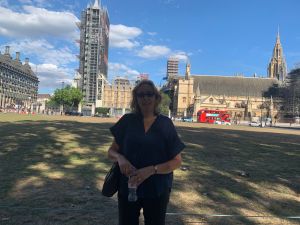 the novel, although I expect Tom to have far more knowledge than I about the Tyburn itself. I’ll be touching on Plague Pits, Roman Remains – like the baths at North Audley Street, completely unmarked on the surface, the Great Conduit which runs along Oxford Street and, of course, the Palace of Westminster, with all its idiosyncrasies.
 First up – bricks. The Victorians were great decorators in brick, something I’ve had several conversations about recently because we’ve just had a face lift for our Victorian house. I now know more about bricks than I ever thought was possible, largely courtesy of David Fairbrother, who oversaw the work, a man who truly loves bricks. On our walk we encountered some excellent examples of Victorian brickwork, like that announcing Grosvenor Works or the decoration on the buildings at the top of Great Smith Street, or, see left, the brickwork on the Marlborough Head public house, North Audley Street (readers of the novel will recognise that street name). The young woman working there was surprised and, I think, rather charmed, by our fruitless search
 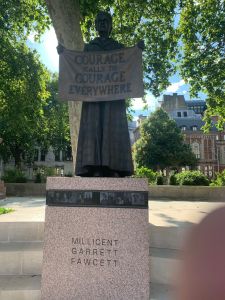 for any indicator that there were Roman baths nearby.
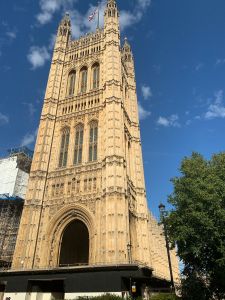
 broadly, around the subject matter of the book. So, a Stop Works sign propped in a doorway of the Norman Shaw buildings on the Embankment ( a former home of the Metropolitan Police and work place of one of the victims in the novel, where he is helping to refurbish the building ). Colourful chains at the construction site on Davies Street by Bond Street Underground Station, site of the first discovered crime, against said victim. The vaulted roof of the arches through which one passes from Horseguards Parade into Whitehall (which appears to be numbered, something I’ve not noticed before) and the receding arches within the arches, through which the protesters pass before harassing my heroine.
 houses in London. Not, perhaps the smallest that, I believe, is The Dove in Hammersmith, but pretty small nonetheless. We found the four-storey Coach and Horses on the edge of Mayfair, it is still a working pub ( though we didn’t enter, either this or the Marlborough Head, just in case you’re wondering, we were committed book walkers ). Besides, the No Entry sign outside could have put us off. Other unusual architecture spotted includes Sothebys’ warehouse, found down a back street and what looked like a closed up market hall in Davies Mews.
 There is the recent, real, discovery of hundreds of bodies, skeletons, in a lost medieval sacristy belonging to Westminster Abbey as reported in
  be what I can only call the procurement scandals. In the novel large government contracts, worth several billion pounds, are being tendered and, as one of the characters says ‘…the contracts aren’t being awarded in the usual way.’ It’s corruption – the contracts are being given to companies run by associates and accomplices of the villains, who also make money on the stock exchange as the shares of those companies rise in value. At least in the book the companies in question have the relevant expertise and a track record in providing the types of services being tendered for.
 three companies, one specialising in pest control, one a confectionery wholesaler and one an opaque private fund owned via a tax haven. The PPE – face masks – sold by the last of these companies, Ayanda Capital, under a contract worth £252m, was found to be unsuitable for use in the NHS (and untested). Yet at least this contract was publicly tendered. The contracts granted to Public First, a company with close ties to Michael Gove and Dominic Cummings, seem not to have been tendered at all and The Good Law Project and a number of non-Tory MPs are seeking judicial review of the awarding of them. They have also begun proceedings against Michael Gove in regard to one of these contracts. Contrary to government regulations, the contracts themselves have not been published (once granted, contracts are required to be published within thirty days).
 money involved.’ My main character Cassie is, of course, working on minor procurement contracts at the start of the novel, but she has no enthusiasm for the work. As a former senior civil servant I sympathise with those who are having to deal with the situation now, knowing that the correct procedures aren’t being followed. It seems that Ministers are hiding behind COVID and emergency powers to hand large sums of money to preferred bidders, regardless of said bidders ability to deliver the contracts.
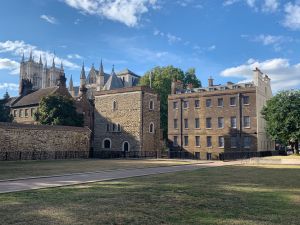 Is the thought of my heroine, Cassie, when told where another character in my novel lives. Yet, before our Bookwalk took us to look at the enviable address, we had some more medieval ground to cover, specifically the 14th century Jewel Tower. This remnant of the Abbey, which stood next to the Abbey moat, now stands on Abingdon or ‘College’ Green opposite Parliament. It is part of the Palace of Westminster, although set apart from Barry’s Victorian pile and Westminster Hall and it plays a crucial role in Plague.
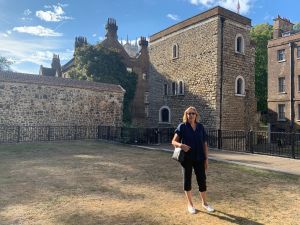 ground which surrounds it, a testament to its great age. It is open to the public, though not at the present moment. We entertained a rather bored-looking set of professional camera men set up in their familiar interviewing place on the Green, by doing our own ‘pieces to camera’ both in front of the Jewel Tower and the Victoria Tower, one of the few parts of the Palace of Westminster not covered in scaffolding or sheeting. Returning to Parliament Square, we went past the Abbey itself and entered Great Smith Street, then Little Smith Street, into that maze of small alleyways with buildings belonging to the Abbey and the Church.
 Great College Street was our destination, where Westminster School buildings run into the 14th century boundary wall, and under which the River Tyburn ran. It is on the corner with Barton Street where our desirable residence sits. Here we were fortunate to come across a woman who worked in the next house along, who was charmed by the thought of the neighbouring house appearing in a novel (and we think we made a sale). I hope the occupants of the actual house are equally charmed.
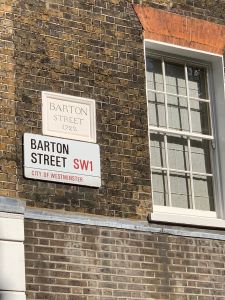 Smith Square, are, to my mind, some of the most desirable in London. The fine Georgian town houses sit in quiet, tree-lined streets, yet are close to one of London’s ‘centres’ and the epicentre of establishment power. Many of them are still in private ownership, either as houses or apartments, though there are many school buildings at the north end and the Georgian buildings give way to corporate headquarters and government departments to the south. Marsham Street is lined with government
  buildings – the Home Office, the Department for Transport, the old DTI building, many of them linked. All lie on the route of the number 88 bus – the ‘Clapham omnibus’ – and we hopped on to it for a few stops to Pimlico, because we were running out of time (and, by now, our feet were hurting). The Pimlico which we currently see, of elegant early Victorian terraces, is predominantly the creation of the property developer Thomas Cubitt in the 1830s. In the novel it is where a
 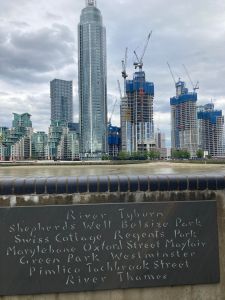 supporting character lives, on Tachbrook Street, so named for the Tach Brook which, at this point, ran into the old River Tyburn and thence to the Thames.
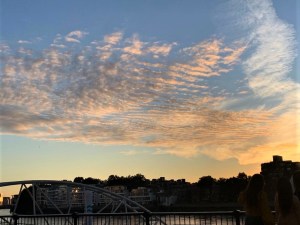 halves awaited. The day ended with a most perfect sunset over the Thames and Pimlico. A really great walk ( over seven miles of it ) and a really great day. My thanks to Helen Hughes for her photography and her company.
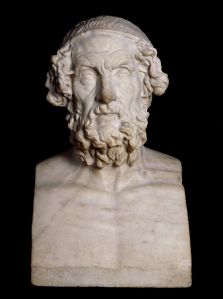 imagined as well as the archaeological city. I spent several happy hours in it yesterday (and will be returning next week).
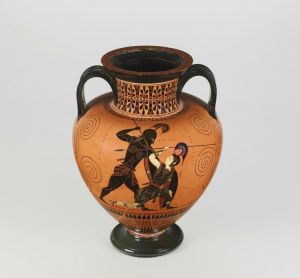 from the coloured figures, like those on the large two handled pot depicting Achilles killing Amazon Queen Penthisiliea (right) or the Judgement of Paris on a wine krater, to the delicate line drawings showing Briseis being led away from Achilles’ tent. I will also remember the stone bas relief showing this scene, with Achilles looking away in anger, but Patroclus placing a consolatory hand on Briseis’ shoulder as she is collected by Agamemnon’s soldier. A tender gesture.
 It is testament to the power of the ancient story that the characters live so vividly again. But then, the story has been told and retold, as evidenced by the lines from the epics scribbled by ancient Roman children on the papyri copy books displayed. Its retelling is brought bang up to date with the poster from the, much derided, 21st century Hollywood film Troy and modern versions of The Judgement of Paris – photographic – and The Siren’s Song ( see left for the ancient depiction, below for the modern collage by Romare Bearden ). Aficionados of the male body please note, Brad Pitt has quite a lot of competition in the buffed masculinity stakes, though it’s interesting that, even where a ‘hero’ such as Odysseus is obviously beyond youth and is depicted on artefacts with an older face, his body is still drawn as youthfully ideal. Hollywood’s fixation with perfect bodies is nothing new.
 There is a very interesting section on the real city of Troy, or what we now believe is the real city. Not Schliemann’s much too early, if appropriately burnt, discovery but a later version. I didn’t realise just how many Troys there were, built on top of one another, but there are informative graphics showing just how these cities developed and when. Indeed the whole exhibition is well organised, with clearly written and illuminating captions. Technology, from the annotated drawings in light of
  various pieces of complex decoration to help the viewer unscramble some of the detail, to the videos showing the massing levels of the different Troys is used cleverly and well.
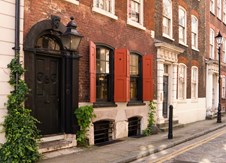 …is what one gets at the Dennis Severs House, or 18, Folgate Street, Spitalields, E1. Not quite a fleeting glimpse of those people who have just left the room, who were eating that meal just before you walked in, or smoking that pipe, or baking that loaf. Whose wig sits on the wing of the chair? Or whose floral perfume scents the formal withdrawing room?
 and storyteller, who died, aged only 51, in 1999. Twenty years after purchasing the house he saw the Spitalfields Trust buy the house and commit to keeping it going, when on his death-bed. It’s still going twenty years later.
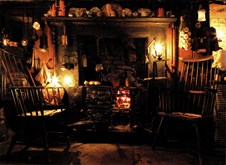 inhabit the house and it is their homely detritus (and comestibles) that one comes across as one climbs the narrow stairs, either down to the kitchen and cellar, where there are the supposed fragments of St Mary’s, Spital (1197) and the warmth of an iron range and the smell of…what is that smell? Or upwards, through fashionable London entertaining to the elaborate boudoir and then up beneath the eaves to the penurious lodgers’ rooms.
 There are wordless guiders, who will direct you if you go wrong.
 Julie Anderson