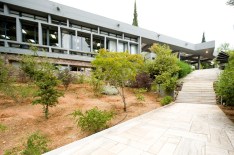
 My new crime thriller Oracle is set in Delphi, Greece, close to the ancient Temple of Apollo half way up Mount Parnassus. The crimes happen during an international conference taking place at the European Cultural Centre which lies just outside the town of Delphi. The ECCD is a real place, which I visited at the end of last century when I attended a conference there.
The Centre was founded in the 1970s, as a way of taking forward the modern Festivals held at Delphi in the 20s and 30s which were, in turn, a revival of the Festivals and Games held here in classical times. Now the Centre is home to the Delphi Academy of European Studies which hosts symposia on European subjects, puts on performances of Greek drama ( in the ancient Theatre as well as the new, purpose built one ) and has an excellent collection of modern art. You can read more about it here.

It has a stunning and scenic position, high up and looking down to Itea on the Gulf of Corinth. The Conference Centre and Guesthouse nestle among the cypress trees on the mountainside and there are private suites (one of which is occupied, in the novel, by a government Minister and his party).
 Aside from the view and the nearby ancient Temple, I remember its fine, confident modern architecture, using local stone as well as concrete and lots of glass – making the most of those spectacular views. My heroine, Cassandra, occupies one of the rooms in the Guesthouse (left) above the restaurant on the ground floor.
It was November when I was there and the weather wasn’t kind – it was mostly raining, but the mountain peaks were snow covered. As I sat in that same restaurant with a storm raging outside and the lights flickering, briefly, a fellow conference goer suggested that it would be a tremendous place for a murder mystery. Over twenty years later, when Claret Press suggested that I write one, the ECCD and the beautiful ancient temple nearby immediately sprang to mind.
 So it was Delphi, not London, which was the setting which I thought of first, but it soon became apparent to me that my first book, introducing the recurring character of my detective and her associates, should be set where most of the books would be taking place and that was London. From there on it had to be Westminster and Thorney Island, places which I knew very well, having trodden the streets there for years. Thus was Plague born. At the end of Oracle it is where Cassie returns to for the third book in the series, Opera, although I confess that I do have a yen to take her off to Rome at some point in the future, another city which I know very well.
I should point out that the title of this article is misleading, however. The ECCD is not, in fact, the scene of the crime, although it is there that both murderer and victim(s) meet. And that, I’m afraid, is all you will get out of me about the plot.
Oracle (Claret Press) will be published on 5th May 2021. It will soon be available for pre-order on Amazon and via the Claret Press website.
 Sad as I am to leave beautiful Delphi (though it’s under deep snow at the moment I am told) I have, at least temporarily, waved goodbye to Oracle, which is now in the hands of the publishers and their book and cover designers. The manuscript has been proofed, the front cover tag-line and back cover blurb have been agreed and the internal design created, again by Petya Tsankova, so it’s consistent with that of Plague, which Petya also designed.
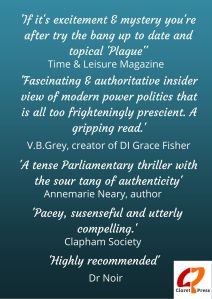
 see below ) is featured on the named ‘day’ pages as the sketch of the Palace of Westminster was in Plague. It looks good. This time, however, the book has a ‘Praise for’ section at the front, ( squirm – it’s what is done ). At the moment this contains endorsements and complimentary review remarks about Plague. As we approach publication day these will be augmented by what I hope will be complimentary reviews and endorsements of Oracle. I also get an ‘About the Author’ at the back, so Claret Press must be pleased with me.
 NetGalley during March, for a limited period only, to attract reviews and test reader reaction. Any revisions will follow and Advanced Review Copies will be produced and despatched to various ‘experts’ and to reviewers for newspapers, magazines and blogs. Quite a lot of the publications which reviewed Plague are anxious to follow up with a review of Oracle and, I’m pleased to say, there are plenty of readers out there who tell me that they re anxious to read it too. Publication day will be 5th May.
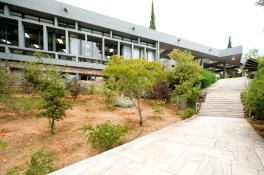 changes at the Centre since I visited it back at the turn of the millenium and to the changes in the town. This is so important given that the trip to Delphi I had planned for last year had to be abandoned because of COVID. I’ll be writing about the amazing Centre and its conferences and performances later. Sharon has introduced me to the new discipline of zemiology and Oracle is probably the first time it has featured in a novel (see earlier post
 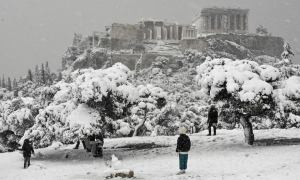 So, a break from the actual writing then, until I begin on Opera, but not a break from work, with lots of activity around getting Oracle absolutely ready for publication and for its promotion and still doing lots of events for Plague. I’ll be writing more about Oracle in the coming weeks, but here’s a photo of what Athens looked like earlier this week.
 All three, as far as I’m concerned.
 the public that seems more apposite. Plague‘s successor, Oracle, is much more of a ‘classic murder mystery’, though I hope it has the same page-turning quality. Yet it too has the political at its heart and, already, some of its themes are hitting the real-life headlines, like questions about the politicisation of the police, something which surfaced again after the assault on the U.S. Capitol. I suspect that this issue is something crime writers will be incorporating in their stories for the next few years.
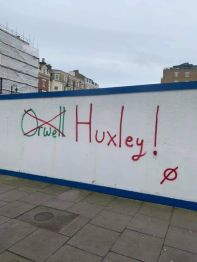 arguably no longer the dominant force in story telling and when social media allows us all to be citizen journalists and political commentators, what place does political fiction have? An important and relevant one, in my view. And I’m not alone – see this piece of graffiti, found in London, NW7 earlier this week ( thank you John Johnston for the photo ). Is the political image of our age the age of the boot on the face, or the pill and the palliative? Orwell or Huxley?
 On Wednesday the world watched as an enraged mob, whipped into action by their leaders, including the outgoing President of the United States, stormed the U.S. Capitol in order to derail the process of endorsing the recent and overwhelming Presidential election results. As the attempted overthrow of legitimate government took place, elected representatives were removed to or found places of safety and thugs ransacked offices, stole Capitol ‘souvenirs’ and took selfies. Pipe bombs, molotov cocktails and guns were found and a policeman, a female insurrectionist and three others died.
 preparedness among those whose job was to protect the Capitol ( the Capitol Serjeant at Arms has already resigned and the Chief of Capitol Police is going ). Many of the questions relate to events which lead up to the insurrection, which didn’t occur spontaneously ( a quick look at QAnon substantiates that ) and the attitudes and beliefs of the people involved. Mistaken and sometimes reprehensible beliefs which have been encouraged by lies in social and mainstream media and by Republicans. There were plenty of Damascene conversions and, as someone on Twitter pointed out, a ‘traffic jam on the Damascus road’ in both Houses, so keen were Republicans to condemn what happened.
 tyranny. This is basic level Civics, but something which seems to need restating. These are also ideas which I explore in Oracle.
 seeks to generate real world action in pursuit of justice.
 events like Grenfell become referred to as a ‘tragedy’ or a ‘tragic accident’, yet they were foreseeable and avoidable and these events and others like them will continue to occur until the law adapts to make punishment of those who enable such events both possible and direct. Zemiology presupposes that isn’t likely to happen, as the powerful have co-opted the law and the legal system to protect their power and interests. An idea not unfamiliar to readers of Plague.
 Christmas period.
 For now, may I wish everyone reading this a happy and peaceful Christmastide, where ever and with whomever, you are managing to keep it. Here’s hoping for a much better 2021.
 Oracle, the next book in the series following the adventures of Cassandra Fortune, is set in Delphi, Greece near the Temple of Apollo. When revising it recently I revisited some old favourites, the gods and goddesses of ancient Greece.
 dominant.
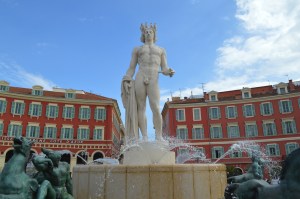 primordial mother, have been found in Delphi, in the Corycian Cave above the Temple to Apollo from the Neolithic period (about 12,000 years ago). Gaia and her daughter, Themis, ruled at Delphi and there was a chapel to her there, though it was long ago absorbed into the larger Temple complex. As Nico, the museum employee in the novel, explains, in legend, the god Apollo arrived at Delphi to wrestle with the Python, the giant snake belonging to Gaia, and won; so he became the ruler of Delphi. It is thought that this represents a change of dominant culture as migrants, whom we now know as the Hellenes, came into Greece from the north. They eventually settled all of Greece and their gods were the Olympians.
  Nonetheless the older gods continued to exist along side the new, as did their off-spring (unless they were thrown into the pit of Tartarus). These included some groups, or sets, of minor deities, like the Fates and the Furies. The latter trio, called the Erinye, were three women, often, especially in more modern times, portrayed with snakes for hair and flashing eyes, their hands dripping blood. The image, right, is of Clytemnestra attempting to wake the slumbering Furies to chase down Orestes in the Orestaia on a vase dating c.350 BCE. Delphi, it was believed, was the centre of the world and it is to the Temple of Apollo there that Orestes flees, calling upon the god to save him from the Furies.
 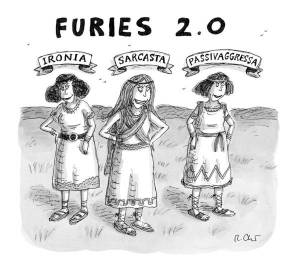 I don’t know if the books which I read are still read today, I hope so, even as new games and films bring the ancient heroes and deities to life for another generation. This Pantheon is firmly anchored within western sensibilities. So much so that we even replicate the old jokes in new ways ( see image left ).
  beings, regardless.
 Ginsberg and the scramble to replace her with someone partisan towards a specific political position also highlighted the link between justice and politics.
 criminal organization, systematically attacking migrants and leftists. The court also announced verdicts for sixty-eight defendants including the party’s political leadership. Nikolaos Michaloliakos and six other prominent members and former MPs, charged with running a criminal organization, were found guilty. Verdicts of murder, attempted murder, and violent attacks on immigrants and left-wing political opponents were also delivered. Golden Dawn held 17 seats in the Hellenic Parliament only five years ago. An independent investigation by the Council of Europe found disturbing links between Golden Dawn and the police.
 Julie Anderson