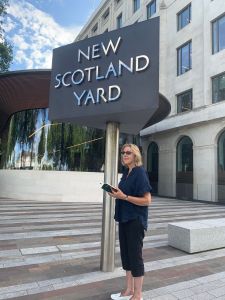
 First a Book Walk for Plague, now a Book Tour!
The Plague Book walk was a real walk, though largely done for publicity purposes and, it seems, it may have gained an after life of its own. The photo-montages have generated interest and the video is still in production. What’s more, London Walks, the guided walks company, is suggesting that I conduct real, guided walks of the book for members of the paying public. Footprints of London is doing one such of the locations in Blood & Sugar by Laura Shepherd-Robinson as part of a Literary Festival, and that book’s set in the past. So it must be possible to do one about Plague, which, after all, is set in contemporary London. I have already written a Plaguewalk leaflet which will, once it’s been tested, be posted on this web-site.
I might begin with a virtual walk – I went on one such at the weekend around parts of Kensington, at the invitation of David Tucker, its guide, who wears his comprehensive knowledge of London and his erudition lightly. It was great fun. Watch this space for developments.
The Plague Book Tour, or, more correctly, Blog Tour, will be underway before then, running from 28th September to 9th October. Organised by crime/horror  specialist damppebbles.com, it includes a book blogger a day for twelve days, reading, reviewing and, I hope, discussing Plague on social media. Anyone who follows #booktwitter or #bookstagram will recognise some, if not all, of the names of the book bloggers involved. I’m looking forward to seeing what Karen, David and Maria, Angi, Sharron, IG, Nicola, Emma, Maddy, Sharon, Vikkie, Chelle and Lesley think about Plague and its cast of characters. Starts Monday.
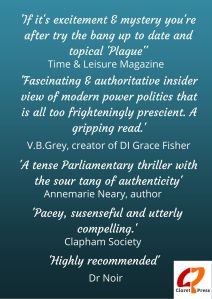 Yes, they are mostly female, but I have had some amazing reviews from male readers already (check out Amazon or Goodreads), as well as some wonderful endorsements from fellow crime and thriller writers, like V.B.Grey, and crime specialists like Jacky Collins, aka ‘Dr Noir’. People like the book!
Of course, a traditional ‘book tour’ of book shops and reading groups isn’t possible because of COVID, but, these days, folk are so social media focussed that a ‘blog tour’ would probably have happened in any event. This one certainly ranges across the country in terms of where the bloggers are actually located. From the Isle of Skye to Kent and from East Anglia to the West Country. That would have been a book tour and a half! I would have made some interesting train journeys.
E-space is where most of the advertising will be focussed too, though there isn’t very much of that. Claret Press isn’t an admirer of Amazon ads, nor those of Facebook, having used them, without any great success, in the past. So we’re going with tightly focused ads, using specialist agencies, via twitter. The usual journals, like the Crime Writers Association ‘Case Notes’ and Newsletter will, we hope, also attract the attention of crime fiction loving readers.
For more about Plague and especially the Book Walk why not try Walking a book, walking a river The book walk continues With an address like that…
 COVID ( ironic for a book entitled ‘Plague’ ). As my previous post,
  First, they decide that no book should be stored in these over-crowded warehouse for more than 48 hours, so only the quick sellers will find house room ( a tough, if logical, commercial decision ). Second, Amazon turn to their tried and trusted method of making decisions about products – an algorithm. The algorithm is predictive and it determines which books are likely to sell quickly i.e. for which there is greatest demand.
 publisher, Claret Press, is a small indie, which doesn’t have the budget for a massive sales pitch and stormtrooper publicists and this counts against Plague too. The clever algorithm is never going to choose to stock Plague over many of those other books. So ‘Temporarily Out of Stock’ appears, even though the book is available.
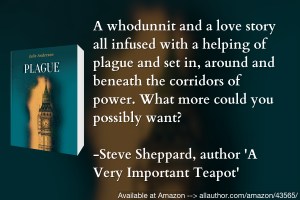 however hard I, and Claret Press, work, it’s unlikely to impress that algorithm.
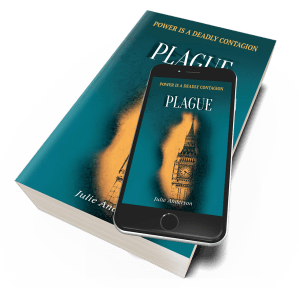
 Yes, it’s happening today, 15th September! And I’m getting some excellent feedback and reviews! So pleased, after all the hard work.
 taking place now I would have to do a major rewrite to incorporate COVID and some, at least, of the events of the novel almost certainly wouldn’t take place. Given that the editing phase of the book was concluded in April, when we had just entered lock down and no one knew what was going to happen, this wasn’t an option. Hence the removal of the year.
 This year they returned on 1st September but will not close as usual. Like all physical gatherings, even relatively small ones (the ‘rule of six’) the conferences have been cancelled and activity will take place online. Given the imminent shenanigans in the Palace of Westminster in regard to the UK Internal Markets Bill, they may not take place at all. The current Parliamentary schedule currently shows PMQs and Private Members Bills proceeding throughout October, but little else.
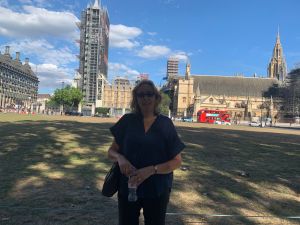 (and major works) which sets the time limit for solving the case. The first arrest is made for a crime committed on 10th September and the day – and night – of 15th has a particular significance (early readers of the book will know this). Hence the publication date of 15th September.
 First up – bricks. The Victorians were great decorators in brick, something I’ve had several conversations about recently because we’ve just had a face lift for our Victorian house. I now know more about bricks than I ever thought was possible, largely courtesy of David Fairbrother, who oversaw the work, a man who truly loves bricks. On our walk we encountered some excellent examples of Victorian brickwork, like that announcing Grosvenor Works or the decoration on the buildings at the top of Great Smith Street, or, see left, the brickwork on the Marlborough Head public house, North Audley Street (readers of the novel will recognise that street name). The young woman working there was surprised and, I think, rather charmed, by our fruitless search
  for any indicator that there were Roman baths nearby.
 broadly, around the subject matter of the book. So, a Stop Works sign propped in a doorway of the Norman Shaw buildings on the Embankment ( a former home of the Metropolitan Police and work place of one of the victims in the novel, where he is helping to refurbish the building ). Colourful chains at the construction site on Davies Street by Bond Street Underground Station, site of the first discovered crime, against said victim. The vaulted roof of the arches through which one passes from Horseguards Parade into Whitehall (which appears to be numbered, something I’ve not noticed before) and the receding arches within the arches, through which the protesters pass before harassing my heroine.
 houses in London. Not, perhaps the smallest that, I believe, is The Dove in Hammersmith, but pretty small nonetheless. We found the four-storey Coach and Horses on the edge of Mayfair, it is still a working pub ( though we didn’t enter, either this or the Marlborough Head, just in case you’re wondering, we were committed book walkers ). Besides, the No Entry sign outside could have put us off. Other unusual architecture spotted includes Sothebys’ warehouse, found down a back street and what looked like a closed up market hall in Davies Mews.
 There is the recent, real, discovery of hundreds of bodies, skeletons, in a lost medieval sacristy belonging to Westminster Abbey as reported in
  be what I can only call the procurement scandals. In the novel large government contracts, worth several billion pounds, are being tendered and, as one of the characters says ‘…the contracts aren’t being awarded in the usual way.’ It’s corruption – the contracts are being given to companies run by associates and accomplices of the villains, who also make money on the stock exchange as the shares of those companies rise in value. At least in the book the companies in question have the relevant expertise and a track record in providing the types of services being tendered for.
 three companies, one specialising in pest control, one a confectionery wholesaler and one an opaque private fund owned via a tax haven. The PPE – face masks – sold by the last of these companies, Ayanda Capital, under a contract worth £252m, was found to be unsuitable for use in the NHS (and untested). Yet at least this contract was publicly tendered. The contracts granted to Public First, a company with close ties to Michael Gove and Dominic Cummings, seem not to have been tendered at all and The Good Law Project and a number of non-Tory MPs are seeking judicial review of the awarding of them. They have also begun proceedings against Michael Gove in regard to one of these contracts. Contrary to government regulations, the contracts themselves have not been published (once granted, contracts are required to be published within thirty days).
 money involved.’ My main character Cassie is, of course, working on minor procurement contracts at the start of the novel, but she has no enthusiasm for the work. As a former senior civil servant I sympathise with those who are having to deal with the situation now, knowing that the correct procedures aren’t being followed. It seems that Ministers are hiding behind COVID and emergency powers to hand large sums of money to preferred bidders, regardless of said bidders ability to deliver the contracts.
 Now that publication day for ‘Plague’ approaches (just under three weeks to go ) it seems an appropriate time to recap on how the book got where it is. I began writing it in 2018 at the behest of Claret Press, a small independent publishers. This took just over a year and a half. When re-writing and revising I engaged with a number of book clubs around the country as well as with members of the writer’s group to which I belong in south London, to take their views. In addition, as part of my research, I have consulted a number of experts – a micro-biologist, a retired policeman and several people who work, or worked, in the Palace of Westminster.
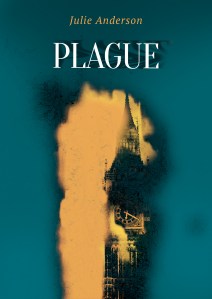
 A number of reviewers read the blurb, looked at the cover and downloaded the text clearly expecting something other than what’s in my book. Their expectations centred on it being a ‘government conspiracy’ novel, possibly in regard to some form of bio-weapon (hence ‘Plague’). I don’t know how that expectation was raised, but it clearly was for a number of people and that had to be addressed. I want to sell books, but I don’t want to disappoint readers, which will happen if they buy it thinking it is something other than it actually is.
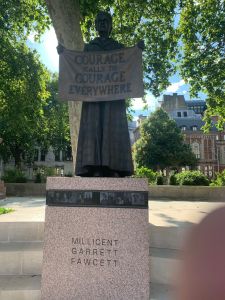
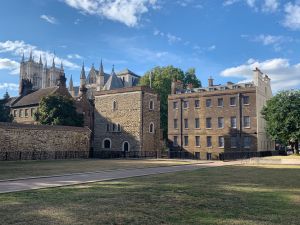 Is the thought of my heroine, Cassie, when told where another character in my novel lives. Yet, before our Bookwalk took us to look at the enviable address, we had some more medieval ground to cover, specifically the 14th century Jewel Tower. This remnant of the Abbey, which stood next to the Abbey moat, now stands on Abingdon or ‘College’ Green opposite Parliament. It is part of the Palace of Westminster, although set apart from Barry’s Victorian pile and Westminster Hall and it plays a crucial role in Plague.
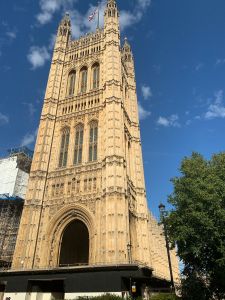
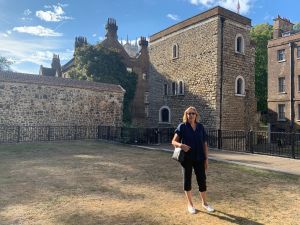 ground which surrounds it, a testament to its great age. It is open to the public, though not at the present moment. We entertained a rather bored-looking set of professional camera men set up in their familiar interviewing place on the Green, by doing our own ‘pieces to camera’ both in front of the Jewel Tower and the Victoria Tower, one of the few parts of the Palace of Westminster not covered in scaffolding or sheeting. Returning to Parliament Square, we went past the Abbey itself and entered Great Smith Street, then Little Smith Street, into that maze of small alleyways with buildings belonging to the Abbey and the Church.
 Great College Street was our destination, where Westminster School buildings run into the 14th century boundary wall, and under which the River Tyburn ran. It is on the corner with Barton Street where our desirable residence sits. Here we were fortunate to come across a woman who worked in the next house along, who was charmed by the thought of the neighbouring house appearing in a novel (and we think we made a sale). I hope the occupants of the actual house are equally charmed.
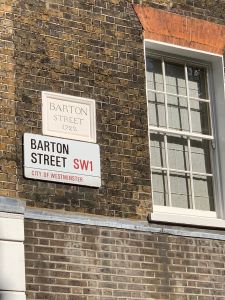 Smith Square, are, to my mind, some of the most desirable in London. The fine Georgian town houses sit in quiet, tree-lined streets, yet are close to one of London’s ‘centres’ and the epicentre of establishment power. Many of them are still in private ownership, either as houses or apartments, though there are many school buildings at the north end and the Georgian buildings give way to corporate headquarters and government departments to the south. Marsham Street is lined with government
  buildings – the Home Office, the Department for Transport, the old DTI building, many of them linked. All lie on the route of the number 88 bus – the ‘Clapham omnibus’ – and we hopped on to it for a few stops to Pimlico, because we were running out of time (and, by now, our feet were hurting). The Pimlico which we currently see, of elegant early Victorian terraces, is predominantly the creation of the property developer Thomas Cubitt in the 1830s. In the novel it is where a
 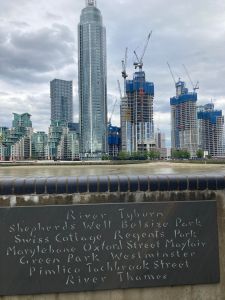 supporting character lives, on Tachbrook Street, so named for the Tach Brook which, at this point, ran into the old River Tyburn and thence to the Thames.
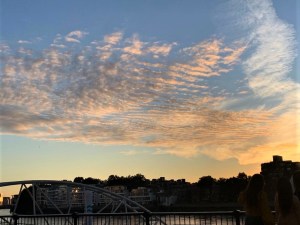 halves awaited. The day ended with a most perfect sunset over the Thames and Pimlico. A really great walk ( over seven miles of it ) and a really great day. My thanks to Helen Hughes for her photography and her company.
 Walking the locations of a book has some unique challenges, but with Plague (Claret Press, 2020) it was relatively easy, because the ‘lost’ River Tyburn provided a, somewhat sketchy, but traceable, route-map. As my previous post described, (
  a haven of calm (now with pelicans). Thence to Queen Anne’s Gate and Old Queen Street and that warren of Georgian streets just south of the park. It is there that Plague locates the private club to which several of its characters belong. This is really medieval London, with its narrow alleyways and twisting streets. The course of the old Tyburn follows present day Tothill Street, now lined with government departments (an important factor in the book), until it reaches Parliament Square at Broad Sanctuary, so called because Sanctuary Tower used to stand there.
 Now this space is occupied by the majestic Methodist Central Hall and the rather less impressive Queen Elizabeth II Conference Centre. Readers of the novel will know that it is there where Cassie first meets a number of interesting characters. Given that the temperature on Thursday was up in the thirties at this point we made a quick detour to buy water, before filming a brief piece to camera in Parliament Square.
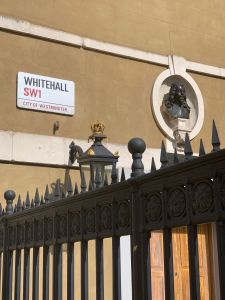 including the chariot of Boudicca next to Westminster Bridge, within which, sewer records tell us, lies an entrance to the sewers below Westminster Palace itself. Then a quick saunter up Whitehall, where some of the older government departments – the Treasury, the Foreign & Commonwealth Office – are housed. Cassie’s boss, the Permanent Secretary, has rooms in Admiralty House, as does his boss, the Deputy Prime Minister. This is not an ongoing position, the current government does not have it, though previous administrations have, when the post was occupied by Nick Clegg, MP and, earlier, John Prescott MP.
 Julie Anderson