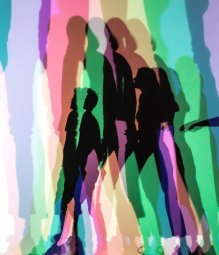
 …exhibition by Olafur Eliasson In Real Life at Tate Modern. It ends on 5th January, so if you live in or near to London and have a little spare time I strongly recommend that you go (but check ticket availability first, this is a VERY popular show and there are only a few days left so tickets might be hard to come by ).
People may remember Danish-Icelandic Eliasson’s brilliant, single The Weather Project bringing sunrise to the Turbine Hall of this same gallery some years ago and he has returned since then with his blocks of Greenland ice melting on the Thames-side forecourt in Ice-Watch to illustrate and draw attention to global warming, but this is 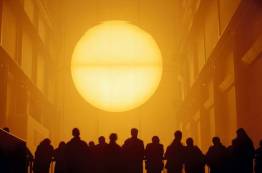 a major show. It can be found on Level 2 of the newer part of the Tate ( although there is also a waterfall/fountain to be seen outside in courtyard ).
The first room is a collection of Eliasson’s models for larger works, often created with mathematician collaborator Einar Thorsteinn. Many of them are beautiful in themselves with lots of natural shapes, based, one imagines, on fibonacci sequences. One model is of a finished work Your spiral view (2002) shown later in this exhibition. Room 2 contains early works and already we see the cleverness and simplicity of Eliasson. Window projection (1990) has the silhouette of a window shone, in light, on to a wall. At first sight the viewer imagines the light is coming through a window from outside, but no, there are no windows it’s just a lamp with a cutout on its lens. In Rainwindow (1999) the artists  uses a real window but recreates the effect of the weather. These are typical of Eliasson’s interest in light and weather.
Room 2 also contains trickery in mirrors and glass, an insect’s eye glass and a mirror which is actually a hole. This leads on to the Kaleidoscopes Room ( via a very interesting corridor which challenges the senses – I’ll say no more ). Here there are hanging reflective spheres and a walk-through corridor of reflections. Thence to a room with a projected, slowly transmuting image – all calm and tranquillity – followed by a room full of energy in which viewers find themselves part of an ever-changing art work on one of the white walls. It is so simple it seems effortless, but of course it isn’t. Like Big bang fountain which is found in a small curtained-off 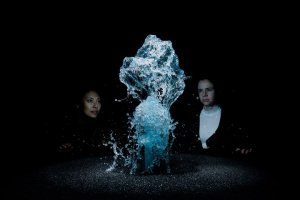 room with no light at all save for a periodic strobe which illuminates a fountain, freezing the water into silver metallic images before the viewers’ eyes.
This exhibition is child friendly and there were plenty there today, many eagerly experiencing the changing light and reflections, most especially in the room with the mirrored ceiling and an, apparently, circular sculpture. This exhibition is also great fun (but heels are not a good idea ).
There are serious points to be made with the twenty year sequence of photographs showing the withdrawl of the ice-cap in Iceland and very beautiful works capturing the impact of melting ice on paint wash and colour discs which use the palette from two of Caspar David Friedrich’s romantic nature paintings. In The Expanded Studio room we see the genesis and development of a number of projects, the design and creation of a solar powered light, the measuring of the disappearing ice and other environmentally engaged work, through film, artefact and notes.
It’s impossible to describe it all. Suffice to say that the visitor will come away with a new perspective on how one uses one’s senses, especially sight, as well as having learned a lot ( I certainly did ). I have been wanting to see this exhibition since it opened and I’m glad I caught it. I’m only sorry that I didn’t go before and could return again!
Olafur Eliasson In Real Life is at Tate Modern until 5th January. It costs £18 for non-members and is worth every penny.
For more on Art see Portrait of an artist Bonnard Colours Zubaran Impossible Light
 … that’s the time a potential reader gives to the cover of each book when scanning a bookshop display or online screen. So say the publishers. In that time the individual takes in the design, the title and whatever is written – tag-line or glowing review – on the front cover. If it doesn’t get their attention, their eye moves on to the next. So the pressure to make the cover arresting and appealing is intense.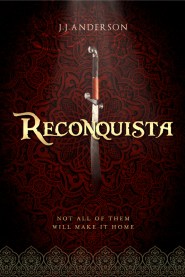
 Incidentally, both books in the Al Andalus series can be had half-price, for less than the price of a cup of coffee, at the Smashwords Christmas Sale which runs from Christmas Day until the New Year.
 2022! )
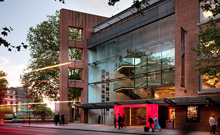 So to Sadlers Wells Theatre for the annual Flamenco Festival in north London. This time I had only returned from Jerez de la Frontera the day before and I went to see Santiago Lara and Mercedes Ruiz who hail from that city. I have written about this married couple before ( see
 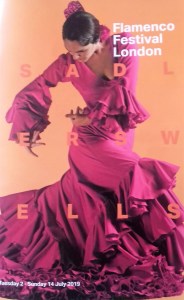 and Eduardo Guerrero, who I have tried to see several times at the Jerez Festival, only to be stymied by the schedule. Accompanied by rising singing star Maria Fernandez Benitez, known as Maria ‘Terremoto’, and male singers, Emilio Florido and Ismael ‘el Bola’. They were billed as the Gala Flamenca and it was excellent.
 The programme began with Morena dancing an alegria. As is always the case with British theatre audiences, while the dancing was well received, there was little feedback between performer and audience until the end of each piece. This contrasts with watching flamenco in Jerez, when the audience is supposed, even obliged, to clap, shout encouragement and cheer during the performance. I was very pleased therefore when a particularly spectacular series of steps ended with a sweeping flourish and a spontaneous cheer from the audience. I noticed Lara, who was nearest the edge of the stage, start to smile. The performance had ‘taken’ and the audience were bound in.
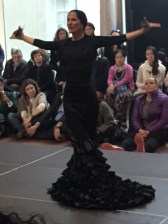
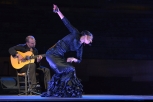 Mercedes Ruiz. Ruiz, dressed in black, male garb performed accompanied only by the singing and her own castanets and stamping feet. She was outstanding. The audience was well and truly captured by now, so much so that Ruiz could be playful, making us laugh as well as astounding us with her artistry. How could anyone top that?
 Well, then came Eduardo Guerrero, long black hair flying, in a stunning Cana. Guerrero’s arabesques were straight out of the Miguel Linan playbook, athletic, fluid and captivating. What was not was the truly amazing footwork which followed, which had the audience, by now half way to behaving like Jerezanos, applauding and cheering with every flourish. As a female member of our group said afterwards, he was gorgeous and absolutely commanding ( and the dancing was pretty good too ).
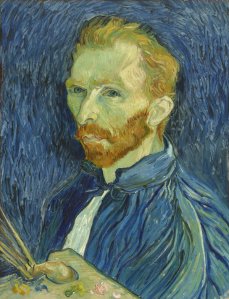 as a young man, not the James Joyce novel but Tate Britain’s summer exhibition, on Vincent Van Gogh and his time in in south London. Van Gogh arrived at the age of twenty in 1873 and lodged in Brixton ( though it’s described here as Stockwell ) where he fell in love with his landlady’s daughter. He worked for two years at the offices of Covent Garden art dealers Goupil, before turning to both teaching and preaching, when he was dismissed from his job.
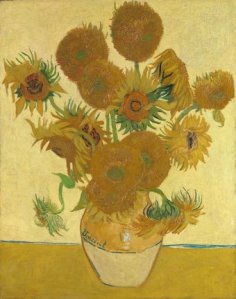 paintings, drawings and washes, but also many works of contemporary, or near contemporary, artists who were living in London at that time or which Van Gogh would have seen while he was here. It includes works and prints which Van Gogh owned and there is cross-over here with the Tate’s winter exhibition of 2017/18
  Francis Bacon, who acknowledged their debt to Van Gogh ( see study, by Bacon, left, of his painting of Van Gogh in the sun-bleached landscape of the south of France ).
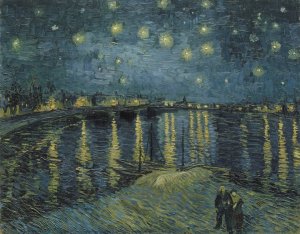 obvious, indeed they may seem tenuous to the untrained eye, though I have no doubt that the scholarship behind this exhibition is excellent.
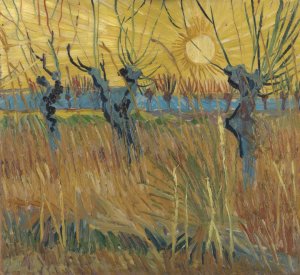 visited at 4 o’clock on a Friday, when we thought it would be quiet, yet it was anything but. Afterwards a steward told me that, in relative terms this was quiet! So beware the crowds. Entry costs £22, with concessions for students, seniors etc. and if you are not a member you will have to book. It’s well worth a visit.
 …is what one gets at the Dennis Severs House, or 18, Folgate Street, Spitalields, E1. Not quite a fleeting glimpse of those people who have just left the room, who were eating that meal just before you walked in, or smoking that pipe, or baking that loaf. Whose wig sits on the wing of the chair? Or whose floral perfume scents the formal withdrawing room?
 and storyteller, who died, aged only 51, in 1999. Twenty years after purchasing the house he saw the Spitalfields Trust buy the house and commit to keeping it going, when on his death-bed. It’s still going twenty years later.
 inhabit the house and it is their homely detritus (and comestibles) that one comes across as one climbs the narrow stairs, either down to the kitchen and cellar, where there are the supposed fragments of St Mary’s, Spital (1197) and the warmth of an iron range and the smell of…what is that smell? Or upwards, through fashionable London entertaining to the elaborate boudoir and then up beneath the eaves to the penurious lodgers’ rooms.
 There are wordless guiders, who will direct you if you go wrong.
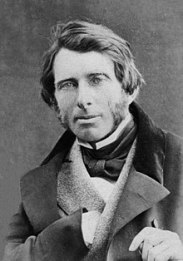 This year’s Spring exhibition at 2, Temple Place is a collaboration with Museums Sheffield and the Guild of St George to bring together a range of paintings, drawings, metal works and plaster casts to celebrate the work and legacy of John Ruskin (1819 – 1900).
 J.M.W.Turner and redefined art criticism of the day. It brought him to the notice of luminaries such as Elizabeth Gaskell and Charlotte Bronte. This was followed by Modern Painters II (1846) written while on the Grand Tour with his parents. He married Effie Gray, the young daughter of a family friend in 1847. Together they journeyed to Venice where Ruskin worked on perhaps his most famous three-volume work The Stones of Venice (1851-1853). It was in The Nature of Gothic chapter in Vol II that he set out his belief in artisanal integrity and attacked industrial capitalism which had such an impact on socialists like William Morris and the Arts and Crafts movement.
 The marriage was, apparently, unconsummated ( though Ruskin contested this ) and was subsequently annulled in 1854, though not before major scandal when Effie left Ruskin for John Everett Millais. Ruskin had championed the Pre-Raphealites and continued to do so, even providing a stipend for Elizabeth Siddal, Rosetti’s wife, to encourage her art. He also became a firm friend of William Morris and Edward Burne-Jones. These friendships are documented in the exhibition, as is his late crossing of swords with James McNeill Whistler. While the case bankrupted Whistler, it also tarnished Ruskin’s reputation and may have contributed to his mental decline. I have never understood how a devotee of Turner’s art could have denigrated Whistler’s and that isn’t something which is tackled here.
 Turner paintings and Durer engravings ( loved the cat ) as well as many of his own drawings and paintings. In addition there are newly commissioned pieces exploring the legacy of Ruskin, from Timorous Beasties, Grizedale Arts, Hannah Dowling and Emilie Taylor. I very much enjoyed
  country house and showcase for architect and collector Sir John Soane, with its attached art gallery. In the sunshine Ealing looked leafy indeed, with its Common and Green ( who knew, not me, certainly ). Still there, set back from the Uxbridge Road, the original Ealing Studios where so many classic films were made. We even found a handsome Georgian/early Victorian hostelry named The Sir Micheal Balcon, after the legendary producer and head of the studios in its heyday.
 frontage and garden now behind a formal war memorial. Entrance gates are to the right hand side of the formal gardens. Inside it is less chaotic – less mad – than his house and museum on Lincoln’s Inn Fields, but it still demonstrates his distinct architectural style and idiosyncratic and impressive design. The interior has been meticulously restored to a very high standard, including the hand-painted and beautiful ‘chinese’ wallpaper in the gloriously light drawing room, the exquisite ceilings and ‘marbled’ walls.
 employer George Dance and which Soane retained, demolishing the rest of the mansion and rebuilding it, including a colonnade of ‘ruins’, which now links the main house and the modern gallery.
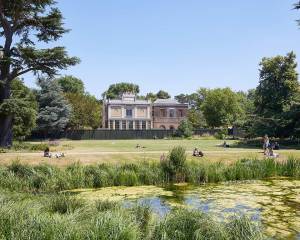 I loved the long glass gallery which runs across the rear of the house and overlooks what would have been the private gardens, including a lake with rusticated bridge. These have now been merged with Walpole Park (1901) a public park which includes another lake, formal gardens and a sporting pavilion. I also loved the two huge rooms in George Dance’s wing, the dining room on the ground floor and salon or drawing room on the first. I’m not surprised that Soane couldn’t bring himself to demolish this even if it means that the whole Manor has a rather lop-sided look.
 the old kitchen buildings into Pitzhanger Gallery. The current exhibition is by Anish Kapoor and it complements Soane perfectly. Kapoor’s mirrored and sculpted discs and boxes play with light, vision and sound just as Soane’s interiors do, tricking the eye. The pieces are interactive and huge fun. A gallery employee told us that he saw something new in each of the pieces every day he turned up for work and took great pleasure in watching visitors play with the distortions. We certainly enjoyed doing so, taking photographs into the sculpted mirrors which captured one of us upside down in the middle ground while the other was the right way up nearer to the piece.
 At Tate Modern’s big Spring exhibition yesterday I (and a lot of other people) enjoyed some vibrant Pierre Bonnard paintings. I confess that I hadn’t seen many before, indeed, I knew little about this contemporary of Matisse.
 of France and his companion and wife, Marthe de Meligny, by Henri Cartier-Bresson and Andre Ostier.
 He is fond of unusual perspectives, choosing to paint views, interior and exterior, through doors and windows, or through tunnels of greenery. He painted landscapes, many around his house in Normandy and subsequently in the south of France where he bought a house. The red tiled roofs of Le Cannet and small towns around it feature prominently in the rooms covering his later life.
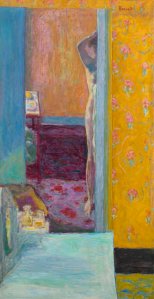 reflected light, in the water, in the bathroom tiles and on the walls, They are also so full of pattern – the carpet, the bath robe – that I began to think of post Impressionists like Gauguin and Van Gogh. One can also see the influence of the Japanese prints which Bonnard had admired so much in his formative years.
 the dark-brown paint of doors and wood panelling, the distinctive blue-green of the shutters,the red-brown and sometimes black of the terracotta floor tiles. I recognise these from visits to stay in the south of France.
 despite the crowds. If, however, you asked me where Bonnard stood in my personal pantheon of twentieth century European artists he wouldn’t be at the top of my list. That’s not to say that he wasn’t taking forward the ideas of the Impressionists and Post-Impressionists ( though he preferred to paint from memory in the studio, not in the open air ), it’s just that more interesting developments were, by that time, taking place elsewhere.
 …is the name of an excellent, fascinating exhibition in Jerez de la Frontera (until 10th March) and Cadiz, from 21st March until 28th April 2019. I saw it at the Claustros de Santo Domingo, the 13th century monastery which is now an exhibition and performance space in Jerez. It is, in Jerez, FREE to enter and I recommend, if you are in the vicinity, that you go and see it.
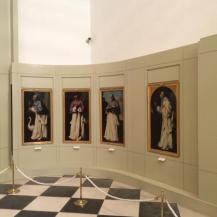 attempt to recreate the stunning light and shade of the originals, the chiaroscuro which earned Zurbaran the nickname ‘the Spanish Caravaggio’. The paintings are astonishingly clear and precise, with knife sharp edges to the drapery and the photographs capture this amazingly well. They also recreate the human portraits, often to great effect ( the modern faces taking on a timeless quality ). As the accompanying leaflet says, however, Zurbaran had only the ‘trickeries’ of paint and light to help him with his creations.
 For us another fabulous Festival de Jerez is over. We have all gone our separate ways, though performances at the 2019 Festival continue until next weekend. Yet again we have been astounded and amazed by the quality, as well as the variety, on offer.
 Sanlucar, re-interpreted by Santiago Lara as music director ( see
 remarkable Coy acting as muse, creative idea and, possibly creation. I do not pretend to have understood it all, but I enjoyed it a lot and look forward to see what this talented dancer does next.
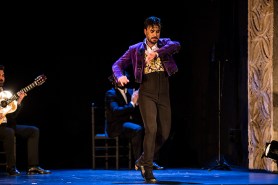 performance and out on the town. A terrific end to our sojourn at the 2019 Festival.
 Julie Anderson