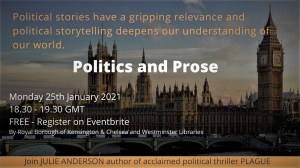
 Maybe it’s because I’m preparing a talk on Politics and Prose for the Royal Borough of Kensington & Chelsea and Westminster Libraries ( it’s free and happening on 25th January if anyone is interested, see Eventbrite Politics and Prose ) or it may be coincidence; but over the holiday I’ve been watching a number of excellent films depicting the world of power and politics, some based on real events.
First was The Death of Stalin, Armando Ianucci’s 2017 very black political satire of the Stalinist Soviet Union. It is a fiction, but its characters are based on real people who were part of the Stalinist ruling elite. These are played by a stellar cast which includes Steve Buscemi, Simon Russell Beale, Jason Isaacs, Michael Palin and  others. The crude and barbaric terror of the Stalinist period is shown, full throttle, where the answer to any problem was murder and truth was what the most powerful said it was. It’s a mesmerising and very funny film, in an absurdist way, but it’s also not comfortable watching. If you haven’t seen it, I can definitely recommend it.
The second film was The Ides of March, (2011) a George Clooney contemporary political drama starring Ryan Gosling, Phillip Seymour Hoffman, Paul Giamatti, himself and others. This was less of a hit than The Death of Stalin and my other choice, but it’s an efficient and, in its way, thought provoking film which captures  the tight-knit nature of U.S. politics – the intern is the daughter of the Committee member, the rival campaign managers are well-known to each other (each trying to exploit the other’s known foibles ). It’s a quieter film which depicts an inhuman and corrupt world – hardly news – but does so through the prism of one man’s ambition and where it leads. Again, recommended.
My third film was The Trial of the Chicago Seven, Aaron Sorkin’s 2020 depiction of the trial which followed the anti-Vietnam War riots at the 1968 Democratic Convention in Chicago. Directed by Sorkin after Stephen Spielberg, whose project this was, had to withdraw, the film was on restricted release in September, but, given the COVID pandemic, went onto Netflix only weeks later. If I hadn’t known that this was based on real events ( and court transcripts ) I wouldn’t have believed it possible. The real Chicago Seven plus Bobby Searle, the eighth defendant (and only black man) and their lawyers are portrayed by another stellar ensemble cast, including Mark Rylance, Eddie Redmayne, Sacha Baron Cohen, Joseph Gordon Levitt, Frank Langella, Michael Keaton and others. Like The Death of Stalin, this has attracted criticism from academics about it’s veracity, but, again like The Death of Stalin, it has been critically very well received.  Anyone who remembers the wit of The West Wing won’t be surprised by that on show here, it made this viewer laugh out loud a few times, though with a bitter twist. This truly was a ‘political trial’. It’s also a clever depiction of a moment in time rather in the way that the TV series Mrs America captured the spirit of the 1970s political backlash to the 60s. I strongly recommend you watch this film.
The real events in Trial, like the shooting by police of Fred Hampton, Black Panther supporter of Searle, in circumstances not dissimilar to the shooting of Breonna Taylor by police in 2020 Kentucky make it very relevant to today. As does the ‘truth is what I say it is’ attitude of the Soviet powerful in Death, not unlike that of Trump and other populists. Political stories have a gripping relevance and political storytelling deepens our understanding of our world.
The first two films were based on written stories; The Death of Stalin on La Mort de Staline, a two volume graphic novel by French writer Fabien Nury and artist Thierry Robin, The Ides of March on Farragut North, a play by Beau Willimon ( Farragut North being the Washington DC metro station at the heart of think tank and consultancy territory ). The Trial of the Chicago Seven was written as a screenplay by Sorkin. Incidentally the U.S. TV version of House of Cards had an executive producer by the name of Beau Willimon. Now there’s a book about politics and power which has been translated to the screens, small and large, to very good effect.
 I’ll be exploring how politics is depicted in stories, as well as discussing what a ‘political novel’ is in my talk on 25th January.
Meanwhile, may I wish that 2021 be a year in which we return to life as we used to know it, but that we appreciate it more; that the vaccine is given to everyone and the dread COVID is either eradicated, or mutates into something much less dangerous. Happy New Year!
 seeks to generate real world action in pursuit of justice.
 events like Grenfell become referred to as a ‘tragedy’ or a ‘tragic accident’, yet they were foreseeable and avoidable and these events and others like them will continue to occur until the law adapts to make punishment of those who enable such events both possible and direct. Zemiology presupposes that isn’t likely to happen, as the powerful have co-opted the law and the legal system to protect their power and interests. An idea not unfamiliar to readers of Plague.
 Christmas period.
 For now, may I wish everyone reading this a happy and peaceful Christmastide, where ever and with whomever, you are managing to keep it. Here’s hoping for a much better 2021.
 Phew! I finally get to look forward to Christmas after the whirlwind of activity – talks, discussions, events, giveaways – which has accompanied the publication of my first crime thriller back in September. All something of an eye-opener to this writer, whose adventure books set in 13th century Spain never generated this much activity and interest. Even in a world reduced by COVID I’ve been very, very busy, almost always online. It’s been tremendous fun, by and large, and I’ve worked with and met some great people, online, on social media and, not least, the readers of my book.
 from a U3A crime fiction reading book group who have chosen Plague as their book for March and want me to do a talk for them, which I’m happy to do. The Royal Borough of Kensington and Chelsea and Westminster people also seemed pleased, they have asked me to do another talk in January, this time about ‘Politics and Prose’ – political fiction in a time of increasing citizen journalism and social media commentary. That’s something I’ve blogged about in the past ( see
  genuine enthusiasm shine through. I’m definitely more comfortable when interacting, either with other speakers or with questioners. That is, in part, why the Secrets of Subterranean London discussion worked so well. If you haven’t watched it, you can find a link
  Fortunately, it worked out well.
 Like any place inhabited by humans for centuries, London is a multi-layered city, its history piled up beneath the feet of the people who walk its streets. This was the subject of last night’s tremendous discussion with Dr Tom Ardill of the Museum of London and award-winning Blue Badge Guide Fiona Lukas.
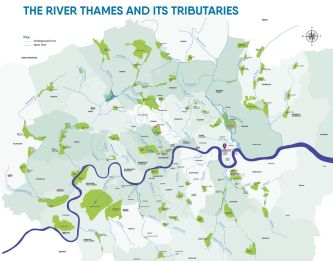 that, by the thirteenth century Londoners of the City were seeking for a fresh water supply further afield and they lighted upon the Tyburn. In order to bring its waters to the City they constructed the Great Conduit which ran south then east across London.
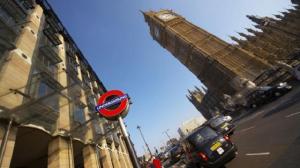 Fiona’s description of the modern travails of London Transport with new London Underground stations was very interesting, especially the example of the new, very deep and very modern, Westminster station . I never knew that the two District line tube tunnels were on top of one another not along side, but, when I thought about it, this made sense of the way the inside of the station was designed. I certainly wasn’t aware of the difficulties encountered because of the proximity of the station to the Houses of Parliament, not least the secrecy about why designs for the new station were repeatedly vetoed.
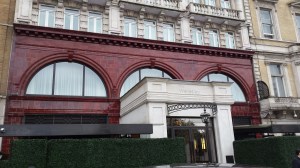 where Churchill’s wartime cabinet used to meet when the Cabinet Office War Rooms were unavailable, or Brompton Road. There is also Aldwych, formerly Strand, a station I used to walk past every day on my way to work in Bush House, close to, yes, a bona fide Roman Baths.
 Actually, there were twelve of them, all members of the UK Crime Book Club, from Perth to Hampshire, Denbighshire to London and many points in between. Twelve signed copies of Plague have been parcelled up and despatched.
 Craven, former CWA Dagger winner, who is currently sitting atop the Best Seller lists with his latest crime thriller ‘The Curator’. A darling of the UK Crime Book Club, ‘The Curator’ has just been voted the Club’s Book of 2020. Good fortune again that it was an easy question for me to answer ( so not about writing best sellers then ) and something of an honour for this crime writing debutante. The whole hour whizzed by, with people sending in questions via Facebook – and telling me that they’d bought the book, which was very good news.
 There was one small problem, one individual, a gentleman from Wales, didn’t respond to my messages of congratulation, indeed, didn’t respond at all. I left it a couple of days and then contacted the Facebook site administrator and said that I would try once more but might need their help. Fortunately, my message yielded a result, though not the expected one. A few minutes after I put up my plea I received a reply from a woman – ‘Dad! You won!’.
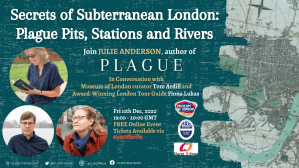 Claret Press is organising an online event which may be of interest to readers of this website. On 11th December, from 7 – 8 in the evening, I will be speaking with Tom Ardill, Curator at the Museum of London and Fiona Lukas, award-winning Blue Badge guide and expert on the London Underground.
 the time. Did you know, for example, that there is a Tyburn Angling Society, set up to try and ‘restore’ the river so as to fish in it ( an almost impossible task since it has been subsumed into Bazalgette’s wonderful London sewer system, but a charming, if quixotic, idea )? He is also a fellow river traveller, having followed the course of the Tyburn, as I did, but taking the southernmost arm, down to Pimlico and he ran it, rather than walked. You can read about his run
  The other contributor is Fiona Lukas, an award-winning Blue Badge Guide, ( she was Guide of the Year for the City of Westminster and City of London ) whose speciality is London Underground. She regularly hosts the popular tour The Lure of the Underground ( listen to her podcast about it
  the novel, although I expect Tom to have far more knowledge than I about the Tyburn itself. I’ll be touching on Plague Pits, Roman Remains – like the baths at North Audley Street, completely unmarked on the surface, the Great Conduit which runs along Oxford Street and, of course, the Palace of Westminster, with all its idiosyncrasies.
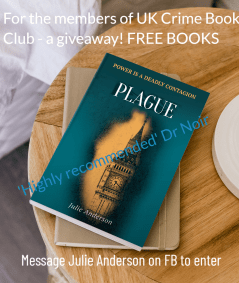 looking forward to participating in the UKCFBC Pub Quiz ( Just Not In A Pub ).
 which keeps my publisher happy ).
 There are so many ways in which place is important to writers – we explored the subject in the first Clapham Book Festival back in 2016 ( see
  Elephant & Castle tower block. The Victorian streets of Clapham are home to my protagonist, while homeless character, Spikey Fullman haunts Shepherd’s Market, but bemoans the recent changes there as not conducive to a good night’s sleep. The venerable Palace of Westminster is a focal point, as are the streets close by – the Georgian terraces as well as the concrete civil service buildings. There are vistas from and of towers and high rises as well as the scenes beneath the earth and the main players walk all the major Westminster thoroughfares between Whitehall, the Embankment and St James, Bond Street and Pimlico.
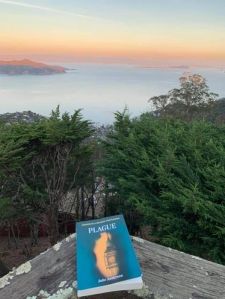
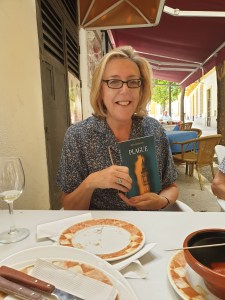
 One point to make about Plague is how far it has travelled, only six weeks into its published life. I have received snapshots of it on the Isle of Skye, in deepest Dorset, in the flatlands of East Anglia and in various parts of the north of England. I have yet to see it in Wales, Scotland or Northern Ireland (though I know it has been read there, because I have seen reviews on Goodreads and Amazon from readers who live there). Plague has also travelled internationally, from the lawn of a Normandy chateau (left) to a Californian balcony over-looking San Francisco Bay (above), from an American Naval Base to a tapas bar in Jerez (admittedly, that one, below, was with me).
 entered the novel for the Ondaatje Prize. This award from the Royal Society of Literature is for a work of fiction, non-fiction or poetry, evoking the spirit of a place. The 2019 winner,
  I, meanwhile, am busy writing the sequel (earlier this week while awaiting a late flight at Sevilla airport, see left, which prompted the thoughts for this article ). Oracle takes place in a very different location to London, at an isolated cultural centre half-way up Mount Parnassus in Greece, close to the ancient site of the Temple of Apollo at Delphi. It is a place both very dramatic and beautiful and is timeless. Its location is central to the novel, not just to the plot, but that’s because place is very important to me as a writer.
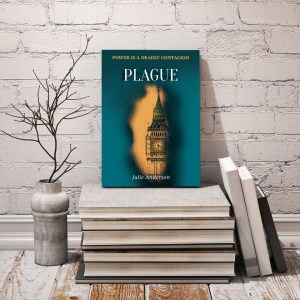 So, we’ve had the Plague Book walk and the Plague Blog Tour ( which finished on Friday ) and both have been fun to do and, I hope, brought the book to the attention of the book-buying public, or at least that section of it which exists on-line. This is the first time a book of mine has been part of a Blog Tour and it’s been an interesting and enjoyable experience. Emma from Damp Pebbles, a crime and horror specialist blog tour organiser, has been helpful and professional throughout, marshalling the book bloggers to produce and reveal their reviews day after day.
 reading what people made of it and there were some new insights too, which even this author hadn’t thought about. For example, thank you Karen Cole for pointing out just how often Cassie self-sabotages. There is also some anticipation around Oracle, the next in the series ( many of the bloggers said they would like to review that one as well ).
 In the absence of a physical launch and book shop signings, I’ve spoken about the book and the writing of it on radio and Youtube ( you can hear/see those interviews and events, if you’ve a mind to, on the Events page of this web-site ). There is more of this planned, with recordings and uploading to Youtube ( to both the Claret Press channel and my own ). For example, at some point before Christmas there will be a discussion with various experts on London and its history.
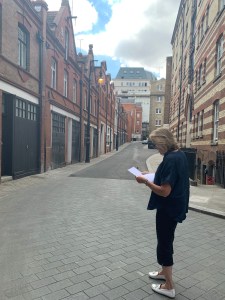 sure how many members of the public would pay to come on either ( David, a London Walks specialist, thinks there may be people who would ). I have other events, interviews and talks, lined up and another twitter ‘giveaway’ too at the end of October.
 USA too.
 One area which features in Plague but which was not covered by our recent bookwalk is SW4, or Clapham, where I happen to live. It is here that the heroine, Cassandra Fortune, has her flat, where she lives with her cat, Spiggott. Like so much of Clapham this would have been built by Victorian and Edwardian pattern builders, so named because they used a template, or several, when constructing street after street during the nineteenth century and into the twentieth. I have placed the flat in a fictitious road within the little maze of roads off Clapham Common South Side, where the buildings are often elegant purpose built maisonettes.
 Another of the aforementioned good things is Clapham Common, which sits in the middle of the Clapham area. It is a photograph of the Common and the ferris wheel of a travelling circus encamped there which alerts Cassie to a newspaper photographer having been snooping around. The photograph left was taken on 1st October 2020.
 South and Clapham North (and we have the Junction too, we’re well connected – this is beginning to sound like an advert for Clapham). At each of them are circular, pillbox style structures which mark the presence of the deep shelters, constructed during the second World War to house civilians during air raids. There were originally ten of these planned across London, though only eight were ever sunk, three of them in Clapham close to the Northern line. Cassie notes the one next to Clapham Common tube station as Daljit, Sergeant Patel, drives her to the Golden Square crime scene. The image above is of the deep shelter at Clapham South, which was used, in the 1950s, to house those migrants arriving from Empire on the HMS Windrush and other similar, later, ships.
 Julie Anderson